
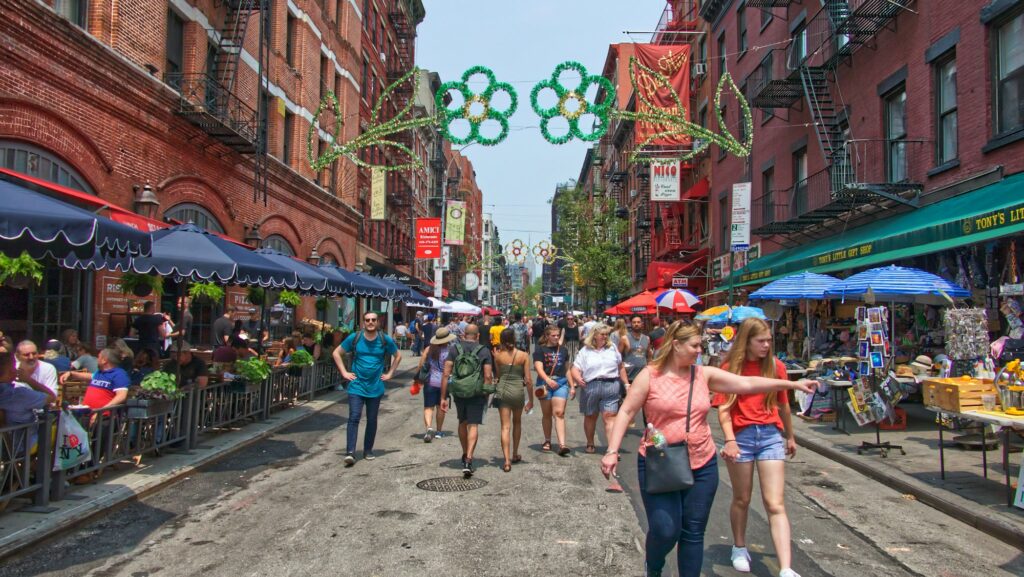
Walk down Mulberry Street today. You will smell garlic before you see the signs. Restaurant menus hang in Italian and English. Red, white, and green flags catch the breeze. Old men argue on stoops as they have for a hundred years.
This is Little Italy. Or what remains of it.
Between 1880 and 1924, four million Italians landed in New York. Most came through Ellis Island. They arrived carrying little. They carried names from Naples, Palermo, Calabria, and Sicily. They spoke no English. They had almost nothing.
They built a neighbourhood. The story of how they did it is one of the most powerful in New York City’s history.
If you love New York’s hidden stories, you’ll love our free weekly newsletter. Subscribe to Love New York →
Where They Came From — and Why
The Italian immigrants who built Little Italy were not tourists. They were people in crisis. Italy’s southern provinces had been devastated for decades. Crop failures hit Sicily hard in the 1880s. The olive and citrus industries collapsed. Taxes rose. Small farmers lost their land.
In Calabria, entire villages faced starvation. Families had two choices: stay and suffer, or leave.
Most chose to leave.
Agents called padroni moved through the villages. They promised work in America. They sold passage on steamships. The voyage cost about $25 — a fortune for a farmer earning pennies a day.
In 1880, fewer than 45,000 Italians lived in New York. By 1910, the number had risen to nearly 340,000. By 1920, New York was home to more Italians than any city outside Italy. The city had become, for a generation, the capital of the Italian diaspora.
Arriving in Lower Manhattan
The ships docked at Ellis Island. Inspectors checked each passenger for disease. Names were registered — sometimes misspelled, sometimes changed by immigration officers who could not understand the pronunciation.
From Ellis Island, the Italian immigrants walked north into lower Manhattan. They settled where rents were cheapest. That meant the most crowded blocks of the city.
Mulberry Street became the main artery. Mott Street ran parallel. Between them, a neighbourhood grew.
The first waves of Italians arrived by region. Sicilians clustered on Elizabeth Street. Neapolitans settled on Mulberry Street. Calabrians gathered near Mott Street. Each group brought its own dialect, its own patron saints, its own food.
It was a world within a world. A few blocks north, Jewish immigrants from Eastern Europe were building the Lower East Side in exactly the same way — street by street, community by community.
Life in the Tenements
The tenements of Little Italy were not comfortable. A typical apartment had six rooms. But a family of eight would take in boarders — often a dozen or more. They slept in shifts.
Rent was about $8 a month. Most men earned $1 a day. Women took in piecework: sewing, feather-sorting, rolling cigars. Children shined shoes or sold newspapers on the street.
The streets were their living rooms. Pushcart vendors lined every block. They sold salted fish, dried beans, olive oil poured from large tins. The smell of fresh bread rose from basement bakeries. In summer, the heat was unbearable. In winter, families huddled around coal stoves.
Disease spread quickly in the tenements. Tuberculosis killed hundreds every year. Infant mortality was high. But the community held together through campanilismo — loyalty to whoever came from the same village back home. That bond was everything.
Faith and Festivals — The Heart of the Neighbourhood
Religion was not just a personal belief. It was the backbone of Little Italy.
Old St Patrick’s Cathedral on Mott Street — built in 1815 — became a centre of Italian Catholic life. The Church of the Most Precious Blood on Baxter Street drew Sicilian parishioners. Each church ran its own saint’s festival and mutual aid society.
But the festivals mattered most. The Feast of San Gennaro began in 1926. It started as a single block of Mulberry Street. Neapolitan immigrants brought the tradition from Naples. They paraded the statue of their patron saint through the streets. They cooked, sang, and lit the neighbourhood with candles.
The Feast of San Gennaro still runs every September. It has grown to eleven days and 60 city blocks. Over one million people attend. It is the longest-running religious street fair in the United States.
Want more stories like this? Our weekly newsletter goes deeper into New York’s heritage every week. It’s free. Subscribe here →
How the Neighbourhood Changed
By the 1940s, Little Italy began to shrink.
The children of immigrants moved to the suburbs. They had grown up in the tenements but earned enough to leave. Italian Americans spread to Staten Island, the Bronx, and New Jersey. Those who stayed in New York often moved to Belmont in the Bronx — the neighbourhood that became the city’s second great Italian enclave.
Meanwhile, Chinatown expanded north. SoHo grew south. The neighbourhood shrank from dozens of blocks to a handful. The population that had once been 50,000 dwindled to a few thousand Italian-American residents.
Today, Little Italy’s official boundaries cover only a few blocks of Mulberry Street — from Canal Street to Broome Street. The blocks that were once exclusively Italian now share space with Chinatown shops and SoHo boutiques to the west. The neighbourhood grew smaller. But it did not disappear.
What Survives — and Where to Find It
Little Italy today is small. But it is still alive. These are the places where the history is most tangible.
Mulberry Street is the heart. Walk from Canal Street north to Broome Street. This is the surviving core of the original neighbourhood.
The Feast of San Gennaro runs each September on Mulberry Street. It is the neighbourhood’s biggest annual event and the best time to visit if you want to experience Little Italy at full volume.
Old St Patrick’s Cathedral (263 Mulberry Street) dates to 1815. It was New York’s first cathedral. It served the Irish community first, then the Italians. Its walled cemetery holds some of the city’s oldest graves and is open to visitors.
Di Palo’s Fine Foods (200 Grand Street) has been run by the same family since 1925. They import cheese, cured meats, and olive oil. Walking in feels like stepping into a different decade. The Di Palo family still serves behind the counter.
Ferrara Bakery (195 Grand Street) opened in 1892. It is one of the oldest continuously operating Italian bakeries in the United States. Their cannoli and torrone are made from recipes that have not changed in decades.
The Italian American Museum (155 Mulberry Street) is a small but important institution. It documents the immigrant experience in Little Italy from the 1880s to the present. Entrance is free.
For a broader day in lower Manhattan, New York’s best museums guide includes several institutions with strong immigration history collections worth combining with a visit to Little Italy.
Tracing Italian-American Roots in New York City
If your family came from Italy, Little Italy is only the start of your heritage journey.
The Italian genealogical records held in New York are among the most detailed in the city. Here is where to look.
Ellis Island Passenger Records — search for free at libertyellisfoundation.org. Most Italian immigrants who arrived between 1892 and 1954 passed through Ellis Island. The original ship manifests survive. They list the immigrant’s village of origin in Italy, the nearest relative back home, and the contact person in America. The village name is the key to tracing the family line further back in Italian church records.
New York City Vital Records — held by the NYC Department of Records and Information Services. Births, marriages, and deaths from the 1880s onward are accessible. Many records from Italian immigrant communities are digitised.
The Calandra Italian American Institute at CUNY has archives and research support specifically for Italian-American genealogy in New York. It is one of the most useful resources for tracing Southern Italian families.
The Center for Migration Studies on Staten Island holds parish records, personal documents, and oral history collections from Italian immigrant communities across New York.
The story of Italian immigration to New York connects to one of the city’s most dramatic immigration chapters — just as Irish immigrants built Five Points a generation earlier, Italian arrivals took the same desperate route from Ellis Island to the tenements of lower Manhattan.
Frequently Asked Questions
Where exactly is Little Italy in Manhattan?
Little Italy is in lower Manhattan, centred on Mulberry Street between Canal Street and Broome Street. It sits between Chinatown to the south and SoHo to the west, and is easily walkable from the subway stations at Canal Street (A, C, E, N, Q, R, W, 6 lines).
When is the best time to visit Little Italy?
September is the best month to visit. The Feast of San Gennaro runs for eleven days each year, usually in mid-September, and draws over one million visitors to Mulberry Street. Outside of September, the neighbourhood is quieter but the restaurants and historic shops remain open year-round.
What Italian-American landmarks have survived in Little Italy?
The most historically significant sites are Old St Patrick’s Cathedral (est. 1815), Di Palo’s Fine Foods (est. 1925), Ferrara Bakery (est. 1892), and the Italian American Museum on Mulberry Street. Mulberry Street itself retains several restaurants that have been under Italian-American family ownership for decades.
How can I trace Italian-American ancestry connected to New York City?
Start with the free Ellis Island passenger database at libertyellisfoundation.org, which covers arrivals from 1892 to 1954 and includes ship manifests showing each passenger’s village of origin in Italy. The NYC Department of Records holds vital records from the 1880s onward, and the Calandra Italian American Institute at CUNY offers specialist genealogical research support for Italian-American families.
Ready to explore the New York your ancestors knew? Subscribe to Love New York — free weekly stories, heritage guides, and hidden history. Join us →

Subscribe Free