
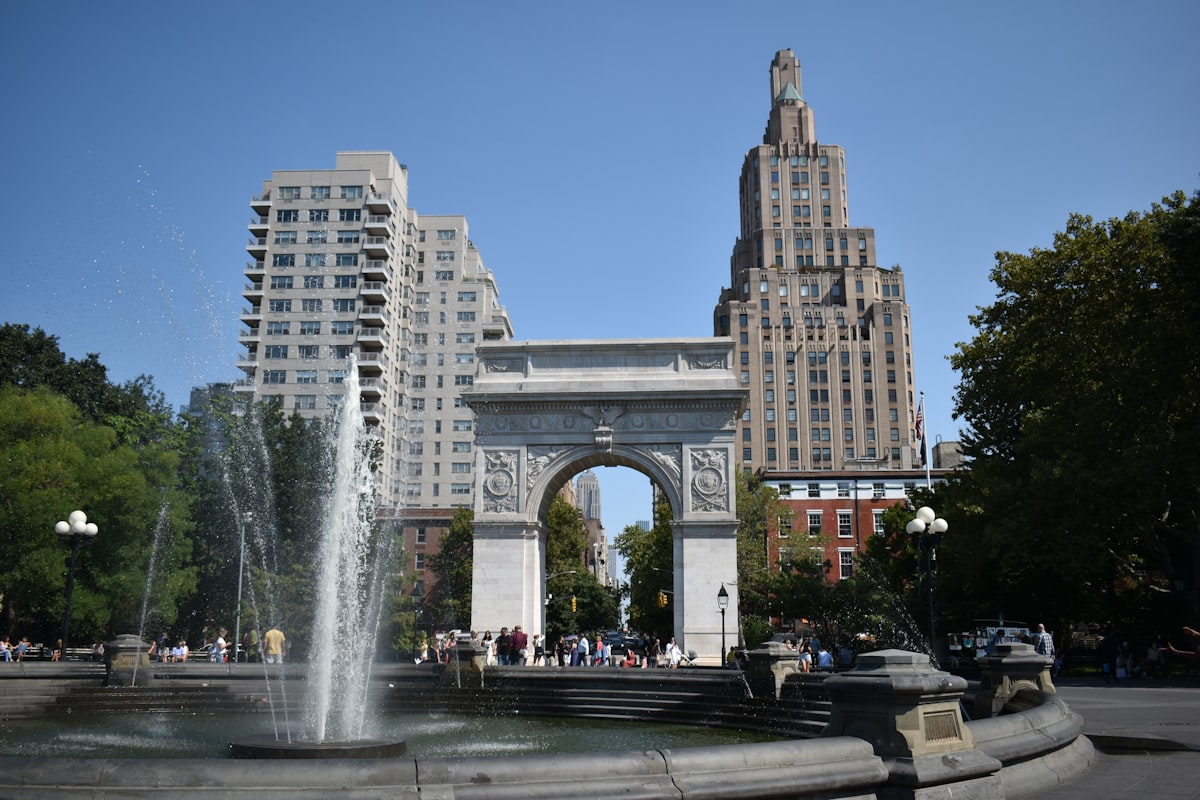
Walk through the arch on Fifth Avenue on any warm afternoon and you will hear it before you see it — a saxophone bouncing off the stone, a crowd breaking into applause, the thump of a beatbox carrying across the grass. Washington Square Park in Greenwich Village has been one of New York City’s great open-air stages for more than half a century, and the street performers who call it home are a big reason why.
This is not a polished theatre production. There are no tickets, no dress code, and no guarantee of what you will find on any given day. That is exactly the point. The park runs on talent, nerve, and the willingness of strangers to stop and watch.
Want more guides to New York City’s neighbourhoods and hidden gems? Subscribe to our free newsletter — delivered to your inbox every week.
The Fountain: Ground Zero for Performance
The central fountain is where most of the action happens. Crowds gather in a natural ring around the circular pool, giving performers a built-in stage and audience. On busy weekends from spring through to autumn, the fountain area can draw dozens of spectators at a time, and the competition between acts keeps the quality high.
Acrobatic troupes are common here. These groups typically build up slowly — cracking jokes, pulling in audience volunteers, ratcheting up the difficulty of each stunt — before finishing with something that makes the crowd step back. It is a tried and tested format, and the best performers execute it with real skill. Tipping is expected; a dollar or two is a reasonable contribution for a twenty-minute show.
Jazz and soul musicians also stake out fountain spots regularly. You might find a three-piece brass band, a vocalist working over backing tracks, or a lone guitarist running through jazz standards. The acoustics near the fountain carry well, and a good musician can hold a crowd for an hour without much effort.
What Types of Performers Appear in the Park
The range of talent is wider than most visitors expect. Here is a breakdown of what you are likely to encounter on a busy afternoon:
- Break-dancers and hip-hop crews — often young men from Brooklyn and the Bronx who treat the park as both rehearsal space and performance venue. The footwork is impressive and the energy is high.
- Classical and jazz musicians — violinists, pianists using portable keyboards, saxophone players. Some are conservatory students. Others are professionals supplementing their income between gigs.
- Magicians and close-up performers — working smaller crowds, sometimes gathering just six or eight people around them. The intimate format suits card tricks and sleight-of-hand well.
- Beatboxers and spoken word artists — less common but memorable when they show up. A skilled beatboxer at the fountain can pull a crowd of a hundred people within minutes.
- Comedians and improvisers — some use the park as an informal testing ground, riffing on passers-by and tourists. Not every set lands, but the good ones are genuinely funny.
- Chess hustlers — technically a different kind of performance, but the chess tables on the park’s southwest side have their own regulars who play for money and are almost always worth watching. Do not sit down unless you know what you are doing.
The History Behind the Performances
Washington Square Park has been drawing performers and artists since at least the 1950s. The folk revival of the late 1950s and early 1960s brought musicians to the park’s benches and pathways, and the area around Greenwich Village became a hub for anyone who wanted to play original music outside the confines of a club or concert hall. Bob Dylan arrived in New York in 1961 and spent time in Greenwich Village during this period, joining the circle of folk musicians who treated the neighbourhood as a musical laboratory.
The park has gone through significant changes since then — it was renovated extensively in the 2000s and the fountain was relocated to align with the arch — but its function as an informal performance space has never changed. The audience has always been there: NYU students, tourists, local residents, and anyone cutting through the Village on a warm afternoon.
In New York City, street performers are required to have permits to use amplification equipment in parks, but unamplified performance is generally permitted. The rules are enforced loosely, and the park’s culture of informal performance is well established enough that most performers operate without friction.
Exploring New York and want tips delivered straight to you? Join our newsletter community for weekly New York City guides, neighbourhood picks, and things to do.
When to Visit for the Best Performances
The short answer is: warm weather, afternoon and early evening. Here is a more specific breakdown:
- Saturday and Sunday afternoons (2pm–6pm) — the busiest and most competitive times. Multiple acts run simultaneously. This is the most reliable window for finding something worth stopping for.
- Weekday afternoons in summer — good enough, particularly from around 3pm when the lunch crowd has cleared and performers start setting up. Lower foot traffic means smaller crowds but often longer sets.
- Spring and autumn — some performers consider these the best seasons. The weather is comfortable, the park is not overpacked, and tourists are still around but the summer crush has eased.
- Winter — occasional performers still show up, particularly on mild days. The fountain area is quiet and the atmosphere is different — more focused, less chaotic. It is worth a look if you are passing through, but do not count on a full afternoon of entertainment.
Avoid arriving too early in the day. Most performers do not set up before noon, and the peak energy builds gradually through the afternoon. Arriving at 2pm rather than 11am will make a significant difference to what you find.
How to Watch and What to Bring
There are no seats at Washington Square Park. Most people stand, sit on the fountain ledge, or find a spot on the grass. If you are planning to stay for a full acrobatic or comedy set — which can run thirty to forty-five minutes — wearing comfortable shoes and being prepared to stand is sensible.
Bring cash. Most performers take digital tips via QR code or Venmo, but small bills are still the most reliable way to contribute. If you have watched a full show and enjoyed it, tipping is not optional — it is what makes the whole ecosystem function.
The park has food carts along the eastern edge selling drinks and snacks. There are also several coffee shops and cafés within two minutes’ walk on Macdougal Street and the surrounding blocks. It is worth picking up a drink before you settle in to watch — particularly if it is a hot day and the acrobats are forty minutes into their build-up.
Getting There and Getting Around
Washington Square Park is in Greenwich Village, at the southern end of Fifth Avenue. The nearest subway stations are:
- West 4th Street–Washington Square (A, C, E, B, D, F, M lines) — the most convenient stop, a short walk from the park’s northwest entrance.
- 8th Street–NYU (N, R, W lines) — slightly further, but an easy walk south down Broadway.
The park itself is compact — roughly 9.75 acres — so it is easy to walk the full perimeter in under ten minutes. The fountain is at the centre. The chess tables are to the southwest. The dog runs are to the northwest and southeast corners. The main lawn area is on the eastern side. Most performers concentrate around the fountain and on the paths leading to it.
If you are combining a visit with other Greenwich Village sights, the Stonewall Inn is a ten-minute walk to the northwest on Christopher Street. The High Line starts further north in Chelsea, roughly a 20-minute walk. The Village is compact enough that half a day covers most of it comfortably on foot.
Why It Still Works
A lot of cities have parks. Not many have parks where you can reliably spend an hour watching talented strangers do something extraordinary, without paying for a seat or booking in advance. Washington Square Park works because it has decades of reputation behind it — performers know that a good act will draw a crowd here, and visitors know that showing up on a Saturday afternoon is likely to produce something worth remembering.
The performers change. The regulars come and go. But the format — talent, arch, fountain, crowd — stays the same. If you are visiting New York City and you have not been, put it on your list. It is not a tourist attraction in the conventional sense. It is better than that.
Never miss a New York City guide. Subscribe to our free weekly newsletter for neighbourhood guides, restaurant picks, and the best things to do in the city.
