
There is a moment, somewhere between the Atlantic coast and the tarmac, when New York City appears below you. It does not ease you in gently. The skyline arrives all at once — steel and glass stacked against the sky, the Hudson catching light on one side, Queens spreading flat beneath you on the other.
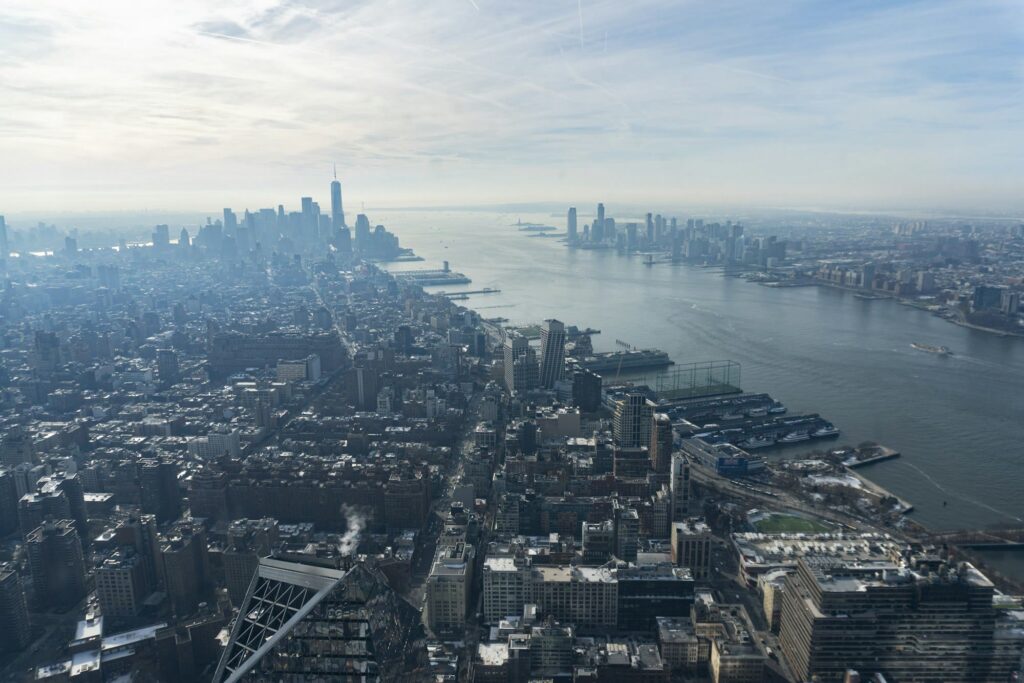
It does not matter how many times you have seen it in films or on a screen. The first real view from the air is different. It is both larger and more comprehensible than you expect. You can actually see the shape of Manhattan — the island sitting between two rivers, the bridges connecting it to the boroughs, the cluster of towers at its southern tip.
This article covers what you can actually see when flying into LaGuardia (LGA) or John F. Kennedy International Airport (JFK), which seats give you the best view, and what to do once you land.
LaGuardia vs JFK: Two Different Approaches
LaGuardia sits directly on Flushing Bay in Queens, about 8 miles from Midtown Manhattan. It is the closer of the two airports to central New York, and the approach — especially from the west — brings you almost directly over the city. You are low by the time the skyline appears. The towers are at eye level, not far below you.
JFK is 15 miles from Midtown, in the south of Queens near Jamaica Bay. The approach is longer and wider. Flights often come in from the south or east, which means you arc out over the Atlantic and the bay before turning towards the runway. The views are broader and the altitude is higher.
Both airports give you a skyline view. But the experience is quite different depending on which one you use.
The Best Seats for Views at LaGuardia
At LaGuardia, the runway orientation depends on wind direction, but the two most common approaches are from the west (landing on runway 04) or from the south (landing on runway 13).
On a westbound approach — coming from the west and heading northeast — the flight path goes directly over Midtown. Sit on the left side of the plane (A-side window seats in a standard 3-3 configuration) for the best view of Manhattan.
On the south approach (runway 13), Manhattan is to the north. Right-side window seats (C-side in a 3-3 layout) give you the better look.
The honest answer is that you will not always know which approach you are on until you are in it. Window seats save your memories. Aisle seats save your knees. That trade-off is yours to make.
The Best Seats for Views at JFK
JFK has four runways orientated broadly east to west. Most arrivals from Europe come in from the south-east over Jamaica Bay.
On this approach, the left side of the plane faces north — towards Queens and Brooklyn as you come in over the bay. You will not get a full Manhattan view from this angle, but you do see the city spread out in a way that makes you appreciate its scale. The sheer number of rooftops below you is striking.
If your flight arrives from the north, which is common on domestic routes and some trans-Atlantic services, you may get a direct pass past Manhattan. Right-side window seats face south-west in that case — which is where the skyline sits.
A practical tip: check FlightAware or FlightRadar24 before you board. Search your flight number and look at the expected route and runway. It takes two minutes and helps you pick the right seat.
What You Will Actually See From the Air
The most recognisable part of the New York skyline from above is Lower Manhattan — the cluster of towers packed into the southern tip of the island. One World Trade Centre is now the tallest structure in the Western Hemisphere at 541 metres. The Empire State Building sits further north in Midtown. The Chrysler Building, with its distinctive art deco steel crown, stands just east of it.
On a clear day from an LGA approach, you can usually pick out:
- The Empire State Building in Midtown Manhattan
- One World Trade Centre in Lower Manhattan
- The Chrysler Building with its steel sunburst crown
- The Manhattan Bridge and Brooklyn Bridge crossing the East River
- Central Park — a sharp-edged green rectangle in the middle of the island
From a JFK approach, a clear day typically shows:
- The full spread of Queens below you as you descend
- Rockaway Beach and the Jamaica Bay Wildlife Refuge
- Brooklyn, with its lower and more varied skyline
- The Verrazzano-Narrows Bridge connecting Brooklyn to Staten Island
Visibility changes everything. A hazy summer afternoon flattens the view and makes the city look washed out. A clear autumn or winter morning can feel like looking at a hand-drawn map. If you have a choice of travel dates, early morning arrivals in autumn tend to offer the clearest conditions.
Getting Into the City From Each Airport
The view ends the moment you land. Then the practical part begins.
From LaGuardia (LGA):
There is no direct rail link from LaGuardia into Manhattan. Your main options are:
- Bus + Subway: The Q70-SBS bus connects to Jackson Heights–Roosevelt Avenue, where you can pick up the E, F, M, or 7 subway lines into Manhattan. Cost: around $2.90 each way. Journey time: roughly 50 minutes to Midtown.
- Taxi: A trip to Midtown costs around $40–55 and takes 20 to 50 minutes depending on traffic.
- Rideshare (Uber/Lyft): Expect to pay $35–60 depending on time of day. Pick-up zones at LGA are clearly signposted from the terminal exits.
From JFK:
JFK has the AirTrain, which connects to the subway system at two stations: Jamaica Station (A, E, J, Z trains) and Howard Beach (A train). AirTrain costs $8.50 each way, paid via OMNY or MetroCard. Total journey to Midtown runs around 55 to 75 minutes.
A yellow cab from JFK to any destination in Manhattan is a flat rate of $70, before tolls and tip. With tolls and tip, expect to pay roughly $85–95. The flat rate applies only to Manhattan — other boroughs are metered.
The Long Island Rail Road (LIRR) also serves JFK via Jamaica Station and is faster than the subway. Fares run around $15–20 depending on the time of day.
What to Do in the First Hours After Landing
You have seen the skyline from the air. You have cleared arrivals. Now what?
New York has the largest urban transit system in North America. It runs 24 hours a day, every day of the year. A single fare on the subway or city bus costs $2.90, paid by tapping a bank card or phone via the OMNY system, or using a MetroCard. One fare gets you anywhere on the network, including transfers between lines.
The most common mistake first-time visitors make is trying to walk distances that look short on a map. Midtown blocks are long. Twenty blocks north to south is about one mile; crosstown is slower still. The subway is almost always quicker than walking or taking a cab in the middle of the day.
If you want to reconnect with the view you had from the plane, the observation decks in Midtown are straightforward to visit. The Top of the Rock at Rockefeller Centre (30 Rockefeller Plaza) offers a clear sightline to the Empire State Building. The Edge at Hudson Yards is the highest outdoor sky deck in the Western Hemisphere. One Vanderbilt, attached to Grand Central Terminal, is a newer option with a glass floor section.
Tickets for all three can be booked in advance online — worth doing in summer and at weekends when queues are long. Prices range from around $38 to $45 for adults.
The view from the air is the introduction. The city takes its time showing you the rest.
Photo: Patrick Tomasso / Unsplash
