
Most people pass through Grand Central Terminal without looking up. There’s a train to catch, a crowd to push through, a city waiting outside. But the building above you holds one of the most carefully constructed illusions in American architecture, a private railroad track that once carried a president through Manhattan without anyone knowing, and a hidden bar behind an unmarked door that most New Yorkers have never found.
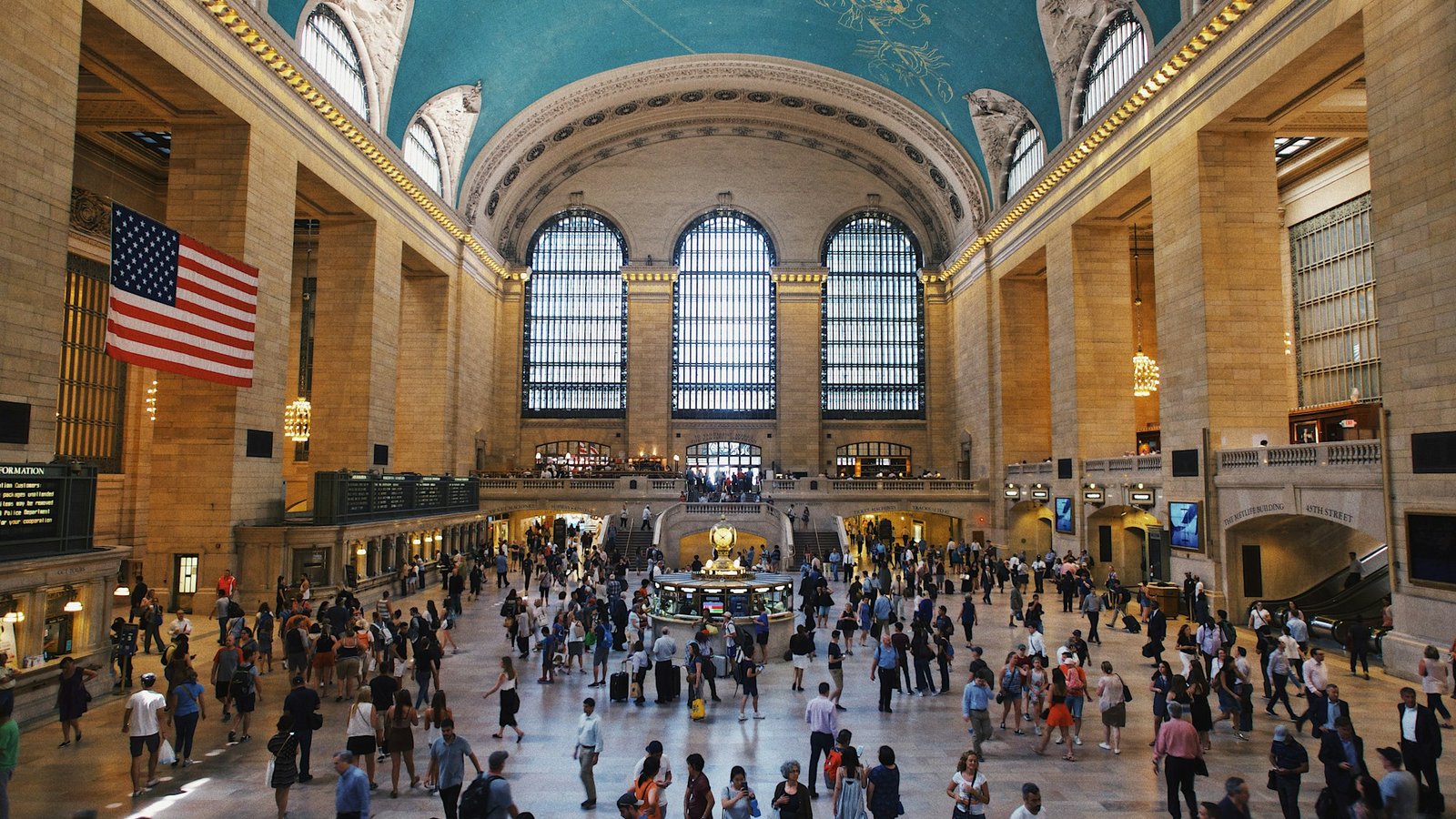
Grand Central opened in 1913, and in the more than a century since, it has handled billions of commuters, featured in hundreds of films, and become one of the most recognized buildings in the world. But familiarity has a way of hiding things in plain sight.
The Ceiling That Got It Backward — On Purpose
The turquoise ceiling above the main concourse is one of the most photographed surfaces in New York. It shows 2,500 stars in gold leaf, laid out in a pattern drawn from a medieval manuscript. And it is painted in mirror reverse.
On the real night sky, if you face south, east is to your left. On the Grand Central ceiling, east is on the right. The constellations are flipped.
The explanation, when it finally came, was that the ceiling shows the sky as God sees it — looking down from above rather than up from below. Whether that was always the intention or a happy explanation for a mistake depends on who you ask. Either way, New Yorkers have been walking beneath a mirror universe for over a hundred years.
There’s one more detail. The ceiling was originally painted in 1912. By the 1980s it had turned a muddy brown from decades of cigarette smoke and diesel fumes. The 1990s restoration peeled back the grime and revealed the original cerulean blue — but a small square was deliberately left unrenovated near the east balcony. It’s there so visitors can see exactly how dark it had become.
The Presidential Railroad Track Hidden Beneath Manhattan
Below the terminal’s lower level, on a platform known as Track 61, there is a private railroad siding built for one specific purpose: moving a president through New York City without anyone seeing him.
Franklin D. Roosevelt used a wheelchair due to polio. During his presidency, the press largely cooperated in keeping this from public view — photographs of him being lifted or carried were extremely rare. Track 61 was part of how that was managed in New York.
His armored private railcar could run directly from the main line into Track 61, positioned beneath the Waldorf Astoria Hotel. A private elevator — still there — carried him directly to the hotel’s upper floors. He arrived in New York’s most prominent hotel without appearing in public once.
The track still exists. It is not accessible on a regular visit, but occasional specialized tours have included it. The railcar is long gone — but the infrastructure that carried a president in secret remains, one floor below the morning commuters.
The Whispering Gallery Most Visitors Never Find
One floor below the main concourse, tucked into the lower dining concourse outside the Oyster Bar, there is a small architectural accident that has been quietly astonishing people for decades.
Stand in one of the four tiled corners beneath the arched Guastavino ceiling. Whisper something — anything. A person standing in the diagonally opposite corner, thirty feet away, can hear you as clearly as if you were standing next to them.
It works because the curved tile vaults act like a parabolic reflector. Sound waves travel along the ceiling rather than dissipating into the air. It is completely unintentional — the Guastavino tiles were chosen for structural strength, not acoustics.
New Yorkers have been using it to propose marriage for years. Couples discover it on first dates. Total strangers find themselves whispering across it to each other. It costs nothing, requires no reservation, and is available every day the terminal is open.
Enjoying this? Join New York lovers getting stories like this every week. Subscribe free →
The Woman Who Saved Grand Central From the Wrecking Ball
In 1963, New York demolished Pennsylvania Station — then considered one of the great public buildings in the world — to build the current Madison Square Garden. The loss was enormous. The public reaction transformed how America thinks about historic preservation.
Grand Central was next. In 1967, the terminal’s owners announced plans to demolish it and build a 55-story office tower above the existing structure. Economically, they argued, the land was too valuable to leave as a train station.
Jacqueline Kennedy Onassis led the fight to stop it. She wrote letters, gave public speeches, appeared at rallies, and helped build a coalition of architects, historians, and ordinary New Yorkers who found the prospect unthinkable. Her celebrity gave the cause a platform it would not otherwise have had.
The case went all the way to the Supreme Court. In 1978, the Court ruled in favor of the terminal. Grand Central was saved. The ruling also strengthened landmark preservation law across the country — meaning that the fight for one building in Midtown Manhattan helped protect thousands of historic structures across America.
The Hidden Bar Behind an Unmarked Door
Near the northwest corner of the terminal, behind a door that most commuters pass without noticing, is a bar with a ceiling that cost more to paint than most apartments.
The room once belonged to John W. Campbell, a businessman and one-time transit commissioner who leased the space in 1923 and transformed it into a private office designed after a 13th-century Florentine palazzo. Hand-painted ceiling. Stained glass windows. A $100,000 private safe. He worked there for decades before the terminal took it back after his death.
The room became an office, then a jail used by the transit police, then storage. It sat closed for years. In 1999 it reopened as a bar, and today the Campbell Bar operates in that same space — the hand-painted ceiling still intact above every drink.
And if that’s not enough: somewhere above the main concourse, hidden from view, there are functioning tennis courts — a detail that surprises nearly everyone who discovers it, even people who have worked in the terminal for years.
Frequently Asked Questions About Grand Central Terminal
Is Grand Central Terminal free to visit?
Yes, entry to Grand Central Terminal is completely free. The main concourse, lower dining concourse, and the whispering gallery are all open to the public at no cost. Some guided tours of behind-the-scenes areas charge a fee, but walking through the building itself costs nothing.
Where is the Whispering Gallery in Grand Central Terminal?
The Whispering Gallery is located in the lower dining concourse, just outside the entrance to the Oyster Bar restaurant. Look for the four arched corners beneath the tiled Guastavino ceiling. Stand in one corner and whisper — someone at the opposite corner will hear you clearly.
What is the story behind Grand Central’s backward ceiling?
The celestial ceiling in the main concourse depicts 2,500 stars in the correct constellation patterns, but the entire image is reversed — mirrored east to west. The traditional explanation is that it shows the sky as seen from outside the Earth looking in, not from the ground looking up. It was painted from a medieval manuscript and restored to its original turquoise and gold in the 1990s.
Can you visit Track 61, the secret presidential platform under Grand Central?
Track 61 is not open for regular public access, but it has been included on occasional specialized tours of Grand Central’s infrastructure. The platform itself was built to allow President Franklin D. Roosevelt to arrive in New York City without appearing in public, connected via a private elevator to the Waldorf Astoria Hotel above.
What is the best time to visit Grand Central Terminal?
Early mornings on weekdays (before 8am) and weekend afternoons offer the most comfortable experience for exploring the architecture and hidden details. Midday on weekdays is extremely busy with commuters and tourists. The terminal is open 24 hours, and late evening visits have a particular atmosphere with the main concourse much quieter.
Grand Central is not just a place to catch a train. It is a building that has held nearly every kind of human experience New York produces — presidents arriving in secret, lovers whispering across a ceiling, ordinary commuters who have walked past a Florentine palazzo every morning for years without knowing it was there.
The next time you pass through, look up. Then look around. Then look for the unmarked door near the northwest corner. The building has been waiting to show you something.
You Might Also Enjoy
- The Day New York Tore Down Its Greatest Building — and What the City Lost Forever
- How the Chrysler Building Secretly Became the World’s Tallest — For 11 Months
- The Wooden Towers on New York’s Skyline Are Hiding a Beautiful Engineering Secret
Plan Your New York Trip
Grand Central Terminal is at 89 E 42nd St in Midtown Manhattan, open 24 hours and accessible from multiple subway lines. For a full guide to making the most of your time in the city, see our complete New York City itinerary or check the best time of year to visit for your trip.
Join 1,100+ New York Lovers
Every weekday morning, get New York’s hidden gems, neighbourhood stories, food origins, and city secrets — straight to your inbox.
Subscribe free — enter your email:
Love more? Join 65,000 Ireland lovers → · Join 43,000 Scotland lovers →
Free forever · Unsubscribe anytime

Subscribe Free