
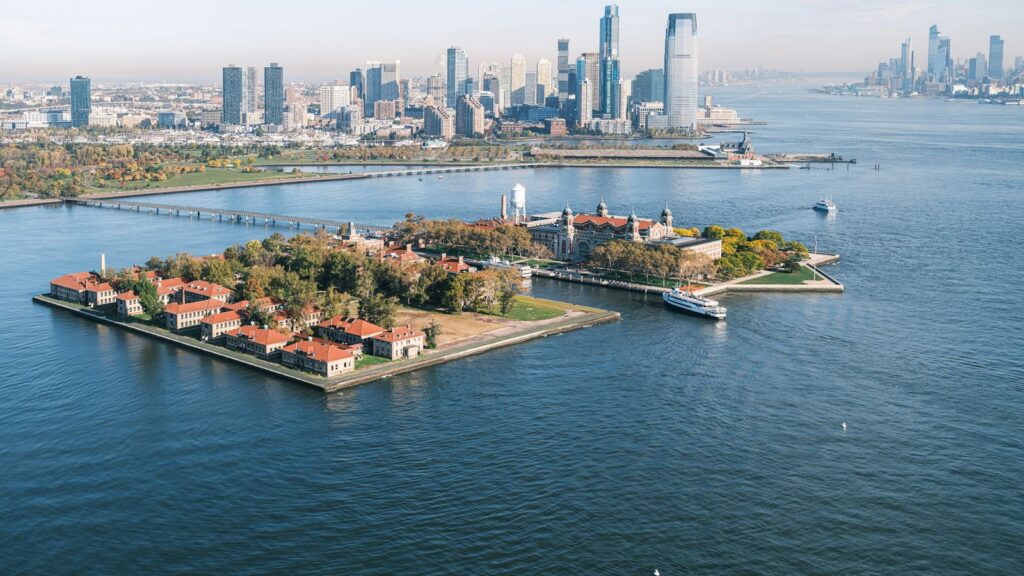
New York City is more than a destination — it is the front door of America. For generation after generation, the first sight of the United States was not the skyline of Chicago or the beaches of California. It was the harbour of New York, the torch of the Statue of Liberty, and the red-brick halls of Ellis Island. If you have American roots — and statistically speaking, there is a very good chance you do — New York is where your family’s story in the New World began.
Researchers estimate that 37% of all Americans can trace at least one ancestor who passed through the port of New York. Between 1892 and 1954, Ellis Island alone processed more than 12 million immigrants — Italians, Jews, Irish, Poles, Greeks, Puerto Ricans, and dozens of other nationalities — all of them stepping off ships and into the city that would define their descendants’ lives. Before Ellis Island opened, the earlier immigration station at Castle Garden handled millions more from 1855 to 1890.
Whether your family name was changed at the immigration desk, shortened on the factory floor, or quietly anglicised over two generations, the records of New York can help you find it — the original spelling, the village left behind, and the relatives who never made the crossing. This guide walks you through every step, from your kitchen table to the archives of Manhattan.
Step 1: Start With What You Know
Every great genealogy search begins at home. Before you open a single database, sit down with the oldest family members you can reach and ask them to tell you everything they remember. What country did the family come from? What was the original surname? Do they remember a city, a town, or even just a region? These fragments of oral history are often the key that unlocks the archives.
Dig through boxes, attics, and old drawers. Look for naturalization papers (they often list the original town of birth), passenger tickets or steamship receipts, old letters with foreign postmarks, religious documents like baptismal certificates or confirmation cards, and photographs with handwritten names on the back. Even a funeral prayer card or an old prayer book can contain a name or date that changes everything. Write down everything you find, no matter how small it seems.
Step 2: Ellis Island & Statue of Liberty Records
This is where the magic begins. The Ellis Island Foundation has digitised arrival records for the period 1892 to 1957, and they are completely free to search at libertyellisfoundation.org. Search by surname and you may find your ancestor’s passenger manifest — a document that is far richer than most people expect.
These manifests recorded not just the immigrant’s name and age, but their hometown in Europe, the name and address of a relative they were travelling to meet in America, the name and address of a relative still at home, their occupation, how much money they were carrying, and even a physical description. In many cases, the manifest is the only surviving record that links an American family directly to a specific village in the Old Country.
For arrivals before Ellis Island opened, the earlier immigration station at Castle Garden processed immigrants from 1855 to 1890. Those records are searchable for free at castlegarden.org. If your great-great-grandparents arrived in that earlier wave of immigration — many Irish famine survivors, for instance, came in the 1840s and 1850s — Castle Garden is your starting point.
Step 3: NYC Municipal Archives
The New York City Department of Records and Information Services holds one of the most remarkable collections of vital records in the world. New York City has been registering births since 1866, marriages since 1847, and deaths since 1795 — stretching back to a time when the city was still a relatively small port town. For families who settled in Brooklyn, Queens, the Bronx, or Staten Island as well as Manhattan, all five boroughs are covered.
You can search the online index at nycma.lunaimaging.com, and once you identify the record you need, physical copies and certified certificates can be ordered or viewed in person at the Municipal Archives at 31 Chambers Street, Manhattan. Death certificates are particularly valuable for genealogists — they often list the deceased’s parents’ names and birthplaces, which can reach back another generation in a single document.
Step 4: New York State Census (1825–1925)
Many researchers do not realise that New York State conducted its own census every ten years — separate from the federal census — from 1825 all the way through to 1925. These state censuses fall in between the federal ones and can fill critical gaps in a family timeline. The 1925 New York State Census is particularly prized because it frequently recorded the original European town or village where an immigrant was born, a detail that the federal census often reduced to just a country name.
Ancestry.com holds the largest digitised collection of New York State censuses. If you do not have a subscription, many public libraries provide free access to Ancestry.com through their library card portals. The New York Public Library, in particular, offers free Ancestry access both on-site and remotely for cardholders.
Step 5: Federal Census 1790–1950
The federal census was conducted every ten years and is one of the most powerful genealogical tools available. Crucially, census records include not just names and ages but birthplace and parents’ birthplace — two fields that can bridge the gap between America and the home country in a single line. From 1880 onward, the relationship of each person to the head of household is also recorded, making it possible to map entire families living together.
FamilySearch.org is the best free resource for federal census records and is maintained by the Church of Jesus Christ of Latter-day Saints — one of the most committed genealogical organisations in the world. The 1940 census became publicly accessible in 2012, and the 1950 census is now fully available online, bringing the free federal record window up to the mid-twentieth century. Search New York City addresses and you may find your family’s exact apartment building listed.
Step 6: Naturalization Records
Naturalization — the legal process by which an immigrant became an American citizen — generated some of the most genealogically rich documents in existence. The Declaration of Intention, sometimes called “First Papers,” was the first step in the process and typically recorded the immigrant’s full name, date and place of birth, hometown in the home country, physical description, and the date and port of arrival in America.
Federal naturalization records for New York are held at the National Archives and Records Administration (NARA) New York Branch at 201 Varick Street, Manhattan. Many records have also been digitised and are searchable through Ancestry.com. The USCIS Genealogy Programme (at uscis.gov/genealogy) can retrieve A-Files and C-Files for individuals who went through the immigration system after 1906, including later naturalizations and visa records.
Step 7: Community & Ethnic Records
New York’s immigrant communities kept their own records — in churches, synagogues, fraternal organisations, and community societies — that often survive where government records do not. The tenement neighbourhoods of the Lower East Side were home to wave after wave of Italian, Eastern European Jewish, Irish, and later Puerto Rican families, and many of those communities maintained meticulous records of their own.
Key resources by community include: the YIVO Institute for Jewish Research (yivo.org) for Eastern European Jewish families; the American Irish Historical Society (aihs.org) for Irish-American genealogy; the Italian Genealogical Group (italiangen.org) for Italian-American families; and the Tenement Museum (tenement.org), which offers a research service and can help trace families who lived in specific Lower East Side buildings. Many Catholic parish records are also held at diocesan archives and are not available online — a direct inquiry to the relevant diocese can be well worth the effort.
Step 8: DNA Testing
DNA testing has transformed genealogy over the last decade, and for New York family research it is particularly powerful. AncestryDNA has by far the largest consumer DNA database in the world, with particular strength in Italian, Irish, Jewish, and general American populations — exactly the communities that dominated New York immigration. A DNA match with a third or fourth cousin can open up an entirely new branch of the family tree and potentially lead you to relatives still living in the ancestral homeland.
MyHeritage DNA is particularly useful for making European connections, as it has strong representation from European users. 23andMe provides a detailed ethnicity breakdown that can confirm family stories about mixed heritage or reveal unexpected origins. FamilyTreeDNA is the best option for haplogroup analysis — the deep ancestral lineage that traces your paternal or maternal line back thousands of years. Most serious genealogists eventually test on two or three platforms to maximise their matches.
Step 9: Planning a Heritage Trip to New York
There is nothing quite like standing on the same ground your ancestors walked — and New York makes that experience accessible, meaningful, and genuinely moving. The Lower East Side of Manhattan is where many immigrant families first settled, and wandering its streets today, past the old tenements and the surviving synagogues and the Italian delis, is to step directly into the world your great-grandparents knew.
Key stops for a heritage visit include: Ellis Island and the Statue of Liberty (ferry from Battery Park — book in advance); the Tenement Museum on Orchard Street (book a guided tour — it is extraordinary); the New York Public Library Milstein Division on 42nd Street (a free genealogy help room where expert staff will guide your research); and the Municipal Archives at 31 Chambers Street. Borough-specific archives in Brooklyn and Queens hold records for families who settled outside Manhattan, and many local historical societies can help with neighbourhood-level research.
Free Resources at a Glance
- libertyellisfoundation.org — Ellis Island passenger records 1892–1957 (free)
- castlegarden.org — Castle Garden records 1855–1890 (free)
- FamilySearch.org — federal census, vital records, immigration (free)
- nycma.lunaimaging.com — NYC vital records index (free)
- stevemorse.org — Ellis Island One-Step search tool (free, often finds records that the standard search misses)
The story of your family did not begin in the suburb where you grew up. It began somewhere else — in a village in Calabria, in a shtetl in the Pale of Settlement, in a townland in County Cork, in a barrio in Puerto Rico — and it came to America through New York. The records are there. The archives are waiting. Your family’s story is ready to be found.
Subscribe free to Love New York for weekly stories about the city your ancestors built — the history, the hidden places, and the heritage that makes New York unlike anywhere else on earth. Join us here →
