
It starts before six in the morning.
A pushcart seller’s voice cuts through the dark. “Herring! Fresh herring!” Below your window, the cobblestones are slick with morning damp. The smell of coal smoke rises from a dozen chimneys.
You are in a tenement on Orchard Street. Your apartment has three rooms. Seven people live here.
This is the Lower East Side in 1910. The most crowded place on earth.
If you love New York’s hidden stories, you’ll love our free weekly newsletter. Subscribe to Love New York →
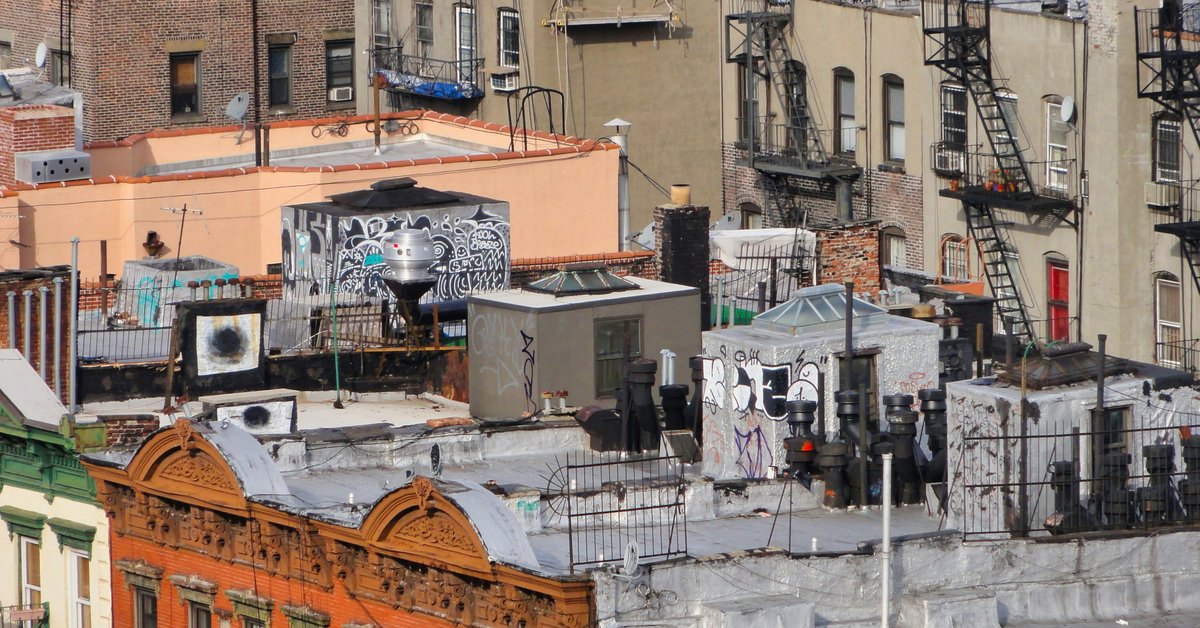
The neighbourhood and its people
More than half a million people crowd into this small triangle of lower Manhattan. The blocks between Delancey Street, East Broadway, and the East River hold more people per acre than anywhere else in history. Later studies estimated around 700 residents per acre on the busiest blocks.
Most are Jewish immigrants from Russia, Poland, Galicia, and Romania. Many arrived through Ellis Island in the previous decade. They came with little English, little money, and enormous determination.
Some blocks are Italian. Around Mulberry Street and Hester Street, you hear Neapolitan and Sicilian dialects. In places, the two communities overlap. Yiddish on one floor, Italian on the next.
Many of these families passed through the same arrival process. Learn more about what Ellis Island was really like for the families who came through it.
The apartment
Your flat is called a railroad tenement. The rooms line up one behind the other, like carriages on a train. Light reaches the front room and the back room. The middle room has none.
Rent is about twelve dollars a month. That is a large share of what a garment worker earns. To cover it, many families take in a boarder. A single man might sleep on the kitchen floor for two dollars a week.
There is no bathroom inside the apartment. The shared toilet is in the hallway — one per floor, for six families or more.
The kitchen is the heart of the home. The stove heats the flat in winter. It cooks the meals. It heats the water. It dries the laundry when the cold outside makes hanging impossible.
The working day
Your father leaves before seven. He is a presser at a garment factory nearby. His iron weighs nine pounds. He uses it for twelve hours a day, standing at a table in a room crowded with twenty other men.
The pay is around six to eight dollars a week. The hours are sixty or more. He works six days a week for most of the year.
The garment trade dominates the neighbourhood. Hundreds of small workshops line the streets above the shops. Whole blocks hum with the sound of sewing machines. Women stitch shirtwaists. Men press trousers. Young teenagers run errands and thread needles.
The same communities that worked in these factories built the neighbourhood’s identity. Read the full story of how Jewish immigrants shaped the Lower East Side.
Your mother does piecework at home. She attaches buttons to shirt fronts. The factory sends the work; she returns it finished. It pays perhaps fifty cents a day. She works while the youngest children sleep and after the older ones leave for school.
The market
By eight in the morning, Hester Street is alive.
The pushcart market is unlike anything in the city. Hundreds of wooden carts line the street. Vendors sell pickled cucumbers from barrels. They sell herring, bread, buttons, old clothing, and kitchen pots. The air smells of brine, coal smoke, and horse from the delivery wagons that push through the crowd.
The noise is extraordinary. Haggling happens in Yiddish, Italian, and broken English. No one pays the first price asked.
Orchard Street is for dry goods and fabric. Hester Street is for food. Delancey Street, wider and busier, connects the neighbourhood to the wider city.
For the women of the LES, the market is not just commerce. It is a daily gathering. Here they learn who has work and who has none. Here news from the old country spreads. Here a newcomer from Minsk or Łódź finds a familiar accent and a friendly face.
The children
The public schools are packed. Many run two shifts. Children attend in the morning or the afternoon only.
After school, many children work. Boys sell newspapers on street corners. Girls help with home sewing. A family might earn an extra dollar or two a week from take-home piecework — children stitching by lamplight after dinner.
The boys also attend heder — the Jewish religious school. The rabbi teaches Hebrew in a cramped back room after regular school ends. It is not comfortable. But for families who crossed an ocean to keep their faith, this matters deeply.
On summer evenings, children take over the streets. Stickball fills the space between the pushcarts. The fire escapes of the tenements become balconies, sleeping places on the hottest nights, and social spaces where the whole building’s life plays out. Read about how New York’s fire escapes became the most lived-in spaces in the city.
Want more stories like this? Our weekly newsletter goes deeper into New York’s heritage every week. It’s free. Subscribe here →
The synagogues
There are more than two hundred synagogues in the Lower East Side in 1910. Some are grand. The Eldridge Street Synagogue, built in 1887, rises above the rooftops in Moorish and Gothic Revival style. Its interior is extraordinary — carved wood, stained glass, a painted ceiling that took decades to restore.
Most synagogues are far simpler. A rented room above a bakery. A cleared basement. These small congregations — shtiebels — serve immigrants from the same town or region in the old country. Thirty men from a village in Poland might pray together every Friday night. The connection to home is kept alive.
On the Sabbath, Orchard Street goes quiet. The carts disappear. Families dress in their best clothes and walk to shul. The Sabbath belongs entirely to them — not the factory, not the landlord, not the noise of the city.
The newspapers and the community
The Jewish Daily Forward — the Forverts — publishes on East Broadway, a few minutes’ walk from the pushcart streets. By 1910, it reaches hundreds of thousands of readers.
Its famous column, the Bintel Brief — “A Bundle of Letters” — prints readers’ letters asking for guidance. Should I bring my parents from Russia? Should I give up the Sabbath to keep my job? Should I leave a husband who no longer speaks kindly?
These letters are among the most honest documents of immigrant life ever published. They show the choices people faced. They show the community they built to face those choices together.
The neighbourhood is also full of organisations. The Educational Alliance on East Broadway offers English classes, lectures, and a library. The Henry Street Settlement, founded by Lillian Wald in 1895, provides nursing care and community support. The Hebrew Immigrant Aid Society — HIAS — meets newcomers at the docks and helps them find their feet.
For all the hardship of tenement life, this neighbourhood is not without support. People know their neighbours. People help their neighbours.
Evening
The factories close. The pushcart men wheel their unsold goods back to storage. The streets fill again.
In summer, people crowd onto fire escapes to escape the heat inside. Children sleep on rooftops. The sounds of the neighbourhood shift from commerce to life — music, argument, laughter, prayer.
Seward Park, opened in 1903, offers a few acres of green space. On warm evenings, families gather there. Children play. Old men argue about the news from the Forward. A young woman reads a library book on a bench.
Tomorrow the alarm will not exist. The pushcart voices will do its work instead.
What survives today
Much of the original neighbourhood has changed beyond recognition. But the threads are still there.
The Tenement Museum, at 97 Orchard Street, is the most direct connection to 1910. The building was constructed in 1863. More than 7,000 people lived there over the decades. The museum has restored several apartments to their historical condition — complete with original wallpaper and objects left behind when the building was closed in 1935.
The Museum at Eldridge Street occupies the fully restored 1887 synagogue. It holds regular services and is one of the great religious buildings in New York City.
Russ & Daughters, the appetising shop on Houston Street, opened in 1914. Katz’s Delicatessen, on East Houston, has been here since 1888. A visit to either connects you to the food culture of 1910.
Walk Orchard Street on a weekend. The weekend market still runs in warm months. Look at the buildings above the shops. The bones of the old neighbourhood are still there, in the ironwork and the brickwork and the narrow windows above.
The Williamsburg Jewish community carried many of these same traditions just a bridge away. Read the story of how Jewish immigrants built Williamsburg, Brooklyn.
Frequently Asked Questions
What was a typical apartment like on the Lower East Side in 1910?
Most apartments were “railroad flats” — three to four narrow rooms arranged in a line. Light reached only the front and rear rooms. Families of five to eight people commonly shared these spaces, and many also took in boarders to help cover the rent.
Where can I visit today to connect with the history of the Lower East Side?
The Tenement Museum at 97 Orchard Street is the best starting point, with restored apartments from the 1870s through the 1930s. The Museum at Eldridge Street is the fully restored 1887 synagogue. Katz’s Delicatessen (est. 1888) and Russ & Daughters (est. 1914) are both still operating from their historic roots.
How can I find out if my ancestors lived on the Lower East Side?
Start with the Ellis Island Foundation database at libertyellisfoundation.org for passenger arrival records. The New York Public Library’s Milstein Division holds census records, city directories, and naturalisation documents. The Tenement Museum also provides resources for tracing specific building addresses on the LES.
What happened to the Lower East Side community after 1910?
As families prospered, they moved outward — to the Bronx, Brooklyn, and eventually to the suburbs of New York and New Jersey. The neighbourhood’s character shifted significantly from the 1950s onwards. Several historic Jewish institutions remain, and the cultural memory is carefully preserved by the museums and community organisations that still operate here.
Ready to explore the New York your ancestors knew? Subscribe to Love New York — free weekly stories, heritage guides, and hidden history. Join us →
