
The Metropolitan Museum of Art holds more than two million objects spread across 5,000 years of human history. Most visitors walk through a small fraction of it and leave with their heads full. But a week later, a month later, sometimes years later, one thing lingers. A painting. A carved face. A room you almost walked past.
That question — what stays with you? — is one our New York community keeps coming back to. This article is our attempt to answer it properly, with real detail about the works that tend to haunt visitors long after they’ve left Fifth Avenue.
Love New York? Get our free weekly guide — the best the city has to offer, straight to your inbox. Subscribe here →
Washington Crossing the Delaware
This is the one that stops people in their tracks, literally. Emanuel Leutze painted it in 1851, and it measures roughly 3.8 metres by 6.4 metres. When you turn the corner into the American Wing and see it for the first time, the sheer scale of it is a shock.
The painting shows George Washington standing in a small wooden boat crossing the Delaware River on Christmas night, 1776. The ice is brutal. The men look exhausted. Washington looks composed in a way that strains belief. That’s partly the point — Leutze was painting a symbol, not a photograph. He was working in Dusseldorf at the time, partly inspired by the European revolutions of 1848.
What makes it stay with you is the contradiction at its centre. It’s both wildly dramatic and completely still. The flag doesn’t quite match the historical record (it predates the actual Stars and Stripes). The figures in the boat don’t all fit the eyewitness accounts. And yet it’s one of the most recognisable images in American history. People carry it in their heads without even knowing where they first saw it.
The Met acquired it in 1897. It lives in the American Wing, Gallery 760. Go early if you can — the room fills up by mid-morning.
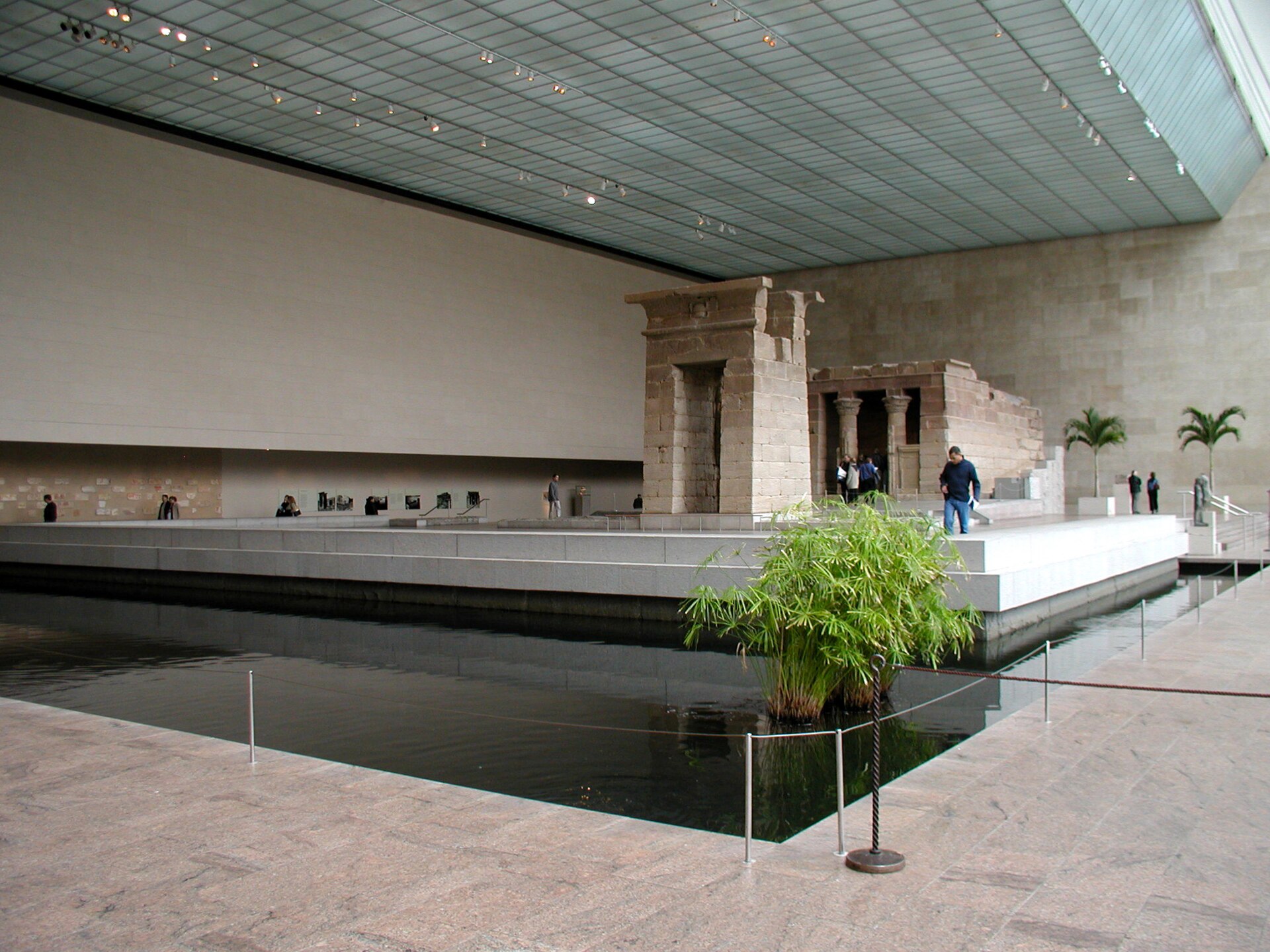
The Temple of Dendur
It is an actual Egyptian temple. Built around 15 BCE during the reign of Emperor Augustus, it was originally located on the west bank of the Nile in Nubia. In 1965, Egypt gifted it to the United States as a thank-you for American support in saving ancient monuments during the construction of the Aswan High Dam, which flooded vast stretches of the Nile valley.
The Met disassembled it, shipped it in 661 crates, and rebuilt it inside the Sackler Wing in 1978. It sits on a raised platform beside a long reflecting pool, with natural light pouring in through floor-to-ceiling glass. When the afternoon sun hits it, the sandstone glows.
The carvings on the walls show Augustus dressed as an Egyptian pharaoh, offering to the gods. It is a piece of Roman propaganda dressed as Egyptian religion. You can see graffiti scratched into the stone by 19th-century visitors — names and dates from the 1820s. The Met has decided to leave it there. It’s now part of the object’s history.
Nothing quite prepares you for the experience of walking up to an ancient temple inside a Manhattan museum. It’s included with general admission. It’s also one of the most photographed spots in the entire building, which is fair — it looks like nothing else in the city.
Madame X by John Singer Sargent
In 1884, John Singer Sargent exhibited this portrait at the Paris Salon and it caused a scandal. The subject was Virginie Amelie Avegno Gautreau, an American socialite living in Paris. In the original version, one shoulder strap had slipped off her shoulder. Critics found it improper. Sargent repainted the strap upright. The damage to his reputation in Paris was done regardless.
He eventually sold the painting to the Met in 1916, describing it in a letter as “the best thing I’ve done.” He was probably right. The black dress, the pale skin, the sharp profile, the slight air of defiance — it’s a portrait that reads as modern even today. You can see why Paris was unsettled by it.
The Met displays it in the European Paintings galleries. Sargent requested that the subject’s name be withheld during her lifetime. The label simply read Madame X. Her identity was only made public after she died in 1915. The title stuck.
People tend to walk past it, then walk back. The longer you look, the more interesting the posture becomes — the way she holds herself, the ring on her right hand, the jewelled crescent at her neckline. It’s a painting you can spend ten minutes in front of and still feel like you’ve missed something.
Want more New York like this? Our free newsletter covers the city’s culture, history, and hidden corners every week. Join thousands of New York lovers →
The Death of Socrates by Jacques-Louis David
Painted in 1787, two years before the French Revolution, this is a painting about dying with conviction. Socrates was condemned to death by the Athenian government for corrupting the youth and impiety. He was offered exile but refused. He would die in Athens, on his terms, in accordance with his beliefs.
David shows him in his final moments, surrounded by grieving disciples, reaching for the cup of hemlock as calmly as if he’s picking up a glass of water. The composition is pure theatre — every figure is placed deliberately, every gesture counts. The weeping man on the far left, back turned to the viewer, is intended to be Plato, though historically Plato wasn’t present at the death.
What strikes people is the control of it. David uses the architecture of the scene to make Socrates look like the only calm person in the room. He dominates the painting not through size but through stillness. It was considered a masterpiece the moment it was exhibited in Paris, and it holds up completely more than two centuries later.
The painting entered the Met’s collection in 1931. It’s in the European Paintings galleries. At roughly 1.3 metres by 1.96 metres, it’s a manageable scale — not overwhelming, but large enough to draw you in and hold you there.
Autumn Rhythm by Jackson Pollock
If you’ve always found abstract art difficult, this is the painting that tends to make people reconsider. Pollock painted it in 1950, working on an unprimed canvas laid flat on the floor of his barn in East Hampton, pouring and dripping enamel paint in layers. He called the method “action painting.” Critics called it chaos. The Met called it one of the great American paintings of the 20th century.
The Met’s canvas measures 2.67 metres by 5.27 metres. Standing in front of it, you stop thinking about whether you “understand” it. You start noticing the density in some sections, the thinness in others, the rhythm (to use Pollock’s own word) of how the marks move across the surface. It is genuinely absorbing, even for people who would normally walk past an abstract work.
The Met acquired it in 1957, the year after Pollock died in a car accident aged 44. It’s displayed in the modern and contemporary art galleries. Try to catch it when the room isn’t crowded — you need space to step back and take in the full scale at once.
The Arms and Armour Galleries
These galleries divide opinion sharply, which is part of why they stay with people. The Met has one of the finest collections of arms and armour in the world — around 14,000 objects spanning Europe, Asia, the Middle East, and the Americas, from ancient times to the 19th century.
The most striking display is the row of armoured knights on horseback near the entrance. Full horse armour from 16th-century Germany, paired with full suit armour for the rider. They are extraordinary objects — each suit the product of hundreds of hours of skilled metalwork, shaped to fit a specific person.
Children tend to love these galleries. Adults often find themselves unexpectedly absorbed. The craftsmanship is the draw — the etching on a sword blade, the articulation of a gauntlet, the weight and purpose of each object. It’s a different kind of looking than you do in a painting gallery, and it’s included with general admission.
Practical Information for Your Visit
The Met is at 1000 Fifth Avenue, between 80th and 84th Streets on the Upper East Side. It’s a 10-minute walk from the 86th Street subway station on the 4, 5, and 6 lines. The museum is open seven days a week, with the only full closures on Thanksgiving Day, Christmas Day, and New Year’s Day.
Admission is pay-what-you-wish for New York State residents and New York State students. For out-of-state visitors, the suggested admission is $30 for adults, $17 for seniors, and $12 for students. Children under 12 enter free regardless of where they’re from. Crucially, your ticket is valid for three consecutive days — the Met is genuinely too large to take in during a single visit, and the policy acknowledges that.
The museum opens at 10am most days. Arriving at opening gives you roughly an hour before the bulk of tour groups arrive. Friday and Saturday evenings — the museum stays open until 9pm on those nights — can also be quieter than weekend afternoons, and the galleries feel different in the evening light.
Coat check facilities are near the main entrance. The cafeteria on the ground floor is functional and reasonably priced. The rooftop bar (open seasonally in warmer months) has one of the better views of Central Park available anywhere in the city, though it does get crowded on clear days.
Audio guides are available for hire. The Met app, which you can download before arriving, works well as a self-guided tool and lets you search objects by gallery location. If you’re visiting with children, ask at the information desk for the family activity guide — it’s designed to make the collection accessible without talking down to younger visitors.
One practical note: the museum is very large and the floors are hard. Comfortable shoes matter more than most visitors expect. Build in time to sit — there are benches throughout the galleries — and don’t try to see everything. Pick three or four rooms and spend real time in them. You’ll leave with more than you would from a three-hour sprint through every wing.
Planning a New York trip? Our free weekly newsletter is full of honest, practical advice from people who love this city. Subscribe — it’s free →
Image: Temple of Dendur, Sackler Wing, The Metropolitan Museum of Art, New York. Photo by Gunnar Klack via Wikimedia Commons (CC BY-SA 4.0).
