
New York City has three famous East River bridges within a short distance of each other. The Brooklyn Bridge is the most well-known, the Manhattan Bridge sits just to the north, and the Williamsburg Bridge is further north again. All three are lit after dark. But which one actually looks best at night, and where should you stand to see them? Here is a practical guide to all three.
Love New York? Get our free weekly newsletter with the best things to see, eat, and do across the city. Subscribe here →
The Brooklyn Bridge
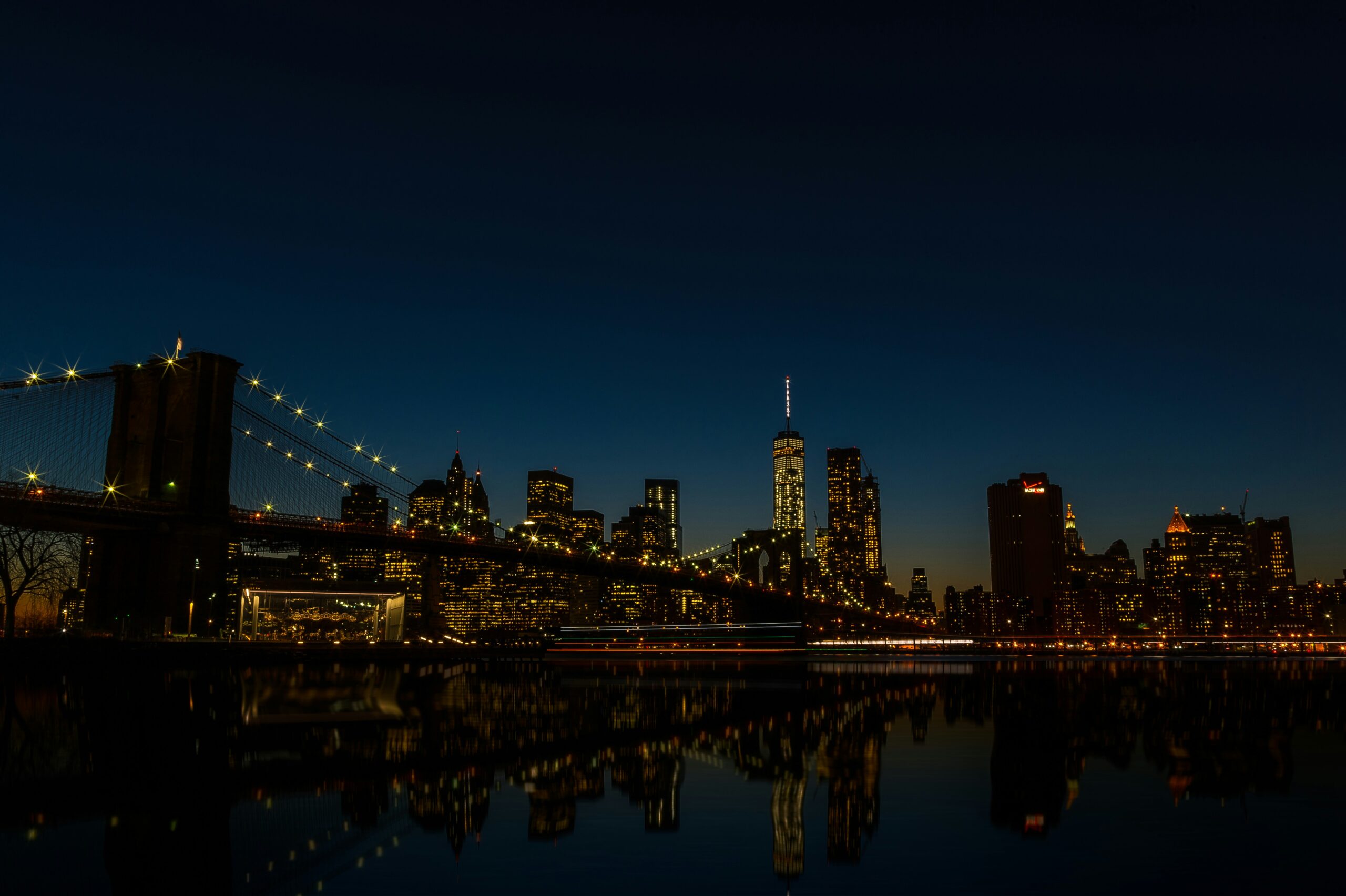
The Brooklyn Bridge opened in 1883. At the time, it was the longest suspension bridge in the world. It spans roughly 1.8 kilometres between Lower Manhattan and Brooklyn Heights. The towers are built from limestone, granite, and Rosendale cement — and at night, warm white lights illuminate the stone, picking out the gothic arches that run through both towers.
The cable arrangement is one of the most distinctive features. The vertical suspender cables drop from the main cables in a fan pattern, and at night the lighting catches them clearly. The effect is geometric and striking — very different from the steel-tower bridges to the north.
The most popular viewpoint is the Brooklyn Bridge Park waterfront promenade on the Brooklyn side. From here, you look back toward the lit bridge with the Lower Manhattan skyline behind it. This is the view that appears on postcards and in films. It is accessible from the entrance near the Fulton Ferry Landing.
You can also walk across the bridge. The pedestrian path runs along the upper deck, above the car lanes. The walkway entrance on the Manhattan side is near City Hall Park at Centre Street. On the Brooklyn side it comes out near Adams Street. The crossing takes around 25 minutes at a comfortable pace. At night, particularly after 9pm, the foot traffic is lighter than during the day.
Of the three bridges, the Brooklyn Bridge is the most architecturally detailed. The stone towers, gothic arches, and the warm lighting all give it a character that the others do not have. If you only have time for one bridge at night, this is where most visitors go first — and rightly so.
The Manhattan Bridge
The Manhattan Bridge opened in 1909, about 500 metres north of the Brooklyn Bridge. It is a longer span at just over two kilometres, and it carries both road traffic and the subway — the B, D, N, and Q lines run along the lower deck. You can hear and feel it when a train passes.
The towers are steel, not stone, and the design is more functional than decorative. The lighting is a cooler white-blue tone, which suits the industrial character of the structure. It does not have the warm golden glow of the Brooklyn Bridge, but the scale is impressive — it is a substantial structure that dominates its stretch of the waterfront.
There is no public pedestrian walkway on the Manhattan Bridge, so your view of it at night is always from a distance. The best vantage point is from the Brooklyn Bridge walkway itself, facing north. From there you can see both bridges together — the Brooklyn Bridge in the foreground and the Manhattan Bridge framing the skyline behind it.
The other essential viewpoint is Washington Street in DUMBO (Down Under the Manhattan Bridge Overpass). The street aligns directly with the bridge span, so when you stand in the right spot between the old warehouse buildings and look west, the Manhattan Bridge fills the end of the street. This framed view has been widely photographed. At night, with the bridge lit up and the street relatively quiet, it is one of the most distinctive compositions in the city.
Love New York? Get our free weekly newsletter with the best things to see, eat, and do across the city. Subscribe here →
The Williamsburg Bridge
The Williamsburg Bridge opened in 1903 and connects the Lower East Side in Manhattan with Williamsburg in Brooklyn. At roughly 2.1 kilometres, it is the longest of the three East River crossings. The towers are steel latticework — an open, industrial design that was considered a bold engineering choice at the time of construction.
The night lighting on the Williamsburg Bridge is bright and functional. It does not have the warm atmosphere of the Brooklyn Bridge or the dramatic scale of the Manhattan Bridge up close. What it does have is a pedestrian and cycling path, which is free to use and open around the clock. The views from the walkway are strong. From the midpoint of the span, you can see both the Brooklyn Bridge and the Manhattan Bridge stretching away to the south — which is a sight you cannot get from either of those crossings.
The most photogenic ground-level view is from Domino Park on the Williamsburg waterfront. The park runs along the East River and offers clear sightlines to the bridge, the water, and the Manhattan skyline. It is a less crowded alternative to Brooklyn Bridge Park, particularly on weekday evenings. The park is open until 10pm on weekdays and 11pm at weekends.
The Williamsburg Bridge draws fewer tourists than the other two, which can be a practical advantage. The walkway is spacious and the crossing is uncrowded after dark. If you want to walk across a bridge at night without navigating large groups, this is the better option.
How to See All Three in One Evening
The DUMBO waterfront area in Brooklyn is the most efficient base for viewing all three bridges in one outing. Start at Pier 1 in Brooklyn Bridge Park, where you can see the Brooklyn Bridge directly above and the Manhattan Bridge to the north. Walk south to the Main Street waterfront for a clean view of the Brooklyn Bridge span. Then head into DUMBO to Washington Street for the framed Manhattan Bridge shot.
From DUMBO, it is about a 25-minute walk north along the waterfront through Vinegar Hill to reach the Williamsburg Bridge and Domino Park. Alternatively, take the East River Ferry — the ferry stops at DUMBO and Williamsburg and operates until late in the evening.
The blue hour — the 20 to 30 minutes just after sunset — is the best time to photograph any of the three. The sky holds some colour while the bridge lights are already fully on, giving you more tonal range than a fully dark shot. In October and November, sunset falls earlier, which makes it easier to time a visit. Autumn also brings clearer, drier air that sharpens the lights.
Practical Information
- Brooklyn Bridge pedestrian access: Centre Street (Manhattan side) or Adams Street (Brooklyn side). Free. Open at all hours.
- Williamsburg Bridge pedestrian and cycle access: Delancey Street (Manhattan) or Bedford Avenue (Brooklyn). Free. Open at all hours.
- Manhattan Bridge: No pedestrian access. Cycling only, via a dedicated path.
- Brooklyn Bridge Park: Open daily; most sections until 1am.
- Domino Park, Williamsburg: Open until 10pm weekdays, 11pm at weekends.
- Subway: The A/C to High Street–Brooklyn Bridge serves the Brooklyn Bridge Park area. The J/M/Z to Marcy Avenue serves the Williamsburg Bridge on the Brooklyn side.
All three bridges are free to observe and cross where pedestrian access is available. There are no entry fees, no tickets, and no time limits on the walkways. The only cost is your subway fare to get there. Budget an evening rather than an hour — the waterfront between DUMBO and Williamsburg covers a lot of ground, and it is worth walking slowly.
Love New York? Get our free weekly newsletter with the best things to see, eat, and do across the city. Subscribe here →
