
In 1963, New York raised a wrecking ball against one of the most magnificent buildings it had ever built. The granite columns came down first. Then the 84-foot marble waiting room. Then the grand staircase, the stone eagles, the vaulted glass ceiling that had welcomed 28 million travelers a year. The original Penn Station was gone. The rubble was hauled to a landfill in New Jersey. Something that had taken decades to build vanished in less time than it takes to grow a tree.
Ada Louise Huxtable, the architecture critic for the New York Times, watched the demolition from the street. “We will probably be judged not by the monuments we build,” she wrote, “but by those we have destroyed.” She was right. And New York spent the next decade proving it.
What Penn Station Actually Was
To understand what was lost, you have to picture something most New Yorkers today have never seen.
The original Pennsylvania Station opened in 1910, designed by the legendary firm McKim, Mead & White. They modeled the main waiting room on the ancient Baths of Caracalla in Rome. The ceiling rose 84 feet above the floor. Natural light poured through iron-and-glass arches that soared 150 feet high. Pink granite columns lined a concourse stretching two full city blocks — from 31st to 33rd Street, between Seventh and Eighth Avenues.
It was not just a train station. It was a statement. New York is a city that treats arrivals as occasions. Travelers stepping off trains didn’t emerge into a crowded hall. They entered a space that made them feel they had arrived somewhere worthy of the journey.
Why the Most Beautiful Station in America Got Torn Down
By the late 1950s, the Pennsylvania Railroad was in financial trouble. Air travel was eating into long-distance ridership. The costs of maintaining that enormous structure were punishing.
The railroad’s solution: sell the air rights above the station to developers. A new sports and entertainment complex would rise on top. The station would keep operating underground, but the magnificent structure above would come down.
Architects and critics protested loudly. A group called Action Group for Better Architecture in New York picketed outside with signs reading “Don’t Amputate — Renovate.” Nobody in power was listening. Demolition began in October 1963 and ran for three years.
The Words That Echoed for Decades
Huxtable’s editorial in the Times became one of the most quoted passages in American architectural history. Her words gave language to a grief that had been wordless. New York hadn’t just lost a building. It had lost a piece of its civic soul.
The building that replaced Penn Station opened in 1968. What came next has long been considered among the least inspiring public spaces in the country — a stark, fluorescent-lit maze beneath a sports arena. The contrast with what had stood there was almost impossible to comprehend.
The architectural historian Vincent Scully put it plainly: “One entered the city like a god. One scuttles in now like a rat.”
Enjoying this? Join New York lovers getting stories like this every week. Subscribe free →
The Law That Rose From the Rubble
Something changed after Penn Station came down.
In 1965, New York City passed the Landmarks Preservation Law — a direct response to what had just been destroyed. It created a commission with the power to designate buildings as landmarks and shield them from demolition. It was the first law of its kind in the country.
It came just in time. In 1968, the railroad that owned Grand Central Terminal — which holds its own remarkable secrets beneath its tracks — announced plans to build a 55-story office tower above the station. The Landmarks Commission blocked it. A legal battle followed for a decade, reaching all the way to the U.S. Supreme Court.
In 1978, the Court upheld the city’s landmarks law. Grand Central was saved. It stands today in large part because Penn Station fell.
What’s Coming Back
The original Penn Station will never come back. But its spirit is being reclaimed, slowly.
Moynihan Train Hall, which opened on New Year’s Day 2021, occupies the old James A. Farley Post Office building directly across 31st Street. That building was also designed by McKim, Mead & White — the same architects as the original station. Its soaring glass atrium has given commuters back something they’d lost: a space that acknowledges that arriving somewhere matters.
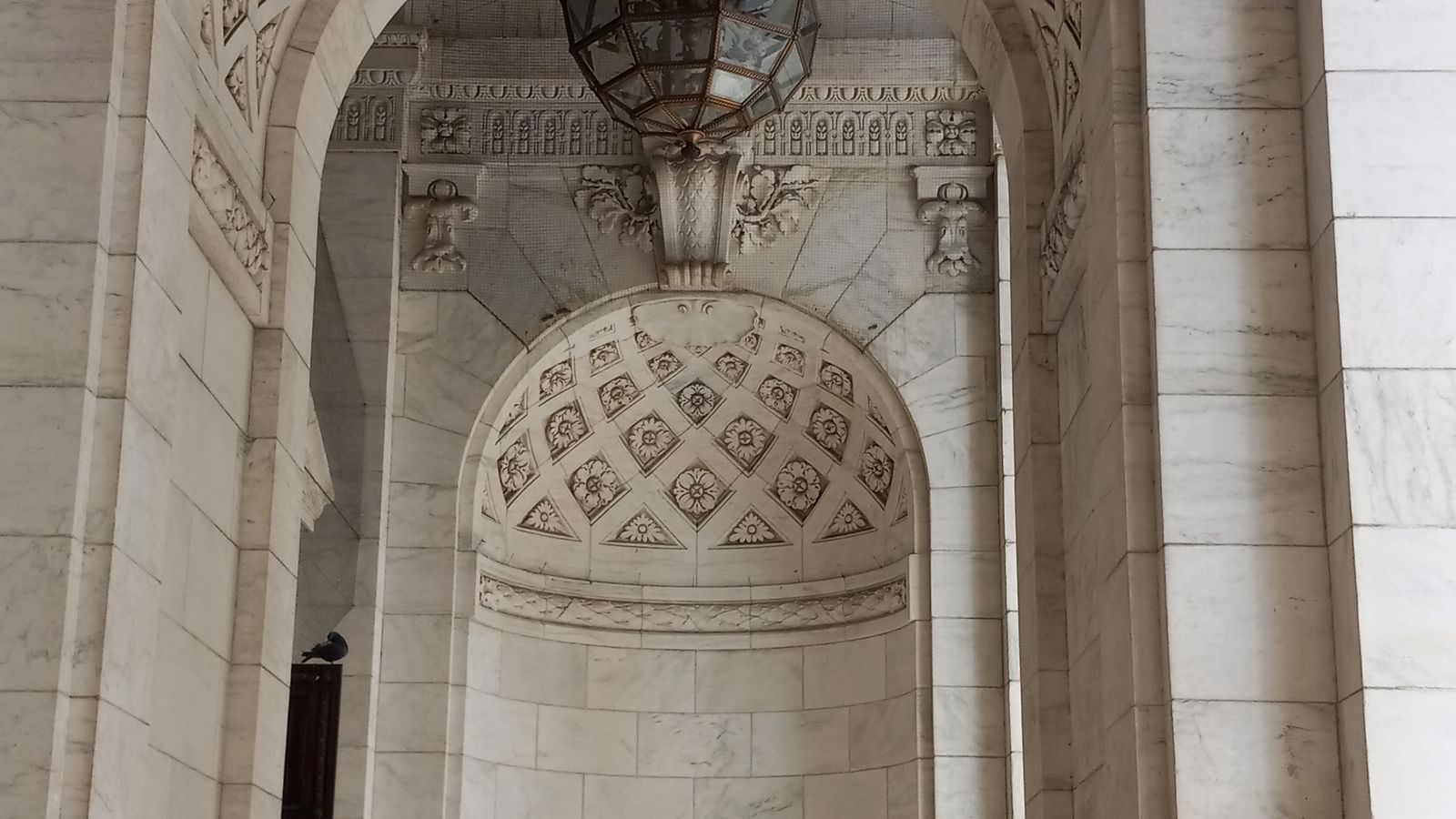
And if you want to feel what Penn Station looked like in its heyday — the marble arches, the Beaux-Arts detail, the sense of civic grandeur — you don’t have to go far. The New York Public Library on Fifth Avenue, built in the same tradition and completed just one year later in 1911, still stands. Step inside. Look up at the marble. That’s what stood on 33rd Street for fifty years before New York decided it didn’t need it anymore.
Carnegie Hall came within eight weeks of a similar fate, saved partly by the law Penn Station’s destruction helped create. Every great building still standing in this city carries that history with it.
Cities make mistakes. What matters is what they do next. New York looked at the rubble of Penn Station and decided that grief had to mean something. The Landmarks Preservation Law has since protected more than 37,000 buildings across the five boroughs. Every Art Deco lobby, every cast-iron facade, every brownstone block that still defines this city’s character is there partly because New York once lost something it could never get back.
Step off a train at Moynihan Hall some morning. Look up through the glass roof. The light pours in the same way it once did, a hundred years ago and ten blocks away. New York hasn’t forgotten. It just learned — the hard way — what was worth protecting.
You Might Also Enjoy
- The Secret Beneath Grand Central That Franklin Roosevelt Didn’t Want Anyone to Know
- Carnegie Hall Was 8 Weeks From the Wrecking Ball — Until One New Yorker Said No
- Why New York Built the World’s Tallest Skyscraper During a Depression — and Nobody Came
Plan Your New York Trip
Ready to explore Midtown’s architecture and history in person? Our New York City travel tips guide covers everything you need before your visit — from neighborhoods and transit to the landmarks that define the city’s character.
Join New York Lovers
Every weekday morning, get New York’s hidden gems, neighbourhood stories, food origins, and city secrets — straight to your inbox.
Subscribe free — enter your email:
Love more? Join 65,000 Ireland lovers → · Join 43,000 Scotland lovers →
Free forever · Unsubscribe anytime
