
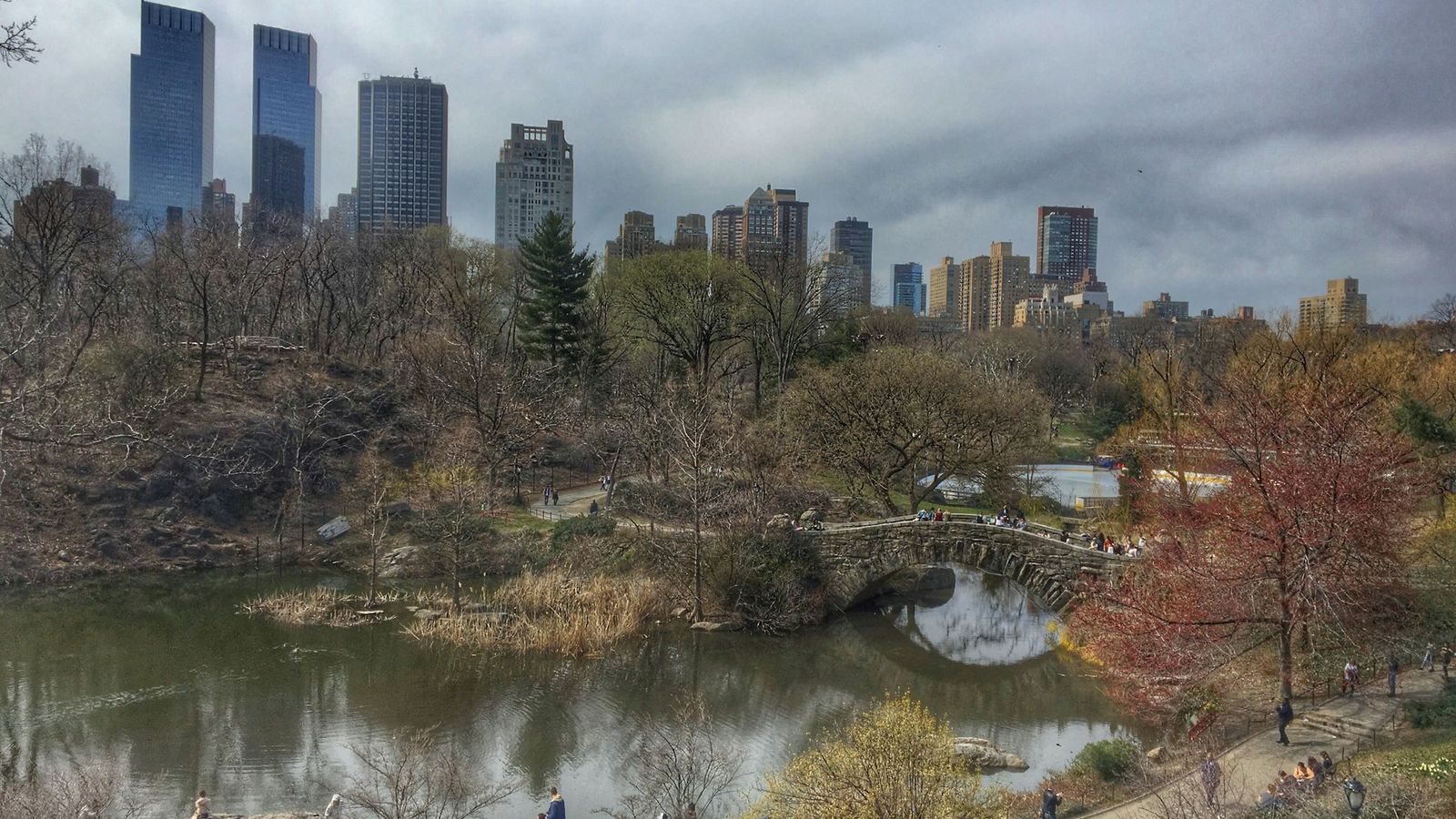
Every year, 42 million people walk through Central Park. Most follow the same well-worn loop — Bethesda Fountain, the Great Lawn, Strawberry Fields, home. But the park stretches 843 acres from 59th Street to 110th, and some of its most extraordinary places have no lines, no crowds, and no signs pointing to them.
The Secret Garden You Can Actually Visit
At 105th Street and Fifth Avenue, behind a pair of ornate iron gates, is the Conservatory Garden — the only formal garden in Central Park. It is a separate world.
The garden divides into three sections: French, Italian, and English. The English section has a lily pond at its centre and a bronze fountain modeled on characters from Frances Hodgson Burnett’s The Secret Garden. In May, wisteria climbs the surrounding pergola in thick purple waves.
On a Sunday afternoon in peak spring, you might share the Conservatory Garden with fifty people. At Bethesda Fountain, two miles south, you’ll find thousands. The difference is startling — and the garden feels all the more beautiful for it.
The Fort That Predates the Park Itself
At the very northern end of the park, past the Harlem Meer, a stone structure sits half-hidden among the trees. The Blockhouse was built in 1814 during the War of 1812 — a fortification raised to defend Manhattan from British attack.
It predates Central Park by nearly five decades. When Frederick Law Olmsted and Calvert Vaux designed the park in 1858, they left the old blockhouse standing. Today it remains exactly as it was: unrestored, unguarded, and almost entirely forgotten.
Most visitors never make it past 96th Street. The ones who do often walk straight past it. No gift shop, no interpretive display — just a 200-year-old stone fort, standing quietly in the woods at the top of Manhattan.
The Woodland Where New Yorkers Go to Get Lost
The Ramble is a 36-acre woodland in the centre of the park, designed deliberately to feel disorienting. The paths bend and double back on themselves. Streams appear unexpectedly. You can be completely alone here, surrounded by trees, with the sounds of the city entirely gone.
Olmsted designed the Ramble as a wild space — a deliberate counterpoint to the park’s more formal areas. He wanted people to feel genuinely removed from the city, not just distracted from it. It still works.
Every spring, more than 200 species of migratory birds pass through on their journey north. Serious birders arrive before sunrise and rarely talk about the place in public. It is, by quiet agreement, one of the most peaceful spots in New York. If you’re planning your visit, our 3-day New York City itinerary can help you work in an early-morning Ramble walk before the crowds arrive.
Enjoying this? Join New York lovers getting stories like this every week. Subscribe free →
An Egyptian Obelisk, 3,500 Years Old
Behind the Metropolitan Museum of Art, almost no one notices it. Cleopatra’s Needle is a 3,500-year-old granite obelisk carved in Egypt around 1450 BC — roughly a thousand years before the Parthenon was built in Athens.
It arrived in New York in 1881, transported across the Atlantic on a specially built ship, then hauled through Manhattan’s streets on wooden roller logs. Moving it from the docks to its current position took 112 days. Hieroglyphics still cover all four sides.
The obelisk stands on a hill overlooking the park, in plain view of the pedestrian path. But most visitors’ eyes go to the museum. The ancient monument beside it goes largely unnoticed, which is exactly why it’s worth seeking out. New York hides its most interesting things in plain sight — much like the secret rooms inside Grand Central Terminal that most commuters pass every day.
The Wilderness That Was Locked Away for Over a Century
Near the southeast corner of the park, a small wooden gate opens into four acres of dense, quiet woodland. The Hallett Nature Sanctuary was closed to the public for more than 100 years — deliberately left as an undisturbed wildlife habitat in the middle of the city. It reopened in 2016 after a careful restoration by the Central Park Conservancy.
The sanctuary is only open for limited hours during spring and fall, and the entrance gate is easy to walk past. Inside, the trees are old and grow close together. Hawks nest here. The birdsong is dense and layered in a way that feels almost impossible this close to Fifth Avenue.
Stand still for a few minutes and the city genuinely disappears.
Frequently Asked Questions
What is the best time to visit the Conservatory Garden in Central Park?
Spring is the peak season — typically mid-May — when the wisteria and crabapple trees are in full bloom. Arriving early on a weekday gives you the garden almost entirely to yourself, with no crowds and the morning light at its best.
Where is Cleopatra’s Needle located in Central Park?
It stands directly behind the Metropolitan Museum of Art on the park’s east side, near 81st Street. From the main path along the East Drive, walk toward the museum’s north wing — you’ll see the obelisk on the hill before you reach the building.
Is the Ramble in Central Park open to everyone?
Yes, the Ramble is free and open every day. It sits roughly in the middle of the park between 73rd and 79th Streets. Early morning in spring is the best time to visit — the birding is extraordinary and foot traffic is minimal before 9am.
When is the Hallett Nature Sanctuary open?
The Hallett Nature Sanctuary operates on limited hours, typically weekend mornings during spring and fall. Check the Central Park Conservancy website for the current schedule before visiting — the hours change by season and the gate is not always staffed.
Central Park rewards curiosity. Its most beautiful moments are not the ones on the tourist maps.
You Might Also Enjoy
- What Grand Central Terminal Is Really Hiding From Its 750,000 Daily Visitors
- The Saturday Market That Changed How New York Eats — and Still Does
- 3 Days in New York City: The Perfect First-Timer’s Itinerary
Plan Your New York Trip
Ready to explore more of New York City beyond the obvious? Our complete 3-day New York itinerary includes tips on timing, neighborhoods, and the lesser-known spots that make the city worth coming back to.
Join 1,100+ New York Lovers
Every weekday morning, get New York’s hidden gems, neighbourhood stories, food origins, and city secrets — straight to your inbox.
Subscribe free — enter your email:
📲 Know someone who’d love this? Share on WhatsApp →
Love more? Join 65,000 Ireland lovers → · Join 43,000 Scotland lovers →
Free forever · · Unsubscribe anytime

Subscribe Free