
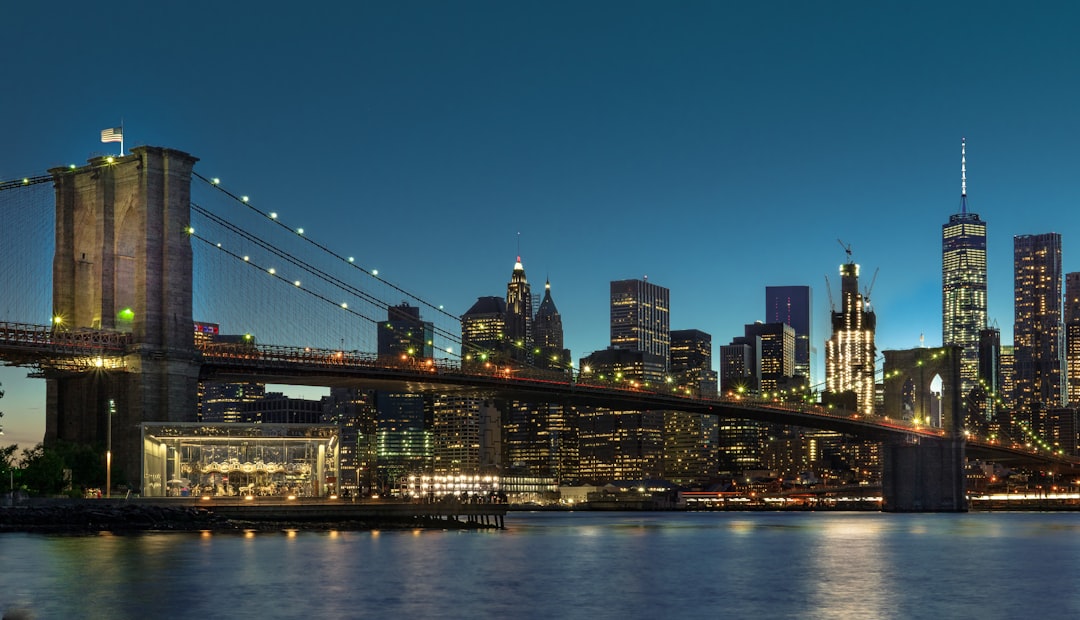
Photo: Brooklyn Bridge at night. Credit: Partha Narasimhan via Unsplash.
The Brooklyn Bridge is one of the most recognised structures in the world. It spans the East River, connecting the boroughs of Manhattan and Brooklyn, and has done so since 1883. Whether you walk across it, photograph it from the waterfront, or simply watch the city lights reflect off the water below, the bridge delivers an experience that stays with you long after you leave New York.
This guide covers everything you need to know before you visit — including the history, how to get there, the best times to go, and what the surrounding neighbourhood of DUMBO has to offer.
Love New York? Get travel tips, local guides, and hidden gems delivered to your inbox every week. Subscribe to our free newsletter →
A Brief History of the Brooklyn Bridge
Construction began in 1869 under chief engineer John A. Roebling. He died shortly after the project started, following an accident at the site. His son Washington Roebling took over, but he too was seriously injured — suffering from decompression sickness after working in the pressurised underwater caissons used to build the bridge’s foundations.
Washington’s wife, Emily Warren Roebling, then became central to the project. She spent years studying engineering, carrying instructions to the construction crew, and managing progress on her husband’s behalf. When the bridge finally opened on 24 May 1883, she was the first person to cross it.
The bridge took 14 years to build and cost approximately $15 million — roughly equivalent to $400 million today. At the time of opening, it was the longest suspension bridge in the world, with a main span of 486 metres (1,595 feet). Twenty-seven workers died during construction, many from caisson disease. It remains a working bridge today, used daily by cars, cyclists, and pedestrians.
Walking the Pedestrian Walkway
The pedestrian walkway runs along the centre of the bridge, raised above the traffic lanes on either side. A full crossing from Manhattan to Brooklyn — or the reverse — is approximately 1.6 kilometres (one mile) and takes between 25 and 40 minutes on foot, depending on your pace and how often you pause.
The walkway is open 24 hours a day, every day of the year. It is shared with cyclists, so stay to the right-hand side, which is designated for walkers. The left lane is for cyclists — the division is clearly marked on the surface, though it can get confusing when the bridge is at its busiest.
There are no facilities on the bridge itself. Bring water and wear comfortable, flat-soled shoes. The surface is wooden planking, which can be slippery when wet. The bridge is exposed, so wind can be a factor — especially in winter and on the upper sections near the towers.
When to Visit the Brooklyn Bridge
Early morning is the best time for most visitors. The bridge is quieter, the light is better for photography, and you avoid the peak tourist crowds that build through the day. Sunrise visits — especially in autumn and winter when the sun rises directly over Brooklyn — are particularly striking.
Midday in summer can be hot and very congested. The bridge attracts millions of visitors each year, and the walkway becomes noticeably cramped during peak hours from late morning to early evening. If summer is your only option, aim for before 8am or after 7pm.
Evening visits are worth considering in their own right. The bridge is lit from below after dark, the cables and towers take on a different character, and the reflections on the East River are excellent. The view of the Manhattan skyline from the Brooklyn side at dusk is among the most photographed scenes in the city.
Planning a New York trip? Our weekly newsletter covers the best places to eat, stay, and explore — straight to your inbox. Join thousands of New York lovers here →
How to Get There
From Manhattan: The nearest subway stations are City Hall (lines 4, 5, 6) and Brooklyn Bridge–City Hall (lines J and Z). From either station, follow the signage towards the bridge entrance on Centre Street — the walk takes about five minutes. The Manhattan entrance is near Pace University and City Hall Park.
From Brooklyn: The DUMBO neighbourhood sits directly below the Brooklyn side of the bridge. Take the A or C train to High Street–Brooklyn Bridge, or the F train to York Street. From either station, the bridge entrance is a short walk north through the streets of DUMBO.
There is no dedicated parking at the bridge. If you are driving, parking in Brooklyn and walking up through DUMBO is easier than trying to find a space on the Manhattan side. Several car parks operate in the DUMBO area.
Views From the Bridge
Looking north from the walkway, you will see the Manhattan Bridge, completed in 1909, and further north the Williamsburg Bridge. Looking south, you can see the harbour, Governors Island, and on clear days, the Statue of Liberty and the Verrazano-Narrows Bridge.
The view of the lower Manhattan skyline from the bridge’s midpoint — particularly when approaching from Brooklyn — is exceptional. The Financial District towers rise directly ahead, and the perspective changes noticeably as you move from one end to the other. Morning light comes from behind when walking from Brooklyn, making eastward photography easier in the first hours of the day.
The bridge’s Gothic arched towers are arguably its most distinctive feature. They were built from limestone, granite, and Rosendale cement, and rise 84 metres (275 feet) above the water. Walking beneath them from below before you begin the crossing gives a sense of their scale that photographs cannot fully convey.
DUMBO: The Neighbourhood Beneath the Bridge
DUMBO stands for Down Under the Manhattan Bridge Overpass — the neighbourhood that sits below and to the south of the Brooklyn Bridge’s Brooklyn tower. It has transformed significantly over the past 25 years, shifting from a warehouse district into one of New York’s most visited areas.
The cobblestone streets, converted brick warehouses, and framed views of the bridge have made DUMBO popular with visitors and photographers alike. The most recognised angle — looking west along Washington Street with the Manhattan Bridge filling the gap at the end of the road — is busy at all hours but especially on weekends.
Brooklyn Bridge Park runs along the waterfront south of the bridge and offers green space, sports courts, a restored carousel, and clear views of the Manhattan skyline. Time Out Market New York, located in DUMBO, houses a large food hall with a range of vendors. The neighbourhood also has independent coffee shops, galleries, and restaurants well worth exploring before or after your bridge crossing.
Practical Information
- Crossing the bridge on foot or by bicycle is free.
- Public toilets are available near the Manhattan entrance, close to City Hall Park.
- Photography is permitted throughout the walkway.
- The wooden planking can be slippery in wet weather — flat-soled footwear is advisable.
- Dogs are permitted on leads.
- The walkway is accessible for most visitors, though the ramps are steep in sections and the wooden surface has gaps that can present difficulty for narrow-wheeled chairs.
- The bridge can be cold and windy in winter — layers are recommended from October through March.
The Bridge After Dark
There is a reason night photographs of the Brooklyn Bridge travel so widely. The bridge is illuminated after dark, and the combination of lit cables, Gothic towers, and the Manhattan skyline creates a striking scene that looks different depending on where you stand.
From the pedestrian walkway, looking towards Manhattan, the city lights fill the background and the suspension cables catch the light directly above you. From Brooklyn Bridge Park on the waterfront, looking back at the bridge, the view takes in both the structure and the skyline behind it — a wider, more composed scene that is particularly well-suited to photography during the blue hour just after sunset.
Night visits also tend to be quieter. Combine an evening walk across the bridge with dinner in DUMBO, and you have a straightforward but genuinely good evening in Brooklyn — no special planning required.
Never miss a New York story. Subscribe to our free newsletter for weekly guides, neighbourhood spotlights, and travel inspiration. Sign up free today →
