
St. Patrick’s Cathedral on Fifth Avenue is one of the most visited buildings in New York City. Every year, around five million people walk through its doors. Some come to attend Mass. Others come to sit quietly in the pews, away from the noise outside. Many simply want to see the interior for themselves.
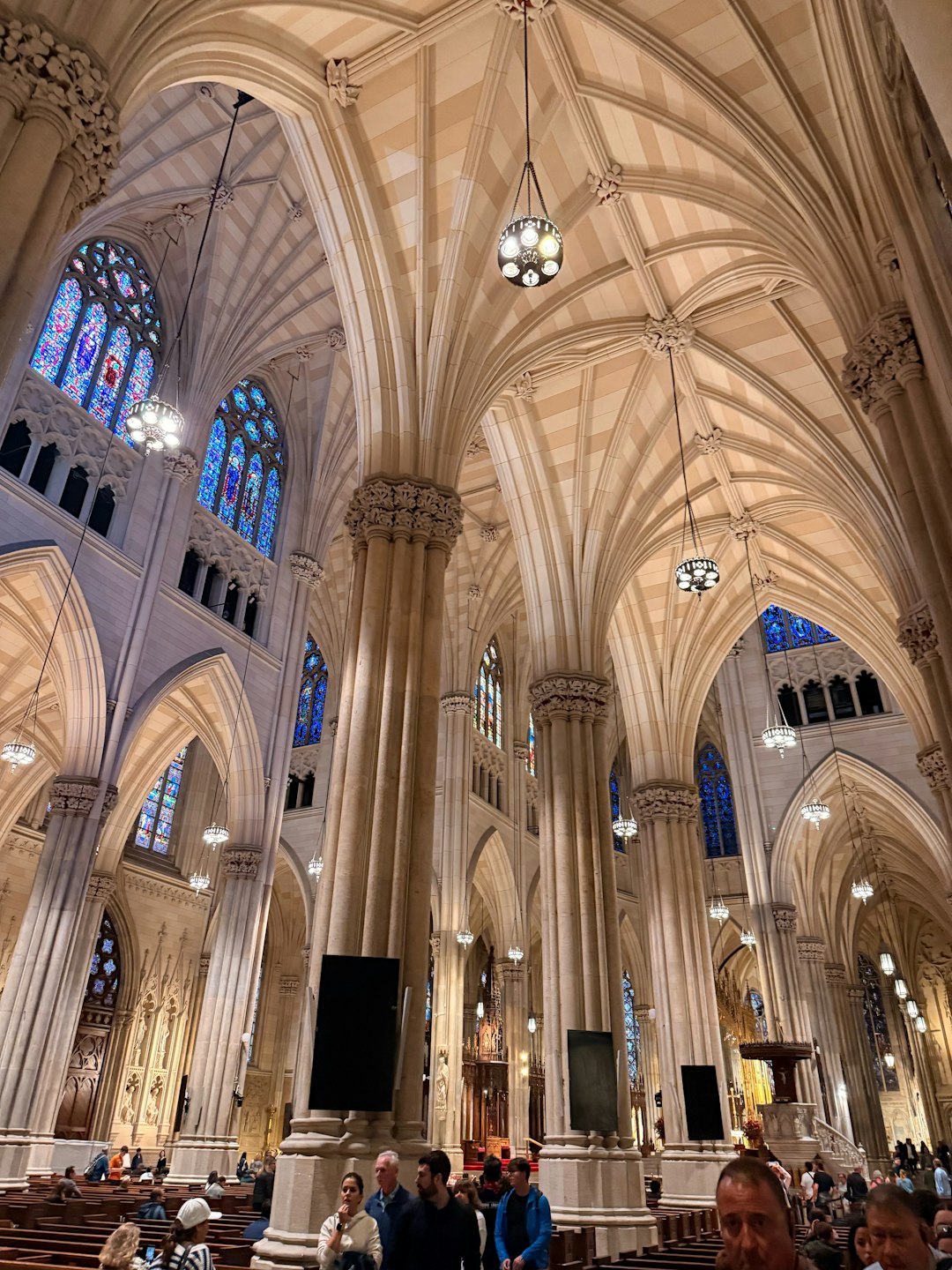
Whatever your reason for going, it helps to know what you’re actually looking at when you get inside.
Love New York? Get our free weekly newsletter — stories, tips, and hidden gems from across the city. Subscribe here.
The Basics: Location, Hours, and Entry
St. Patrick’s Cathedral stands on Fifth Avenue between 50th and 51st Streets in Midtown Manhattan, directly across from Rockefeller Centre. The entrance faces the avenue, so it is easy to find.
The cathedral is open daily, generally from 6:30 am to 8:45 pm. Mass is held multiple times each day. Entry is free. You do not need to be Catholic, or religious at all, to walk in and look around — visitors of every background are welcome, and thousands of non-worshippers visit each week.
If you plan to attend Mass, check the cathedral’s official schedule in advance, as times can vary on Sundays and holy days. During busy periods, such as Christmas and Easter, the cathedral fills quickly and seating is limited.
A Brief History
Construction on St. Patrick’s began in 1858, though the project was interrupted by the Civil War and did not resume in full until after the war ended. The cathedral was dedicated in 1879, with the spires completed in 1888. It was designed by James Renwick Jr. in the Gothic Revival style, drawing on the great medieval cathedrals of Europe.
At the time it was built, the location felt remote — the city had not yet grown this far north. Critics called it “Renwick’s folly.” Within a generation, Midtown had caught up with the building entirely, and it became the heart of Catholic New York.
St. Patrick’s serves as the seat of the Archdiocese of New York. It was designated a New York City landmark in 1966 and added to the National Register of Historic Places in 1976. A major restoration project, completed in 2015, cleaned the exterior stonework and repaired decades of wear, leaving the white marble façade looking much as it did when new.
The Scale of the Building
The cathedral is larger than it looks from the street. The nave runs 405 feet from the entrance to the apse. The building is 174 feet wide across the transepts. The twin spires rise 330 feet above Fifth Avenue.
The interior seats approximately 2,200 people, with standing room for more during major services. The high altar stands 57 feet tall, topped by a bronze baldachin — a canopy supported by four pillars. The baldachin was added in 1942 and was designed by the architectural firm of Maginnis and Walsh.
The nave ceiling rises to around 108 feet, giving the space its characteristic sense of height. First-time visitors often stop just inside the entrance to take this in before moving further.
The Stained Glass Windows
The cathedral contains over 70 stained glass windows. The great rose window above the main entrance is one of the most striking features in the building — it measures 26 feet in diameter and depicts the nine choirs of angels.
Many of the windows were designed and made in Europe, with significant contributions from craftsmen in Chartres, France, and Birmingham, England. The light changes throughout the day depending on the angle of the sun, and the windows look quite different in the morning compared to the afternoon.
The lower nave windows depict saints and scenes from Scripture. Take time to walk along the side aisles if you want to look at them properly — they are easy to miss if you stay in the central nave.
The Lady Chapel
Behind the main altar, at the far end of the cathedral, is the Lady Chapel — a smaller, quieter space dedicated to the Virgin Mary. It was added between 1901 and 1906 and is considered one of the finest examples of Gothic Revival architecture in the United States.
The chapel has its own set of stained glass windows, which are narrower and more intricate than those in the nave. Light filters through differently here, and the space tends to be considerably quieter than the main body of the cathedral, even when the rest of the building is busy with visitors.
If you want a few moments of genuine quiet inside the cathedral, this is the best place to find it.
Exploring New York City? Our free newsletter covers the places and stories that make this city worth loving. Join thousands of readers — subscribe free.
The Organ and Music
St. Patrick’s houses a large pipe organ with around 9,000 pipes. The instrument was built by the firm of Kilgen and Son and has been rebuilt and expanded over the decades. It is one of the most powerful pipe organs in the United States.
The cathedral has a strong choral tradition. Sunday Mass includes full choral music, and there are periodic concerts throughout the year — particularly in the weeks leading up to Christmas. These concerts are often free to attend, though seating fills early.
If you visit during a weekday when no service is in progress, the cathedral is generally quiet. But if a service is happening, you will hear the organ. It is worth pausing to listen for a few minutes even if you have somewhere else to be.
Funerals, Weddings, and Notable Services
St. Patrick’s has been the site of some of New York’s most significant public ceremonies. Funerals for Robert F. Kennedy, Babe Ruth, and Vince Lombardi were all held here. Cardinal John O’Connor presided here for more than 15 years. Pope John Paul II visited in 1979, and Pope Benedict XVI celebrated Mass here in 2008.
Weddings at the cathedral are reserved for registered parishioners. Despite the grandeur of the setting, the process is the same as at any Catholic parish — you need to be a member of the congregation and follow the Archdiocese’s requirements.
Practical Tips for Visiting
When to go: Weekday mornings, before noon, tend to be the quietest times. Weekend afternoons can be extremely crowded, particularly in summer. If you want to sit undisturbed for any length of time, aim for a Tuesday or Wednesday morning.
What to wear: There is no formal dress code for visitors, though the cathedral asks that people dress respectfully. Shorts and sleeveless tops are worn by visitors regularly and are not turned away, but if you plan to attend Mass, more conservative clothing is appropriate.
Photography: Photography is permitted in the cathedral, though flash photography and tripods are generally discouraged during services. Outside of service times, you can take photos freely. The interior is dimly lit in places, so a phone camera may struggle — a dedicated camera with good low-light performance will do better.
Candles and prayer: Votive candles are available near the side altars. There is a small suggested donation. The cathedral provides kneelers in the pews, and it is common for visitors to stop and sit quietly even if they are not there for religious reasons.
Accessibility: The cathedral is wheelchair accessible. There is a lift that provides access to the main nave. If you have specific accessibility needs, contact the cathedral in advance.
The Area Around the Cathedral
St. Patrick’s sits in the middle of one of the busiest stretches of Midtown. Rockefeller Centre is directly across Fifth Avenue. Saks Fifth Avenue is next door to the south. The neighbourhood is commercially dense and expensive, but the cathedral itself provides a genuine contrast — once you step inside, the city noise drops away significantly.
If you are combining the cathedral with other Midtown visits, it pairs naturally with a walk through Rockefeller Centre, a look at the Top of the Rock observation deck, or a stroll north towards Central Park. The cathedral is about a 15-minute walk from the park’s south entrance at 59th Street.
There is no dedicated car park at the cathedral. The nearest subway stations are 47th-50th Streets (B, D, F, M lines) and 51st Street (6 line), both within a two-minute walk.
Why People Keep Going Back
Some people attend St. Patrick’s every week. Others walk in once and never return. But a large number of people — regular visitors to New York, or long-term residents — find themselves going back not for any particular reason, but because the building does something that very few places in the city manage: it slows things down.
New York moves quickly. It is loud, dense, and relentless. The cathedral on Fifth Avenue is none of those things. You can sit in a pew for half an hour and nobody will ask you to leave or buy something. The light through the stained glass changes as the sun moves. The stone stays cool even in summer.
Whether you attend a service, light a candle, or simply sit and look up at the vaulted ceiling, there is something worth experiencing here that you will not find anywhere else on Fifth Avenue.
More New York to explore. Our free weekly newsletter is full of places like this — the ones worth making time for. Subscribe free today.
