
They arrived with little more than the clothes on their backs and a determination to survive. The first Chinese immigrants to settle in New York City in the 1850s and 1860s carved out a few streets in lower Manhattan and held on. They held on through prejudice, through exclusion laws, through decades of deliberate isolation. What grew from those few streets on Mott, Pell, and Doyers is today the oldest and largest Chinatown in the Western world — a neighbourhood that refused to disappear.
This is the story of how Chinese immigrants built New York’s most resilient community, and where you can still feel that history beneath your feet today.
If you love New York’s hidden stories, you’ll love our free weekly newsletter. Subscribe to Love New York →
From the Gold Rush to the Five Points
The first Chinese New Yorkers were not farmers or factory workers fleeing poverty. Many were men who had spent years building the transcontinental railroad across the American West — backbreaking, dangerous work that the United States government hired Chinese labourers to perform at wages that white workers refused to accept.
When the railroad was complete in 1869, tens of thousands of Chinese labourers were left without work on the West Coast. Anti-Chinese sentiment was intense in California, so many moved east. By the 1870s, a small but growing community had settled in New York City, specifically in the area around Five Points — the same dense, chaotic neighbourhood where Irish and Italian immigrants had already built their own communities.
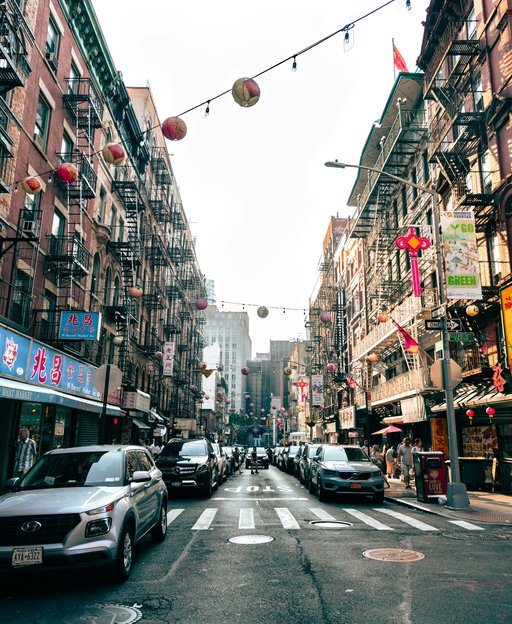
They settled on a few short streets in lower Manhattan. Mott Street became the spine of the community. Pell Street branched east. Doyers Street, with its sharp, unexpected bend, became infamous for another reason entirely.
The neighbourhood they built had to be self-contained by necessity. Chinese immigrants faced discrimination that made working outside their community nearly impossible. They ran laundries, restaurants, and small shops. They built fraternal organisations called tongs — mutual aid societies that provided loans, dispute resolution, and community support. For decades, these streets were the only New York that Chinese immigrants were permitted to inhabit.
The Exclusion Act and Its Consequences
In 1882, the United States Congress passed the Chinese Exclusion Act — the only law in American history to ban a specific nationality from immigrating to the United States. It was not repealed until 1943.
The consequences were profound. For sixty years, the population of Chinatown could not grow through fresh immigration. Families could not be reunited. Wives and children remained in China while husbands and fathers grew old in New York, unable to bring them over. The community became predominantly male — a “bachelor society” of men who sent money home and dreamed of returning but rarely did.
What kept the community alive was its institutions. The tongs evolved into more formal organisations. The Chinese Consolidated Benevolent Association, known as the CCBA, acted as an unofficial government for Chinatown — resolving disputes, communicating with city authorities, and maintaining order in the absence of any other formal representation.
Doyers Street, that short, curved lane connecting Pell Street to the Bowery, acquired a darker reputation during this period. The sharp bend — which locals called the “Bloody Angle” — made it impossible to see around the corner, and rival tong factions used it during the Tong Wars of the late 19th and early 20th centuries. Today, Doyers Street is better known for its barbershops and Vietnamese food — a reminder of how Chinatown has always absorbed new communities over time.
Want more stories like this? Our weekly newsletter goes deeper into New York’s heritage every week. It’s free. Subscribe here →
Mott Street: The Heart of the Community
Mott Street is Chinatown’s main artery, and it has been since the 1870s. Walking its length today means passing through a living archive of Chinese-American history.
The street is lined with restaurants, tea houses, and produce markets that have served the community for generations. At number 16, the Church of the Transfiguration has stood since 1801 — it served Irish immigrants first, then Italian immigrants, and has been a Chinese Catholic church since 1963. It is a building that holds the memory of nearly every wave of immigration to lower Manhattan within its walls.
Further along, the Museum of Chinese in America (MOCA) at 215 Centre Street is the institution dedicated to preserving the history and culture of Chinese Americans. It holds the most comprehensive archive of Chinese-American history in the world, with photographs, oral histories, and documents dating back to the 1850s.
The building at 7 Mott Street was once the headquarters of the Hip Sing Association, one of the major tongs. Today it is a souvenir shop. These addresses meant everything to the men who had no other civic representation in the city.
The 1965 Turning Point
In 1965, President Lyndon Johnson signed the Immigration and Nationality Act, which abolished the national-origins quota system that had effectively banned most non-European immigration since 1924. For New York’s Chinatown, the effect was transformative.
Within a decade, the neighbourhood’s population tripled. Families that had been separated for decades were finally reunited. A new wave of immigrants arrived — not just from Guangdong Province, which had historically supplied most Chinese Americans, but from Hong Kong, Taiwan, and eventually mainland China and Fujian Province.
The neighbourhood expanded rapidly. It spread east past Bowery into what had been the Lower East Side, where Jewish immigrants had built their own remarkable community in the decades before. It expanded west, gradually absorbing what had been the Little Italy that Italian immigrants had constructed from the 1880s onward. Today, the boundary between Chinatown and Little Italy has effectively dissolved.
New restaurants, bakeries, fishmongers, and garment factories opened. The streets filled with the sounds of Cantonese, then Mandarin, then Fujianese. Each wave brought its own customs, its own food, its own community organisations.
Nom Wah Tea Parlor: A Century of Dim Sum
If there is one building in Chinatown that holds the community’s story in its walls, it is 13 Doyers Street.
Nom Wah Tea Parlor opened in 1920 as a bakery. It became a tea parlour, then began serving dim sum — and never stopped. It is the oldest dim sum restaurant in New York City, and possibly in the United States.
For decades, Nom Wah was the gathering place for Chinatown’s residents. Workers came before their shifts. Families came on weekends. Men who had spent forty years in New York without being able to bring their families over came to share a pot of tea with the only family they had — the community around them.
The restaurant was revived by Wilson Tang, the original owner’s great-nephew, in 2010. He kept the original booths, the original menu, and the original atmosphere. The walls are the same red and white they have always been. To eat dim sum at Nom Wah is to eat in a room where a century of Chinese-American life has passed.
Where to Visit Chinatown Today
Chinatown is a living neighbourhood, which means it requires a different kind of attention from a heritage visitor.
Museum of Chinese in America (MOCA) at 215 Centre Street is the essential starting point. The permanent exhibition traces the story from the mid-19th century to the present. Admission is $12 for adults, free on Fridays from 6–9pm. Open Thursday to Monday.
Mahayana Buddhist Temple at 133 Canal Street is open daily and free to enter. It houses one of the largest golden Buddhas in New York City and is an active place of worship. Visitors are welcome but should be respectful of services.
Columbus Park, at the western edge of Chinatown, sits on the site of the original Five Points neighbourhood where Chinese immigrants first arrived. In the park’s early mornings, elderly residents practise tai chi and play Chinese chess. This is the same ground where, as Five Points’ Irish community built their first New York, Chinese immigrants were putting down roots that would prove permanent.
Doyers Street is one of the shortest streets in Manhattan — barely a hundred metres from end to end — but it deserves a slow walk. The curve that earned it its notorious nickname now shelters barbershops and small restaurants. The buildings that once housed tong headquarters now sell phone cases and dried goods.
First Chinese Presbyterian Church at 61 Henry Street, founded in 1888, is one of the oldest Chinese-American institutions in New York. The building still stands.
Planning Your Chinatown Heritage Visit
Best time to visit: Weekday mornings, when the neighbourhood is less crowded and the produce markets are in full swing. Chinese New Year (late January or early February) brings spectacular celebrations but also enormous crowds.
Getting there: Take the N, Q, R, W, J, Z, or 6 train to Canal Street. Walk south on Centre Street or Bowery to enter the neighbourhood.
Time needed: A proper heritage walk, including a visit to MOCA and a dim sum meal, takes around three to four hours.
Practical note: Many restaurants in Chinatown are cash-only. Bring cash.
Frequently Asked Questions
When did Chinese immigrants first settle in New York City?
The first significant Chinese community in New York City formed in the 1870s, when labourers who had worked on the transcontinental railroad moved east after its completion in 1869. By the 1880s, Chinatown’s core streets — Mott, Pell, and Doyers — were firmly established.
What was the Chinese Exclusion Act and how did it affect Chinatown?
The Chinese Exclusion Act of 1882 banned Chinese labourers from immigrating to the United States and prevented Chinese immigrants already here from becoming citizens. It was not repealed until 1943. For sixty years, it prevented Chinatown from growing through new immigration and separated thousands of families.
Where is the best place to learn about Chinese-American history in New York?
The Museum of Chinese in America (MOCA) at 215 Centre Street is the most comprehensive resource, with archives, photographs, and oral histories dating back to the 1850s. It is open Thursday to Monday, with free admission on Friday evenings from 6–9pm.
What is the oldest restaurant in New York’s Chinatown?
Nom Wah Tea Parlor at 13 Doyers Street, established in 1920, is the oldest dim sum restaurant in New York City. It still operates from its original location on Doyers Street, with its original booths and menu largely intact.
How big is New York City’s Chinatown today?
New York City’s Chinatown in lower Manhattan is the largest Chinatown in the Western Hemisphere, with an estimated 90,000 to 100,000 residents. It has expanded significantly since the 1965 Immigration and Nationality Act, absorbing parts of the former Lower East Side and Little Italy.
Ready to explore the New York your ancestors knew? Subscribe to Love New York — free weekly stories, heritage guides, and hidden history. Join us →
