
Most people arrive in New York with a clear picture in their head. They’ve seen the photos, scrolled through the Instagram posts, maybe watched a hundred films set against the skyline. Then they stand directly beneath one of those famous landmarks and realise the picture they had was completely wrong.
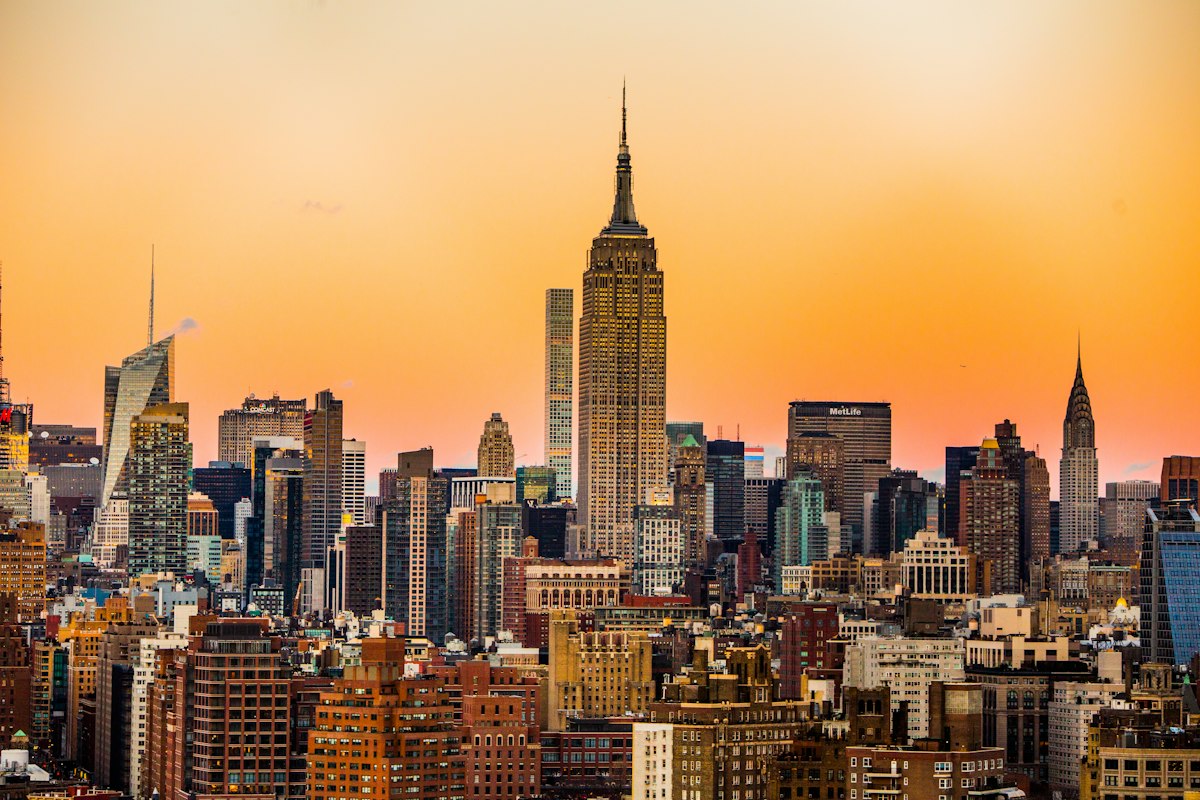
That gap between the postcard version and the real thing is one of the best parts of visiting New York. Some landmarks shrink. Some grow. Some reveal details you never knew existed. Here are the ones that surprise visitors the most — and what to look for when you’re standing right there.
Want more honest guides to New York City? Subscribe to our free newsletter for tips, stories and local insights delivered straight to your inbox.
The Brooklyn Bridge
From across the East River, the Brooklyn Bridge looks elegant and proportional. Walk onto the pedestrian walkway and start moving towards the centre, and something shifts. The two Gothic stone towers rise to nearly 85 metres — about the height of a 25-storey building. When you’re directly beneath one, you stop thinking about the skyline and start staring straight up at the arch above your head.
The cables fan out from the towers in a way that photographs flatten completely. Standing between the two towers, you’re surrounded by hundreds of steel wires converging overhead. The geometry is striking in a way that no aerial shot captures. This is also where you get one of the few places on the bridge where Manhattan and Brooklyn are equally in view — look south-west for the Financial District, north-east towards DUMBO.
One practical note: the walkway is shared with cyclists. Stay on the pedestrian side (marked clearly) and avoid stopping mid-lane for photos. Early morning — before 8am — is the quietest time.
The Flatiron Building
In photographs, the Flatiron Building always appears in three-quarter view, showing its triangular shape. That shot is taken from a distance because it’s the only way to get the whole building in frame. Walk to the sharp northern tip at Broadway and Fifth Avenue and the building almost disappears. The famous wedge narrows to roughly 1.8 metres wide at its point — barely wider than a doorway.
Look up from that corner and the terracotta facade becomes the focus. The Flatiron was built in 1902 and the detailing at street level is extraordinarily fine — limestone and glazed terracotta covering a steel skeleton. Most visitors photograph it from Madison Square Park across the road and never walk up to touch the stone. The building is currently undergoing conversion to residential use, but the exterior remains.
For the best straight-on view of the narrow tip, stand on the pavement at the corner of Broadway and 22nd Street and look north. The facade towers above you at about 87 metres.
One World Trade Center
The tallest building in the Western Hemisphere at 541 metres looks imposing from across New York Harbour. Stand at its base in Lower Manhattan and the experience changes entirely. The building tapers as it rises — its square base rotates into a perfect octagon at the centre and then tapers back — but you cannot see any of that from the ground. What you see is a wall of glass rising so steeply overhead that the building seems to tilt towards you.
The plaza around the base is worth spending time in. The Reflecting Pools mark the exact footprint of the Twin Towers. Each pool measures about 4,000 square metres, with water falling about nine metres into a central void. When you stand at the edge of one of the pools, the scale of what was there before — and what was lost — becomes very immediate. The names of nearly 3,000 people are inscribed around the perimeter.
The observation deck (One World Observatory) is on floors 100 to 102. Tickets should be booked in advance, especially during summer and school holidays.
Planning a trip to New York? Join our newsletter for practical guides, neighbourhood breakdowns, and the things worth knowing before you go.
Grand Central Terminal
From outside on 42nd Street, Grand Central is impressive but partially obscured by the Pershing Square Viaduct. Step through the main entrance on the south side and walk into the Main Concourse and the ceiling stops you. It’s 38 metres high — about 12 storeys — painted in a deep blue-green with the constellations of the Mediterranean sky picked out in gold. The figures are painted backwards relative to how we typically show them, because they represent the sky as seen from outside the celestial sphere looking in.
The ceiling was cleaned and restored in the 1990s after decades of grime — largely from tobacco smoke — had turned the original blue-green almost black. The restored version is far closer to what opened in 1913.
Two things worth knowing: the famous information booth with the four-sided opal clock in the centre of the concourse is real opal, not glass, and estimated to be worth between $10 million and $20 million. Also, the lower-level food hall is one of the better lunch spots in Midtown, with less of a tourist premium than the restaurants above.
The Chrysler Building
The Chrysler Building is one of the most photographed buildings in New York from a distance. Its stainless steel crown, the Art Deco sunbursts, the eagles at the corners — these are all visible in any skyline shot. What photographs do not convey is the detail on the ground floor, or what happens when you look up from directly below the crown.
At street level on Lexington Avenue, the lobby entrance is one of the finest Art Deco interiors in the world. The walls are African marble and onyx. The ceiling mural — painted by Edward Trumbull in 1930 — shows the building itself, along with aeroplanes, workers, and transport infrastructure of the era. Entry to the lobby is free and is open to the public during business hours.
The eagle gargoyles at the 61st floor are modelled after the radiator cap ornament of a 1929 Chrysler Plymouth. They project out from the corners — each one is about 4 metres long. You cannot see them clearly from the street, but from a window in a nearby building at the right height, they are extraordinary. The best public viewing point is from the observation deck of the Empire State Building to the south-west.
The Statue of Liberty
Every photograph of the Statue of Liberty is taken from a distance — from the ferry, from Brooklyn, from the southern tip of Manhattan. The statue appears green, serene, medium-sized. Stand on Liberty Island directly beneath the pedestal and look up, and the figure above becomes enormous. The torch alone is 8 metres long. The face is over 4 metres wide. The full height from ground to torch tip is 93 metres.
Access to the crown requires tickets booked months in advance, but the pedestal and grounds are accessible with standard ferry tickets. From the pedestal observation deck, you’re level with the base of the statue itself — the views of New York Harbour from this height are among the best in the city.
The patina — the green colour — comes from copper oxidation. When the statue was unveiled in 1886 it was bright copper-brown, similar to a new penny. The colour change to its current blue-green took about 20 years.
The High Line
The High Line is typically seen from above — visitors walk the elevated park built on former freight railway tracks, looking out over the Hudson and into the streets of Chelsea and the Meatpacking District. Most people do not think to look at the High Line from below.
Stand on 10th Avenue beneath the structure and look up at the steel underside of the elevated railway. The original freight rail infrastructure is still largely intact — exposed riveted beams, the original structural columns, the heavy industrial steel of a 1930s working railway. The contrast between the manicured park above and the raw industrial infrastructure below is stark. Walking under the High Line on the streets of Chelsea gives you a completely different understanding of what was built and why it was worth saving.
The High Line runs from Gansevoort Street in the Meatpacking District north to 34th Street near Hudson Yards. Access points with lifts (elevators) are at Gansevoort, 14th Street, 23rd Street, and 30th Street.
The New York Public Library Main Branch
The two marble lions outside the New York Public Library on Fifth Avenue and 42nd Street are famous. What visitors rarely anticipate is the scale of the building’s interior once they climb the steps and go inside. The Rose Main Reading Room on the third floor is 90 metres long, 23 metres wide, and about 15 metres high — roughly the length of a city block. It seats about 640 people and its painted ceiling shows clouds over a warm sky.
The building opened in 1911. Entry is free. The reading room is open to the public and you can sit at the tables. There is no requirement to be a New York resident or have a library card to use the room. The decorative detail throughout — the carved marble, the brass fittings, the oak panelling — repays slow looking.
The lions are named Patience and Fortitude — the names given by Mayor Fiorello La Guardia during the Great Depression as a reminder of the qualities New Yorkers would need to get through hard times. Most visitors do not know the names. Now you do.
How to Make the Most of These Visits
The common thread across all these landmarks is that the postcard version is taken from the ideal distance with the ideal lens. Up close, the scale shifts, the details emerge, and the experience becomes physical rather than visual. A few practical points for getting the most out of each visit:
- Go early. The Brooklyn Bridge walkway, Grand Central, and the Statue of Liberty all experience heavy foot traffic from mid-morning onwards. Before 9am, most of these places are significantly quieter.
- Look up. The habit of most tourists is to photograph straight ahead. The detail at the Chrysler Building, the scale of One World Trade Center, the ceiling at Grand Central — these all require looking up and taking a moment to adjust.
- Book ahead. The Statue of Liberty crown and One World Observatory require advance tickets, especially during peak season (June to September and school holidays).
- Free entries matter. Grand Central Terminal, the Brooklyn Bridge walkway, the High Line, and the NYPL Main Branch are all free. These are not lesser experiences — they are some of the best things New York offers.
New York rewards people who slow down enough to actually look at what they’re standing next to. The city’s landmarks are famous for a reason — but the reason usually becomes clear only when you’re close enough to see the details in the stone.
Like this guide? Subscribe to our free New York newsletter — practical guides, seasonal tips, and hidden details about one of the world’s great cities, straight to your inbox.
