
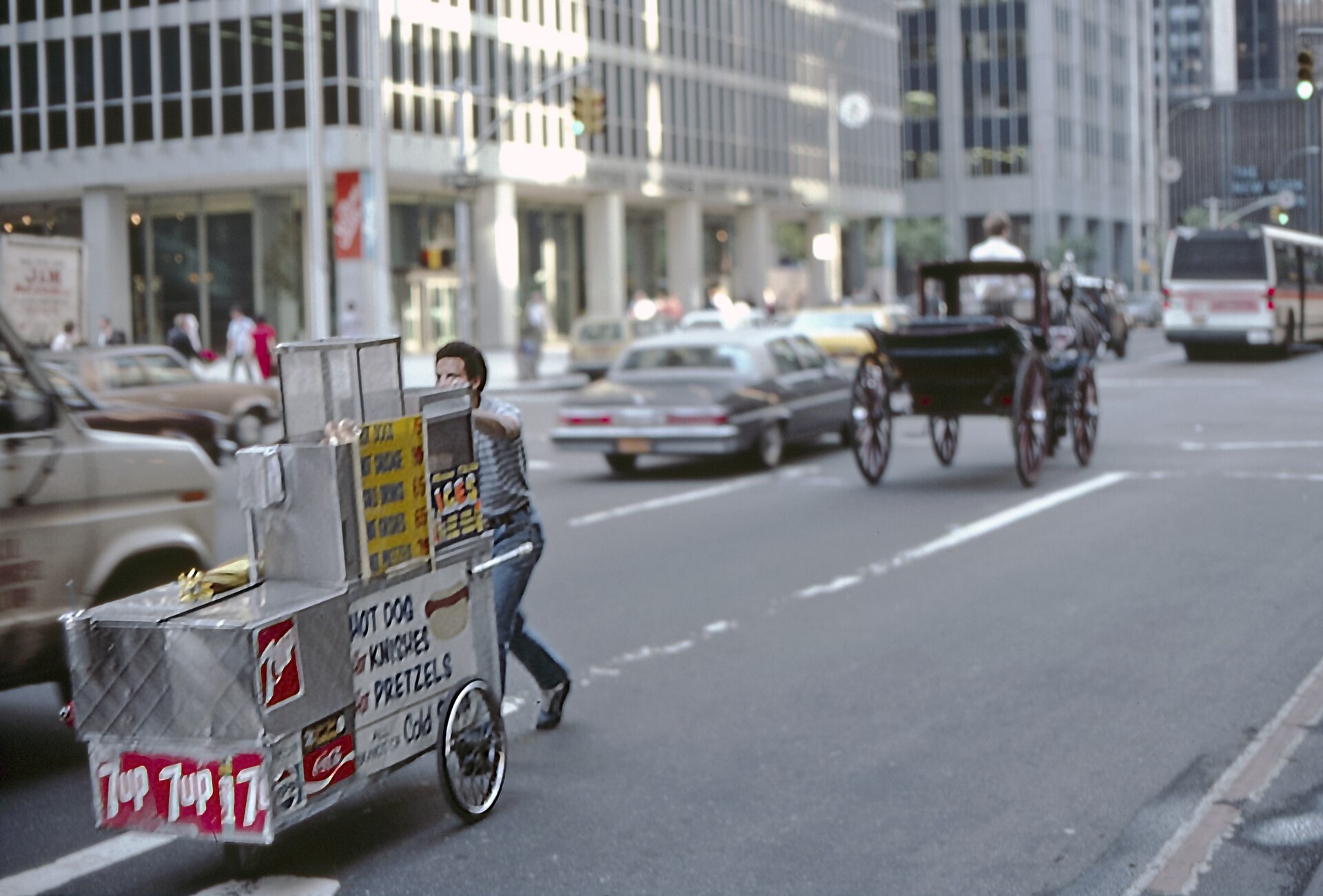
New York City does not make you search for food. It brings food to you. On almost every busy block in Manhattan, and across plenty of streets in Brooklyn, Queens, the Bronx, and Staten Island, you will find a cart, a stall, or a trolley selling something worth stopping for. Street food here is not a novelty or a trend. It is part of how the city eats, how it has always eaten, and how millions of people get through the working day.
The range on offer can feel overwhelming if you arrive without a plan. This guide cuts through the noise and points you at the carts and stalls that are genuinely worth your time, your appetite, and a bit of queue-standing.
Love New York? Get honest travel tips, neighbourhood guides, and local recommendations straight to your inbox. Subscribe to our free newsletter and never miss a thing.
The Halal Cart Phenomenon
If you have spent any time around Midtown Manhattan, you will have noticed the distinctive yellow-and-red carts with long queues stretching down the pavement. These are halal carts, and the most famous of them all is the one operated by The Halal Guys, which started as a single cart on the corner of 53rd Street and 6th Avenue in 1990.
The menu is simple: chicken, gyro meat (lamb and beef), or a combination of both, served over rice or in a wrap, with salad and a choice of sauces. The white sauce, made from yoghurt, mayonnaise, and various seasonings, is the one people come back for. The red sauce brings the heat. A plate typically costs around $9 to $12, which is exceptional value for central Manhattan.
The original 53rd and 6th cart still operates today, and the queue at lunch can stretch for 20 to 30 minutes. If you are short on time, other halal carts around the city offer a nearly identical product. Look for the carts with the aluminium steam trays and the hand-written signs listing chicken over rice. The combination plate with both sauces is the standard order and the correct one.
These carts typically operate from around 10am until the early hours of the morning. The late-night crowds after clubs and bars close have been part of the halal cart tradition since the beginning.
The Classic New York Hot Dog
The hot dog cart is the most recognisable street food fixture in New York. The blue-and-yellow Sabrett umbrella has been a city landmark for decades. Sabrett frankfurters are the standard product: a natural-casing beef dog that snaps when you bite into it, served in a soft steamed bun.
The standard dressing involves yellow mustard and sauerkraut, or the Sabrett onion sauce, which is a sweet and tangy tomato-based condiment with sliced onions. You will find ketchup available, though long-time New Yorkers tend to regard it as optional at best.
Hot dog carts are found throughout the city, but a few locations stand out. The carts near Central Park, particularly on the paths near the 72nd Street entrance on the west side, sell huge numbers on weekends. The carts near Times Square operate almost continuously. Prices run from around $2 to $4 depending on location, making a hot dog one of the cheapest proper meals you can get in the city.
The cart outside the Metropolitan Museum of Art on Fifth Avenue is another reliable option, particularly if you are planning a long museum visit and want something quick before or after.
Pretzels: The Other Staple
The salted soft pretzel is sold from carts and small heated trolleys across the city. It does not have the same cultural mythology as the hot dog or the halal cart, but it is genuinely useful: a filling, portable snack that costs around $2 to $3 and requires no cutlery.
The best pretzels are warm, with a glossy brown exterior and a soft, chewy interior. They are covered in coarse salt and served as-is or with mustard. You will find pretzel vendors near major attractions, transport hubs, and parks. Penn Station, Grand Central Terminal, and the areas around Madison Square Garden consistently have them.
Quality varies quite a bit between vendors, and the ones with the highest turnover tend to have the freshest stock. A pretzel that has been sitting under a heat lamp for two hours is noticeably drier than one that came out recently. If you can see the cart is busy, the pretzels are likely fresh.
Chinatown and the Outer Boroughs
Lower Manhattan’s Chinatown has its own street food culture that operates differently from the Midtown cart scene. Around Canal Street and Mott Street, you will find vendors selling steamed bao (filled buns), fried sesame balls, and scallion pancakes from small folding tables and portable steamer units.
The sesame balls, called jian dui, are made from glutinous rice flour and filled with red bean or lotus paste. They cost around $1 to $2 each. The scallion pancakes are flat, layered, and fried to order. Both are worth eating and both are genuinely hard to find outside this neighbourhood.
In Flushing, Queens, which has one of the largest Chinese communities in the United States, the Flushing Mall’s basement food court and the New World Mall Food Court function as indoor street food markets. Vendors sell Xi’an-style hand-pulled noodles, Sichuan skewers, Taiwanese beef noodle soup, and dozens of other regional Chinese dishes at low prices. The 7 train from Times Square gets you there in about 30 minutes.
Enjoying this guide? We publish regular features on eating, exploring, and making the most of New York. Subscribe to our newsletter for free and get the next one delivered straight to you.
The Knish and Jewish Deli Traditions
The knish is a baked or fried pastry filled with mashed potato, meat, kasha (buckwheat), or cheese. It arrived in New York with Eastern European Jewish immigrants in the late 19th and early 20th centuries and became a staple street food in the Lower East Side and other Jewish neighbourhoods.
Yonah Schimmel Knish Bakery on East Houston Street has been operating since 1910 and is the best-known surviving knish specialist in the city. It is a small, no-frills shop that sells knishes in a range of flavours including potato, mushroom, spinach, and sweet potato. The round knish, baked rather than fried, is the classic form. Prices are around $4 to $6 per knish.
Knishes are also sold from street carts in some parts of the city, particularly in areas with older Jewish communities. You are more likely to find them in the Lower East Side and parts of Brooklyn than in Midtown. They are substantial enough to serve as a meal on their own.
Elote and Mexican Street Food
Mexican street food vendors have become a significant part of the city’s cart scene, particularly in outer borough neighbourhoods with large Latin American communities. The standout product is elote: corn on the cob slathered in mayonnaise, cotija cheese, chilli powder, and lime juice. The version served in cups (esquites) is easier to eat while walking.
These vendors tend to cluster around subway stations, parks, and busy pedestrian areas in the Bronx, Brooklyn, and Queens. Jackson Heights in Queens, which has a large Latin American population, is a reliable area to find them. Prices are usually $4 to $6.
Churros are also widely sold from carts in the outer boroughs: fried dough pastry dusted in cinnamon sugar, often served with a small pot of chocolate dipping sauce. They are particularly common near parks on weekends.
Practical Tips for Eating Well at Carts
A few things make the difference between a good street food experience in New York and a mediocre one.
Go at peak times. The busiest carts have the freshest food. A cart with a queue is almost always a better choice than a cart with nobody at it. Lunch from 12pm to 2pm is when the midday Midtown carts are at their best. The late-night halal cart crowd from around 11pm onwards is a different but equally reliable indicator of quality.
Have cash. Many carts do not take cards, or their card readers are unreliable. Carrying small bills makes the transaction faster and avoids any issues. An ATM withdrawal of $20 before a street food session is sensible preparation.
Check the licence. New York City requires street vendors to hold a food vendor permit. Licensed carts display a permit card. This does not guarantee outstanding food, but it does mean the cart has been through basic regulatory checks. Most established carts are licensed; some pop-up vendors are not.
Venture into the outer boroughs. The best and most interesting street food in the city is not in Midtown. Flushing, Jackson Heights, Sunset Park in Brooklyn, and Arthur Avenue in the Bronx all have street food cultures that are richer and more varied than what you will find around Times Square. The subway gets you to all of them.
Eat something unfamiliar. The halal cart and the hot dog are safe choices, but the city’s street food scene reflects its extraordinary range of communities. If you see something you do not recognise and cannot immediately identify, asking the vendor what it is will almost always produce a helpful answer. New York street vendors are experienced at explaining their food to people who have never tried it.
Where to Start
If you are visiting New York for the first time and want to work through the street food basics in a logical order, a single afternoon can cover a lot of ground. Start with a pretzel at Grand Central Terminal. Take the subway to Midtown and join the queue at a halal cart for lunch. Walk through the Park and stop for a hot dog if you are still hungry. End the day with a trip down to the Lower East Side for a knish at Yonah Schimmel.
That itinerary costs under $20 in total, takes you through several distinct neighbourhoods, and gives you a grounding in what New York street food is actually about. From there, the outer boroughs and their specialities are ready when you are.
New York street food rewards curiosity and penalises caution. The queue is always for a reason. Follow it.
Planning a trip to New York? Our newsletter covers the neighbourhoods, the food, the transport, and the things that guidebooks tend to miss. Sign up free here and get it straight to your inbox.
