
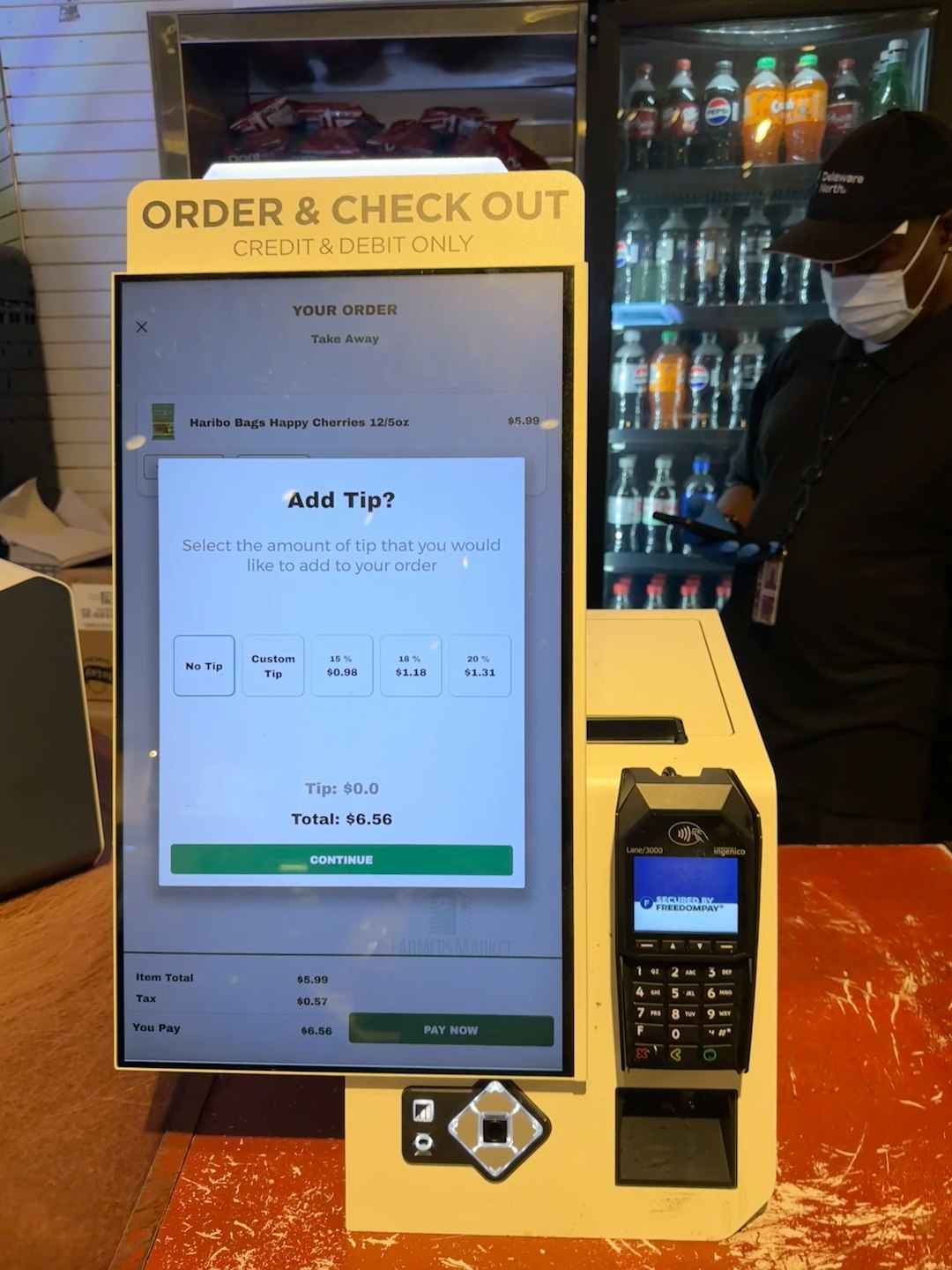
Walk into a New York coffee shop and the card reader will often spin around to face you, offering preset buttons for 18%, 20%, and 25% before you have taken your first sip. That small screen captures the anxiety and the ritual of American tipping better than any guidebook — a custom that is technically voluntary yet socially expected, and one that can feel baffling to visitors from countries where the price on the menu is the price you pay. This is Guide № 005 in The Love New York Guide series.
Get the Full Collectible Guide (Free PDF)
Tipping Culture — in a beautifully designed, printable booklet. The Love New York Guide № 005.
Why Tipping Runs So Deep in New York
Tipping in the United States grew out of the years after the Civil War, when American travelers picked up the practice in Europe and restaurant and railroad employers used it to avoid paying wages, most notoriously to formerly enslaved workers hired as porters and waiters. What began as an imported affectation became structural: employers leaned on customer gratuities instead of payroll. Over the twentieth century tipping spread from fine dining into nearly every service transaction, and today it is woven into how service workers in New York actually get paid.
The practical engine behind it is the “tipped minimum wage.” Federal law allows employers to pay tipped workers a lower base wage as long as tips make up the difference. New York State has moved further than most: as of the end of 2024 the state eliminated the separate lower cash wage for most tipped service employees outside of hospitality, and in New York City tipped food-service workers are entitled to a cash wage with a tip credit on top. Because base pay for many servers and bartenders still assumes tips, leaving nothing genuinely cuts into a worker’s income rather than simply denying a bonus.
The Going Rates, Sit-Down and Beyond
For sit-down restaurant meals, the widely accepted range in New York is 18% to 20% of the pre-tax total, with 20% now treated by many diners as the ordinary baseline rather than the generous end. A time-honored local shortcut is to double the city sales tax, which is 8.875%, giving you roughly 17.75% — a quick floor you can round up from. Bartenders are customarily tipped one to two dollars per drink, or 20% on a tab.
Beyond the table, the customs multiply. Taxi and ride-hail drivers typically receive 15% to 20%. Hotel housekeeping is commonly left two to five dollars per night, ideally daily since the person cleaning your room may change. A bellhop who carries bags is usually given one to two dollars per bag, and a doorman who hails you a cab a dollar or two. Food-delivery couriers are generally tipped around 15% to 20%, or a few dollars minimum, and more in bad weather.
The Screen That Asks: Counter Service and “Tip Creep”
The tablet turned toward you at the coffee counter is the flashpoint of a genuine shift Americans have nicknamed “tip creep” or “tipflation” — the spread of tip prompts into places that never used to ask, from takeout windows to self-checkout kiosks. These screens frequently suggest 20%, 25%, or higher, and they do so before service has even happened. There is no social obligation to tip at the same rate for handing-over-a-muffin as for a served meal; leaving nothing or a small amount at a pure counter transaction is entirely acceptable, and the “No Tip” button is there for a reason.
Where Tipping Is Already Included — or Genuinely Optional
Read the bottom of the menu. Many New York restaurants add an automatic gratuity — often 18% to 20% — to large parties, and the receipt will say so; tipping again on top is a choice, not a duty. A smaller number of places have adopted “hospitality included” or service-charge pricing, where a stated fee replaces the expected tip. New York law requires that any mandatory charge described as a tip or gratuity actually go to service staff, but an “administrative” or “service” charge is not automatically a tip, so if you are unsure whether the staff receives it, it is fair to ask.
Some services are genuinely no-tip zones. You do not tip at fast-food registers, at the counter of a government office, at a doctor’s office, or the barista-free vending machine. And you never tip the owner of a business in the traditional model — though that etiquette rule has softened as more owners work their own counters.
Myths Worth Retiring
Myth: Tipping is calculated on the total with tax. The customary base is the pre-tax subtotal. Tipping on the after-tax figure is common and harmless, but no one is obligated to tip on the sales tax itself.
Myth: A service charge is the same as a tip. Not necessarily. A mandatory gratuity labeled as such must legally reach service staff in New York, but a generic “service” or “administrative” charge may be kept by the house. When in doubt, ask whether staff receive it before deciding what to leave.
Myth: Servers earn a normal wage, so tips are just extra. Base pay for many tipped workers is set with the expectation that tips fill it out. Your gratuity is often a real part of their income, not a bonus on top of a full paycheck.
Frequently Asked Questions
Is tipping actually mandatory in New York?
Legally, no — a voluntary tip is never required. But for served meals, taxis, and similar personal services it is a strong social expectation, and because many workers’ pay is structured around it, leaving little or nothing at a full-service restaurant reads as a pointed statement rather than a neutral choice.
Do I need to tip if a gratuity is already added?
No. If your receipt shows an automatic gratuity — common for large parties — that satisfies the tip. Anything extra is optional and only warranted if the service genuinely went above and beyond. Always check the bill before adding a second tip so you do not pay twice by accident.
How should I handle the tablet asking for 25% at a coffee counter?
Treat it as a suggestion, not a rule. For a quick counter transaction with no table service, a small tip or none at all is perfectly acceptable, and every prompt includes a way to decline. Save the 20%-and-up range for sit-down meals and services where someone is looking after you throughout.
More The Love New York Guides
The Love New York Guide is a numbered series — one tightly focused subject at a time, each with its own downloadable collectible edition. Guide № 001 is The New York Bagel, Guide № 002 is The Fourth of July in New York, Guide № 003 is The Statue of Liberty, Guide № 004 is Subway Etiquette, This is Guide № 005. More editions are on the way.
🗽 Join 1,100+ New York Lovers
Every week, get hidden stories, local secrets, and travel inspiration from people who live and love it.
Subscribe free — enter your email:
