
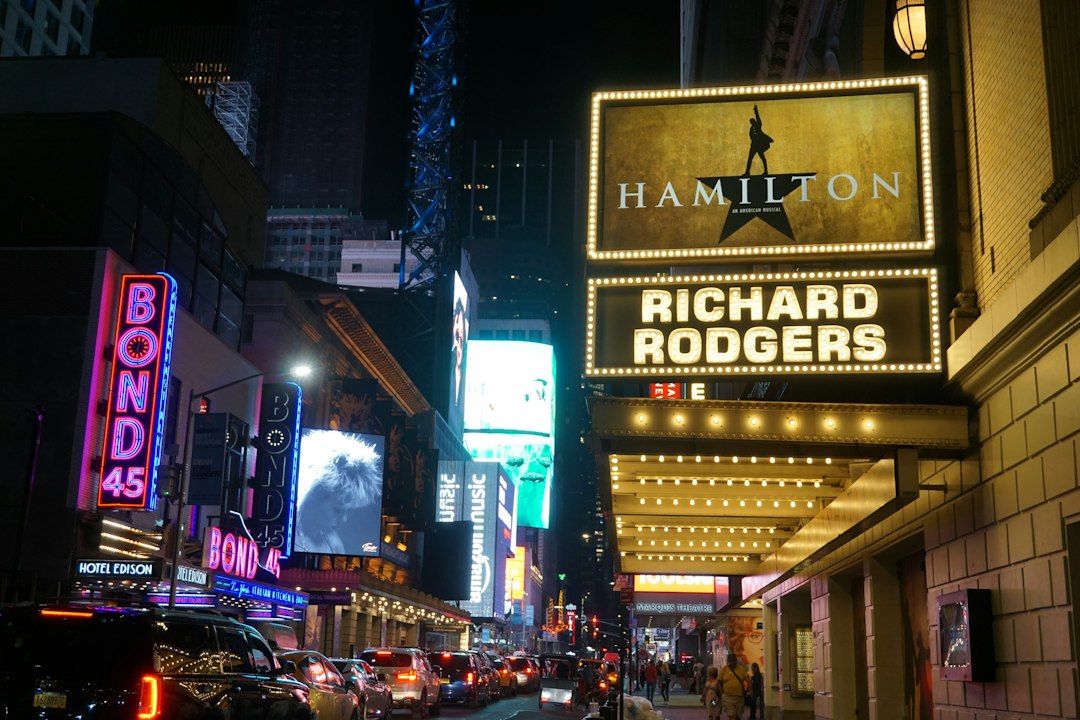
Walk into any dark Broadway house between performances and you will find one bare bulb burning at center stage. It is called the ghost light, and every theater keeps one lit when the building is empty — partly so nobody tumbles into the orchestra pit in the dark, and partly out of a superstition that a stage should never be left in total blackness. That small ritual tells you most of what you need to know about Broadway: it runs on a mix of hard logistics and stubborn tradition. This is Guide № 006 in The Love New York Guide series.
Get the Full Collectible Guide (Free PDF)
Broadway Theater Tradition — in a beautifully designed, printable booklet. The Love New York Guide № 006.
What “Broadway” Actually Means
The word describes a category, not an address. According to The Broadway League, a Broadway theater is a professional house in the Theater District with 500 or more seats, and there are currently 41 of them. The confusing part is that most of them are not on Broadway the street at all — they sit on the cross streets between roughly 41st and 54th, west of Sixth Avenue toward Eighth, clustered around Times Square. Houses with 100 to 499 seats are classed as Off-Broadway, and anything under 100 seats is Off-Off-Broadway.
Ownership is concentrated in a handful of hands. The Shubert Organization and the Nederlander Organization together control a large share of the theaters, with Disney Theatrical operating the New Amsterdam among others. When people say a show “moved houses,” it usually means a landlord needed the stage back for an incoming production.
How a Show Runs, Eight Times a Week
The standard Broadway schedule is eight performances across six days, with Monday almost always dark so casts and crews can rest. Evening curtains have crept earlier over the years — the traditional 8:00 p.m. start is now often 7:00 p.m. — while matinees typically land on Wednesday, Saturday, and Sunday afternoons. Every ticketed seat comes with a free program from Playbill, whose yellow-topped title page has been the industry standard since the late 1800s.
Behind that regularity is a heavily unionized workforce. Performers belong to Actors’ Equity Association, which sets the rules for understudies, standbys, and swings — the people who go on when a principal is out. Equity also keeps one of Broadway’s warmest customs alive: the Legacy Robe (long known as the Gypsy Robe), a decorated garment passed on opening night to the chorus member with the most Broadway credits, who then races it around the stage for luck.
The Tony Awards
Broadway’s top honor is the Antoinette Perry Award, universally called the Tony, first handed out in 1947 and named for the actress, director, and producer known to friends as “Tony.” The awards are presented jointly by The Broadway League and The American Theatre Wing, and eligibility hinges on that same 500-seat definition — only shows that open in one of the official Broadway houses within the season’s cutoff can compete. That single rule is why a celebrated production can run for years Off-Broadway and never be Tony-eligible until it transfers uptown.
Getting In Without Overpaying
Full-price Broadway tickets are expensive, but several legitimate routes cut the cost. The best known is the TDF-run TKTS booth under the red steps in Duffy Square, which sells same-day seats to a rotating list of shows at discounts that commonly reach 20 to 50 percent. Many productions also run digital lotteries and in-person “rush” tickets — a limited number of low-priced seats released the morning of the show — though the specific policy varies by production. For official show information and on-sale dates across the industry, the League also maintains the consumer site Broadway.org.
The Traditions Around the Theaters
Broadway’s culture spills onto the surrounding blocks. Sardi’s on West 44th Street has hung caricatures of stage celebrities on its walls since the 1920s and remains a classic post-curtain spot. A short walk away, The Drama Book Shop — a century-old store now co-owned by a group that includes Lin-Manuel Miranda — stocks scripts and theater books for actors and fans alike. The whole district is looked after by the Times Square Alliance, which is why the sidewalks stay walkable even on a packed two-show Saturday.
Superstition runs deep here too. Performers say “break a leg” rather than “good luck,” refuse to whistle backstage, and never speak the name of Shakespeare’s Scottish tragedy inside a theater, calling it “the Scottish play” instead. The artist Al Hirschfeld, whose line drawings of Broadway stars ran in newspapers for decades, hid his daughter’s name “NINA” in nearly every picture — a game the Al Hirschfeld Foundation still celebrates today.
Myths Worth Retiring
Myth: Broadway shows are on Broadway. Only a few theaters actually front the avenue. The great majority sit on the numbered side streets around Times Square, and the name refers to the professional 500-plus-seat category, not the street.
Myth: TKTS only unloads seats to shows nobody wants. The discount board regularly includes long-running hits and current productions; what is available simply depends on how many seats a given show releases that day.
Myth: You have to dress up. Broadway has no dress code. Audiences range from suits to jeans, and comfort is entirely acceptable.
Frequently Asked Questions
What is the longest-running show in Broadway history?
The Phantom of the Opera holds the record, running for about 35 years before it closed in 2023. Among shows still playing, the revival of Chicago is the longest-running American musical.
How early should I arrive before curtain?
Aim for 30 minutes ahead. Bags are checked at the door, seating can be tight, and latecomers are often held at the back until a suitable break in the performance, so arriving early is the safest way to reach your seat on time.
When did Broadway reopen after the pandemic shutdown?
Broadway went dark in March 2020 and stayed closed for roughly 18 months — the longest shutdown in its history — with theaters reopening in phases in the autumn of 2021.
More The Love New York Guides
The Love New York Guide is a numbered series — one tightly focused subject at a time, each with its own downloadable collectible edition. Guide № 001 is The New York Bagel, Guide № 002 is The Fourth of July in New York, Guide № 003 is The Statue of Liberty, Guide № 004 is Subway Etiquette, Guide № 005 is Tipping Culture, This is Guide № 006. More editions are on the way.
🗽 Join 1,100+ New York Lovers
Every week, get hidden stories, local secrets, and travel inspiration from people who live and love it.
Subscribe free — enter your email:
