
There is a wide set of marble steps on Fifth Avenue between 40th and 42nd Streets in Midtown Manhattan. They belong to the New York Public Library’s main branch, and for more than a century, people have been sitting on them to eat lunch, read, watch the street, or simply rest. If you walk past without stopping, you will miss one of the city’s most democratic spaces.
This guide covers the history, what you can see, and everything you need to plan your visit.
A Building That Has Been Watching the City Since 1911
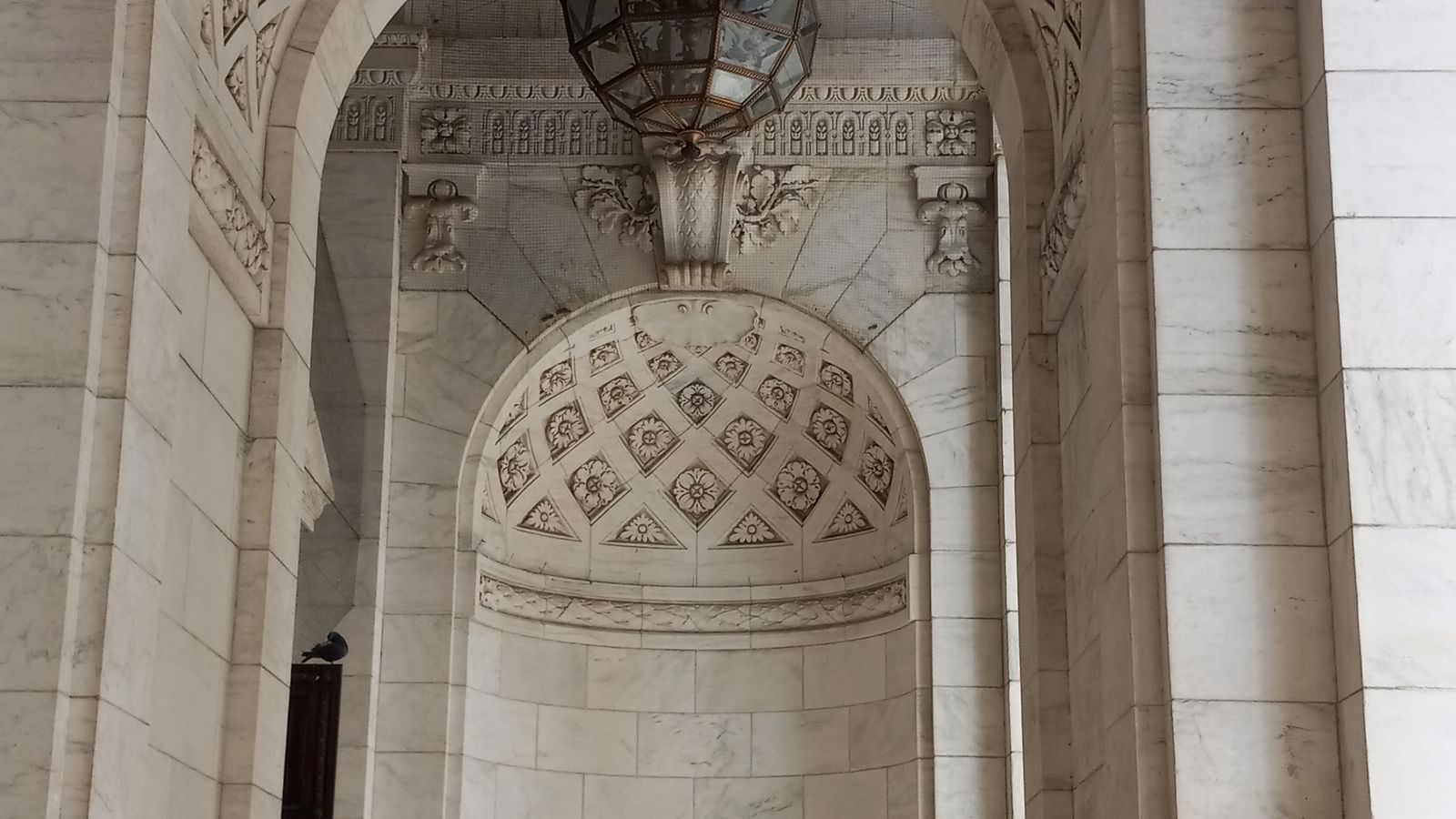
The New York Public Library’s Stephen A. Schwarzman Building — its official name — opened on 23 May 1911. It took fourteen years to build. The architects were John Merven Carrère and Thomas Hastings, both trained at the École des Beaux-Arts in Paris. The result is a Beaux-Arts structure built from Vermont marble, sitting on land that was once the Croton Reservoir.
Before the library, the reservoir held millions of gallons of water that kept the city running. When it was demolished in the 1890s, the city held a competition to decide what should replace it. The library won. Construction began in 1897.
The building cost approximately $9 million to build — a vast sum at the time. It stretches the length of two full city blocks. When it opened, it was one of the largest marble buildings in the United States.
Patience and Fortitude: The Lions at the Top
If you are facing the library, two marble lions flank the main entrance at the top of the steps. They were carved in 1911 by sculptor Edward Clark Potter, who also created equestrian statues at Grant’s Tomb.
The lions were not always called Patience and Fortitude. For years they went by various nicknames — Leo Astor and Leo Lenox, after the library’s founding donors John Jacob Astor and James Lenox. It was Mayor Fiorello La Guardia who gave them their current names during the Great Depression of the 1930s. He said those were the qualities New Yorkers would need to get through hard times.
The names stuck. Today they are city icons. In December, the lions wear large Christmas wreaths around their necks — a tradition that has continued since 1935.
Why the Steps Have Always Been a Gathering Place
The steps are wide, shallow, and south-facing, which means they catch the sun for much of the day. In a city where space is expensive and private, they offer something unusual: a large, free, public place to sit.
Office workers eat lunch here. Tourists rest their feet. Students read. Friends meet. On a warm weekday afternoon, the steps hold hundreds of people at once. On a quiet Sunday morning, you might find them nearly empty.
The steps are not ticketed, not time-limited, and not monitored beyond standard rules of public space. You can sit for five minutes or two hours. You can bring food. You can bring a book. No one will ask you to move.
That simplicity is part of why the steps have appeared in so many films and television programmes. They have featured in The Day After Tomorrow (2004), Sex and the City, Spider-Man (2002), and dozens of other productions. The steps are cinematic partly because they are so ordinary: anyone, anywhere, understands what it means to sit on steps and watch a city go by.
Want more New York guides like this? Subscribe to our free newsletter and get the best of New York City delivered to your inbox each week.
What You Can See from the Steps
From the top step, the view down Fifth Avenue is worth a photograph. To the south, you can see Midtown stretch away towards the Empire State Building. Across the street is a row of shops and buildings that has changed considerably over the decades, but the avenue itself — wide, busy, and loud — has not.
Bryant Park sits directly behind the library. From the steps, you cannot see it, but it is a 30-second walk around the building. The park has free wifi, seasonal events, a winter ice rink, and table tennis tables available to anyone. In summer it hosts free film screenings on Monday evenings.
The street in front of the library is always moving. Buses, taxis, cyclists, food carts, and pedestrians from every corner of the world pass continuously. Watching from the steps, elevated just enough to see over the traffic, gives you a sense of the city’s scale that you cannot get from street level.
What’s Inside: Don’t Skip It
The steps are the reason most people stop. But the interior is open to visitors and does not require a ticket or a library card.
The Rose Main Reading Room on the third floor is one of the finest interior spaces in New York. It runs almost 300 feet long and sits beneath painted ceilings depicting clouds and open sky. The room is still used as a working library. You can sit at one of the long oak tables, request books from the stacks, or simply walk through and look.
The building also holds rotating exhibitions, including displays of rare books, manuscripts, and maps. Past exhibitions have included handwritten manuscripts by Charles Dickens and original drafts associated with the founding documents of the United States.
The library also holds one of only 21 complete surviving copies of the Gutenberg Bible printed on vellum. It has been on public display at various points. Check the library’s website before visiting to confirm what is currently exhibited.
Entry to the building is free. The main branch is open Monday to Saturday and on selected Sundays. Hours vary by season.
Planning a trip to New York? Subscribe to our newsletter for weekly guides, practical tips, and things you didn’t know you needed to know.
Practical Information for Your Visit
Address: 476 Fifth Avenue (at 42nd Street), Midtown Manhattan, New York, NY 10018.
Getting there: Take the subway to 42nd Street–Bryant Park on the B, D, F, or M lines, or to Fifth Avenue–53rd Street on the E or M lines. The library is also a five-minute walk from Grand Central Terminal.
Opening hours: Monday, Thursday, Friday, and Saturday, 10:00 to 18:00. Tuesday and Wednesday, 10:00 to 20:00. Sunday hours vary. The building is closed on public holidays — check ahead.
Cost: Free to enter. No booking required.
Best time to visit the steps: Weekday mornings before 11:00 are the quietest. Lunchtime (roughly 12:00 to 14:00) is the busiest period. Weekend afternoons are crowded in summer and noticeably quieter in winter.
Photography: Permitted throughout the building and on the steps. Tripods require prior authorisation inside.
Accessibility: The library has a ramped entrance on 42nd Street. Lifts serve all public floors. The steps are not required to enter or exit the building.
A Free Seat in the Middle of Manhattan
The New York Public Library steps sit at one of the busiest corners in the world. In any given hour, thousands of people walk past. A fraction of them stop. Of those, most are glad they did.
The steps offer a pause. In a city that rarely stops moving, that is worth something. Whether you sit for five minutes between meetings or spend an afternoon with a coffee from one of the nearby delis, the steps remain exactly what they have always been: a free seat in the middle of Manhattan, with a view of everything.
Image: Shutterstock
Visiting New York soon? Don’t miss a thing — subscribe to our free Love New York newsletter for insider guides, seasonal tips, and local recommendations.
