
Most people are still asleep when New York City’s delivery trucks begin their rounds. By 4am, lorries are already snaking through Midtown, the Bronx, and Brooklyn, carrying the produce, bread, milk, newspapers, and restaurant supplies that the city will burn through before lunchtime. This is the hidden engine of New York — practical, relentless, and almost entirely invisible to anyone who sleeps past 7am.
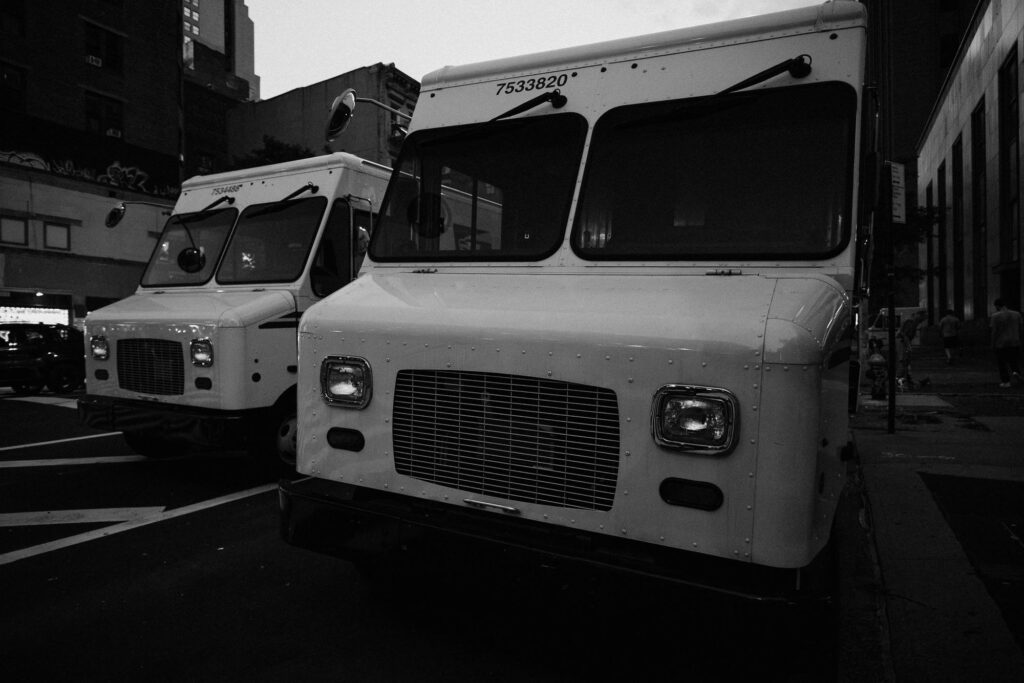
If you have ever wondered why the shelves at your corner deli are already stocked when you duck in at 7am, or why the pavement smells of fresh fish outside a restaurant before it opens, this is why.
Love New York? Get our free weekly newsletter — real stories, local insight, no filler. Subscribe here →
What Time Do Deliveries Start in NYC?
The short answer: earlier than you think. Most commercial deliveries in New York City begin between 3am and 6am. Supermarkets, restaurants, and bodegas typically receive their largest deliveries in this window, before foot traffic and vehicle congestion make it nearly impossible to manoeuvre a 40-foot truck through a Manhattan street.
The city’s Department of Transportation (DOT) has a long-standing programme called Off-Hour Deliveries (OHD), which officially defines off-peak hours as between 7pm and 6am. Businesses that take part receive a small financial incentive — and the city reduces daytime gridlock. According to the NYC DOT, off-hour delivery participants have seen truck trip times cut by up to 65 per cent compared with daytime runs.
Outside of that programme, most independent delivery operators simply learn from experience. Hitting a loading zone on 6th Avenue at 8am means competing with taxis, cyclists, bus lanes, and pedestrians streaming out of Penn Station. Hit the same spot at 4am and you have the block to yourself.
The Unloading Window: Why It Matters
New York City has strict rules about where and when commercial vehicles can stop. Most streets in Manhattan prohibit standing for commercial vehicles during rush hours — typically 7am to 10am and 4pm to 7pm. Outside those hours, designated loading zones are fair game.
This creates a hard deadline. If a driver has not finished unloading before the morning rush begins, they face a choice: move the truck and risk losing their spot, or stay put and face a fine. NYC parking fines for commercial vehicles blocking a bus stop or no-standing zone run from $115 to $265. In areas like Midtown or the Financial District, the NYPD and the city’s parking enforcement agents are active early.
This is why unloading moves fast. A skilled delivery crew can shift a full pallet of goods from lorry to kerb to storage room in under 20 minutes. Watch them work and you will see a precise choreography — the driver stays with the vehicle, a second person ferries goods in, a third signs the paperwork. There is no wasted movement.
What Gets Delivered — and Where
Not all deliveries are the same. The type of goods determines the timing almost as much as the regulations do.
- Food service and restaurants: These receive deliveries from around 3am onwards, particularly for fresh fish, meat, and dairy. The Fulton Fish Market at Hunts Point in the Bronx — the largest seafood market in the United States — runs through the night. Buyers and drivers are there from midnight, and restaurant deliveries fan out across the boroughs from around 3am.
- Grocery and supermarkets: Most large supermarkets receive overnight stockers and early morning deliveries between 4am and 7am. National chains like Whole Foods and Key Food schedule deliveries to land before their doors open.
- Delis and bodegas: These are often supplied by smaller, independent distributors who serve dozens of stops on a single route. A bread or newspaper delivery driver might have 30 stops between midnight and 6am.
- Retail and department stores: Larger stores typically take deliveries via rear loading docks, often between 5am and 9am, before the shop floor staff arrive.
- Construction materials: Concrete and steel deliveries are timed around site start times, typically 6am or 7am when workers arrive on site.
Hunts Point: The City’s Pantry
If there is one place that explains how New York feeds itself, it is Hunts Point Market in the South Bronx. This 329-acre wholesale market complex handles roughly 60 per cent of all produce consumed in New York City. It processes around 1.5 billion pounds of food per year, making it one of the largest food distribution centres in the world.
Trucks arrive at Hunts Point from farms across the United States, from ports where imported goods have been offloaded, and from cold storage facilities in New Jersey and upstate New York. The produce market opens at midnight. The meat market opens at 1am. By 4am, thousands of trucks have already loaded up and are heading back into the five boroughs to make their drops.
The scale is hard to picture without standing there. Lorries queue in the dark. Forklifts move between stalls. Buyers haggle over boxes of tomatoes and crates of melons under fluorescent lights. It is chaotic, loud, and completely essential. Without Hunts Point, New York City’s restaurants, schools, hospitals, and corner shops would run dry within 48 hours.
Want more stories like this about the real New York? Join thousands of readers in our free newsletter. Subscribe free →
Rules the City Enforces
New York City has spent decades trying to manage the tension between the commercial need for deliveries and the everyday reality of congested streets. A few key regulations shape how this plays out:
Loading zones: Marked with a white kerb or signage, these allow commercial vehicles to stop for up to three hours during certain times. Outside those hours, private cars often park there illegally, which is a constant source of friction for delivery drivers.
Truck routes: New York City designates specific truck routes — roads deemed strong enough and wide enough for heavy commercial vehicles. Drivers are required to use these routes and to take the most direct path between them and their destination. GPS units in commercial lorries are increasingly monitored by logistics companies to confirm compliance.
Weight limits: City streets have posted weight limits, and the DOT has weight-in-motion sensors embedded in some roads to detect overloaded vehicles. A fully loaded articulated truck can weigh 80,000 pounds — the federal maximum — and the city’s infrastructure, particularly in older boroughs, was not always built with that in mind.
Noise ordinances: Diesel engines, hydraulic lifts, and metal hand-trucks scraping across pavements are all sources of noise. The city’s noise code limits certain commercial sounds before 7am in residential areas, though enforcement is sporadic.
What You Actually See on the Street
If you are ever up before dawn in New York, the street-level picture is worth watching. Around 3 to 4am, the scene in most commercial neighbourhoods is dominated by trucks. Double-parked lorries line restaurant rows in the Meatpacking District, Hell’s Kitchen, and along the avenues of Flushing. Workers with hand-trucks move between vehicle and doorway. Steam rises from sewer grates. The city sounds different — quieter underfoot, but with the low rumble of diesel engines and the clatter of metal.
By 5am, the first shift of sanitation workers is usually wrapping up their collections. Food trucks are beginning to set up near office buildings and construction sites. Newspaper drops have already happened outside delis and bodegas.
By 6am, the second wave of deliveries begins — UPS, FedEx, Amazon, and other parcel carriers start their first runs of the day. These are different vehicles: smaller, more agile, running individual package routes rather than wholesale bulk drops. They will continue through the afternoon.
By 7am, the wholesale delivery window is effectively closed. The trucks are gone or circling for a second stop. The city opens its doors, and everything that arrived in the dark is now on shelves, in refrigerators, behind counters — ready for a city that has no idea it was ever moved.
The Human Side of the Early Shift
The people driving and unloading these trucks are among the least visible workers in the city. Most are up by 1 or 2am. They navigate one of the most complex urban road networks in the world in the dark, under time pressure, with physical work waiting at every stop. Pay in the sector ranges widely, but unionised wholesale delivery drivers at major food distributors can earn between $28 and $45 per hour, with overtime common on weekday mornings.
The job is harder than it looks. Loading dock access in Manhattan is often cramped or non-existent. Drivers sometimes have to double-park and run a 200-foot line of goods into a building by hand. In winter, ice on the pavements makes every hand-truck run a controlled skid. In summer, the heat radiating off tarmac at 4am is already exhausting.
New York’s food system, retail sector, and construction industry all depend on these workers completing their routes before the city wakes up. It is one of those facts about New York that most visitors — and many residents — never think about, but once you know it, you see the evidence everywhere: the flattened cardboard boxes stacked by kerbs, the smell of diesel, the wet streak on the pavement where ice was hosed off a loading ramp. The city does not stock itself.
Discover the New York that most visitors never see. Our free weekly newsletter goes deeper. Sign up free →
Photo by Malte Schmidt on Unsplash
