
Every city has its windows into ordinary life. London has its pubs. Paris has its pavement cafés. New York City has the subway — and nothing else comes close as a theatre of human behaviour.
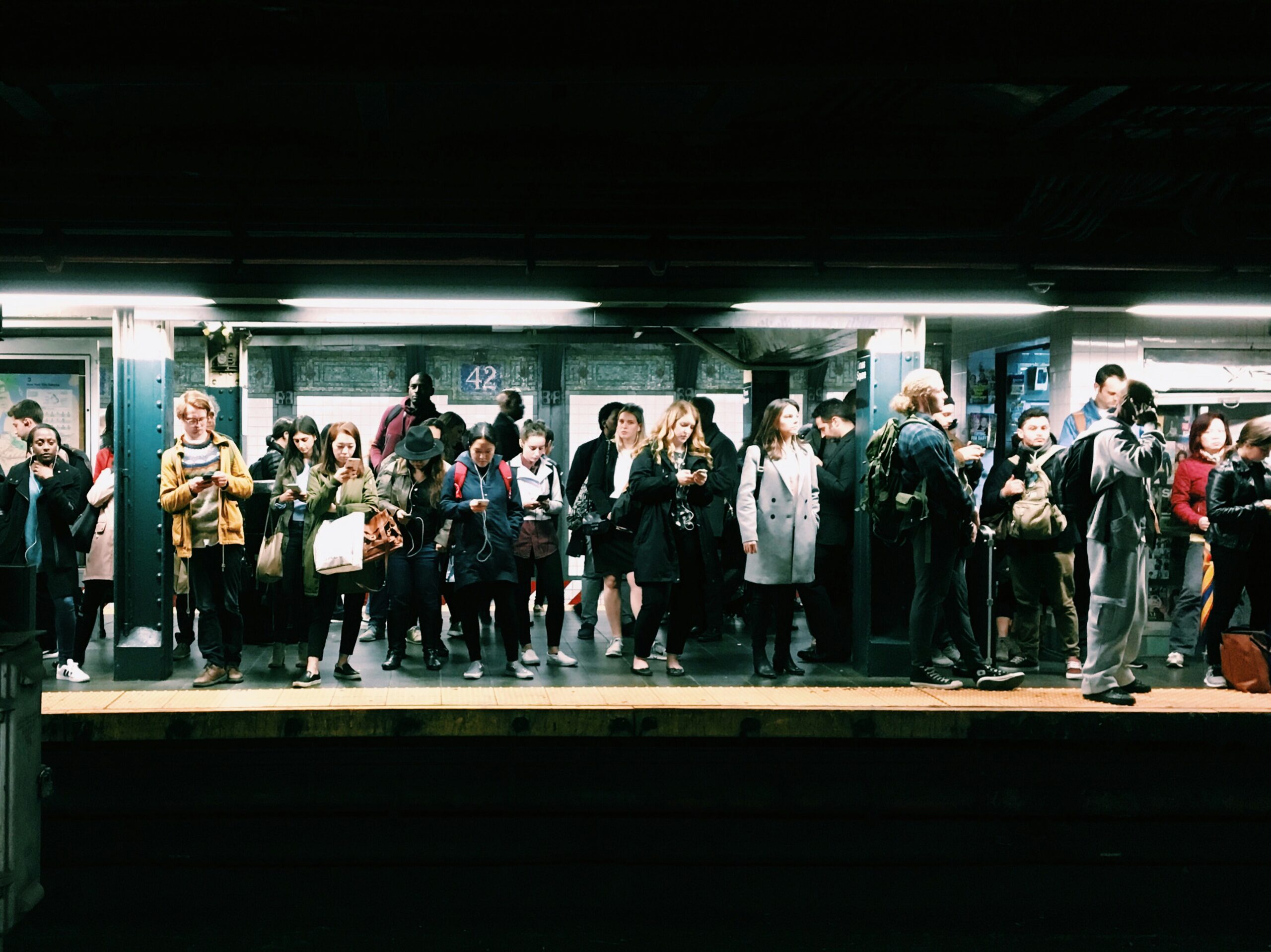
More than 3.5 million journeys are made on the New York City subway every weekday. That is 3.5 million stories, packed into 472 stations across 245 miles of track. Every one of those journeys puts you shoulder-to-shoulder with people from every background imaginable. And if you are paying attention, you will never want it to end.
Enjoying this? Subscribe to our free New York newsletter — real stories, practical tips, and the best of the city, delivered to your inbox.
A Captive Audience Unlike Any Other
The subway works as a people-watching venue for a simple reason: nobody can leave. Once the doors close, everyone in that carriage is heading somewhere together. There is no back room to retreat to, no table to duck behind. You get the full picture.
Compare that with watching people in a park or on a street corner. On the street, everyone is moving, and interesting moments vanish before you can process them. On the subway, you have time. You can watch someone reading a thriller and catch their face every time something unexpected happens. You can observe two strangers work out a silent negotiation over the last seat. You can watch a child notice something through the window for the first time — genuine delight, completely unfiltered.
New York’s subway has an unusual social dynamic that makes all of this possible. Strictly speaking, people are not supposed to engage. There is an unspoken rule: keep eye contact minimal, keep conversations private. That rule, paradoxically, makes everything more interesting. People drop their guard. They talk on the phone, eat their lunch, rehearse lines for an audition, or stare into the middle distance processing something difficult. You see people as they actually are — not as they want to be seen.
Who You Will See on the NYC Subway
The diversity of New York is not just a statistic. It shows up physically on the subway, carriage after carriage, stop after stop.
On a single morning commute on the A train, you might sit across from a construction worker in steel-capped boots, a doctor reviewing notes on a tablet, a student from Queens with earphones in and textbooks open on their lap, a woman dressed for a Wall Street meeting, and a man with a battered guitar case who busks in the station every Tuesday. This is not unusual. This is Tuesday.
The subway connects more than 40 distinct neighbourhoods, each with its own character. A ride from the Bronx down to Brooklyn will take you through communities with roots in the Caribbean, South Asia, West Africa, Latin America, China, and dozens of other places. The accents and languages you hear in a single journey are worth the fare alone.
Time of day changes the cast entirely. During morning rush hour — roughly 7am to 9am — carriages fill with commuters who have the particular energy of people with somewhere urgent to be. After 9pm, the crowd shifts. Night-shift workers heading out, groups of friends deciding where to go, tourists running late, and the occasional character who seems to exist entirely outside of normal schedules.
Weekend afternoons are peak people-watching time. Families with pushchairs. Groups arguing cheerfully about where to eat next. Solo visitors consulting their phones. Musicians who perform between stations and pass through carriages collecting tips. On a good weekend afternoon, one carriage can feel like an entire neighbourhood in motion.
Enjoying this? Subscribe to our free New York newsletter — real stories, practical tips, and the best of the city, delivered to your inbox.
The Lines Worth Riding for People-Watching
Not all subway lines are equal as people-watching venues. A few stand out.
The L train (8th Avenue to Canarsie) runs through Williamsburg and is a favourite for those who live in Brooklyn and Manhattan. The mix of commuters, artists, and tech workers gives it a particular energy — and during rush hour, the carriages are compact enough that the theatre is up close.
The A train is the longest line in the system, running from the Far Rockaways in Queens to Inwood in upper Manhattan. It passes through some of the busiest and some of the quietest parts of the city. If you want variety in a single journey, this is the line to take.
The 6 train on the East Side passes through Grand Central Terminal, itself one of the great human spectacles in New York. Catching the 6 at rush hour, when the platform fills to capacity, is a lesson in how a city manages organised chaos.
The 7 train, running between Flushing in Queens and Times Square, is sometimes called the International Express — and that is not an exaggeration. It runs through neighbourhoods with some of the highest concentrations of immigrants in the country. The food options at the stops along the way are worth researching before you ride.
The F train, stretching from Queens through Manhattan and into Brooklyn, passes through enough distinct communities to feel like several different cities. Riding it end to end takes roughly 90 minutes and rewards patience.
The Unwritten Rules of Subway People-Watching
There is a right way to do this, and it mostly comes down to being a decent human being.
Do not stare. This sounds obvious, but it matters. A fixed stare in New York is an aggressive act. Train your eye to move naturally, and do not settle on any one person for more than a few seconds. You are observing, not inspecting.
Do not photograph strangers without their permission. People in public spaces have a reasonable expectation that they will not end up on someone’s social media. Photographing the platform, the mosaic tile artwork, the station signage — all fine. Pointing a camera at someone sitting three feet away is not.
Respect the space. The subway is crowded, and everyone is managing their own small territory — a few inches of seat, a thin bubble of personal space. Headphones are a signal that the performance is private. Honour it.
Beyond those basics, the subway is genuinely open. New Yorkers are friendlier on trains than their reputation suggests, particularly outside rush hour. If someone is reading a book you have strong opinions about, it is not unheard of to mention it. If someone looks lost, offering directions is almost always welcome.
Why New Yorkers Actually Love the Subway
Ask a New Yorker what they hate about the subway, and you will get a detailed, passionate answer. The delays. The summer heat on the platforms. The occasional service disruption that turns a 20-minute journey into 45.
Ask the same person what makes New York feel like New York, and somewhere in that answer, the subway will appear.
It is one of the few remaining public spaces in the city that genuinely belongs to everyone. The same A train carries the billionaire and the cleaner, the tourist on their first day and the resident who has lived in the same flat for 30 years. Packed into the same carriage, waiting at the same platform, subject to the same delays. There is something levelling about that, and New Yorkers know it.
The subway also runs around the clock, every single day. It does not shut at midnight. It does not run a reduced Sunday timetable. It is there at 3am when you need it, and the people you share it with at that hour are an entirely different cast to the 8am commute. Both are worth experiencing.
For visitors, the subway is both practical and revealing. It costs $2.90 per journey (as of 2026), payable via contactless card or the OMNY tap system. It goes almost everywhere you want to go. And it does something no taxi or rideshare can replicate: it puts you inside the city rather than simply passing through it.
How to Make the Most of Your Ride
If you are visiting New York, ride the subway at least once without a fixed destination in mind. Pick a line, tap your card, and get on. Ride for 20 minutes. Watch who boards and who exits. Notice the small rituals — the way people shuffle towards the door two stops before they actually need to leave, the way a crowded carriage quietly reorganises itself when someone with a pram steps on.
Bring a book you do not mind ignoring. Sit near the middle of the carriage, where the view in both directions is widest. Avoid rush hour for your first exploratory ride — the carriages are too packed to see much. A late morning on a weekday, or a Saturday afternoon, gives you space to look around properly.
Take the 7 train to Flushing for lunch, then ride it back watching who gets on at each stop. Or ride the A from 59th Street all the way up to 168th Street in Washington Heights — about 15 minutes — and then back down. The neighbourhoods change, the people change, and the light through the windows changes depending on whether the line runs above or below ground.
You will miss things. You might miss your stop entirely.
That, as it turns out, is not a problem. It is practically a tradition.
Enjoying this? Subscribe to our free New York newsletter — real stories, practical tips, and the best of the city, delivered to your inbox.
