
The message arrives in a family group chat. A distant cousin has found something. A manifest. A name. An address on Orchard Street. And suddenly, New York is not just a city on the map. It is where your family began.
Updated October 2026: we corrected the Ellis Island database name and years, the census years you can search, the New York City vital records years, where naturalization records are held, and the Tenement Museum address, checked on statueofliberty.org, archives.gov and nyc.gov/records.
Millions of people around the world share this story. They descend from the great waves of immigration that swept through New York in the 19th and early 20th centuries. Irish families fleeing famine. Jewish families escaping persecution. Italian contadini leaving behind nothing but hope. Polish, Greek, Puerto Rican, Chinese — all of them passed through this city. Many stayed.
If your family came through New York, the records exist. This guide will show you exactly where to look.
If you love New York’s hidden stories, you’ll love our free weekly newsletter. Subscribe to Love New York →
Start With What You Know
Before you open a single database, write down everything your family already knows. Names. Dates. Places. Even half-remembered stories count.
Ask the oldest living relatives first. They may recall the name of the street, the port of departure, or the village in the old country. Even a fragment — “Grandma always said we came from somewhere near Naples” — can narrow your search enormously.
Write it all down. This is your foundation.
Ellis Island: The First Stop for 12 Million People
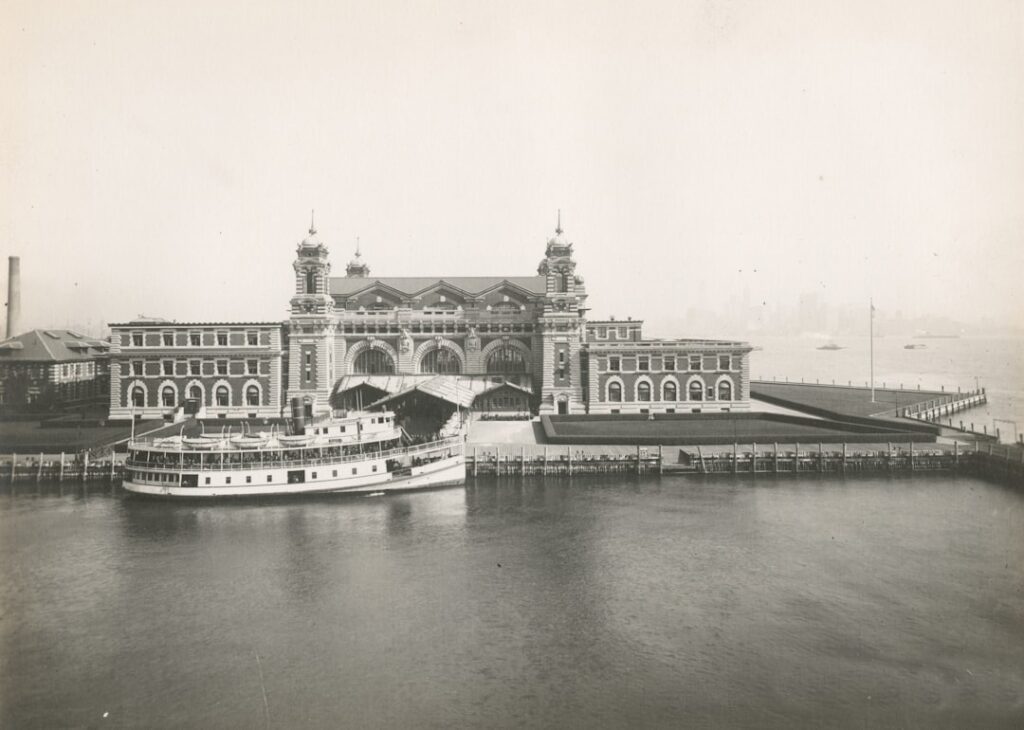
From 1892 to 1924, Ellis Island was America’s largest and most active immigration station, and over 12 million immigrants were processed there (National Park Service). If your ancestors came during that period, there is a good chance they passed through its Great Hall.
The Statue of Liberty-Ellis Island Foundation runs a free searchable database, the Arrival Records Collection. It covers Ellis Island and New York, plus other U.S. ports, across the 18th, 19th and 20th centuries, so it reaches back to the Castle Garden years before Ellis Island too. You can search by name and narrow by arrival year, birth year and last residence. For New York arrivals from 1820 to 1891, FamilySearch’s free “New York Passenger Lists, 1820-1891” is another place to look. Checked October 2026.
The records include the original ship manifests. These were filled out at the port of departure. According to the National Archives, a passenger list may give nationality and place of birth, age, profession, place of last residence, and the name and address of the relative the passenger was joining in the United States. That detail — the contact person in America — often leads directly to the first tenement address your family ever called home.
Ancestry.com also holds a large collection of Ellis Island records, alongside census data, draft cards, and naturalization papers. A subscription is worth considering for serious research.
One important note: names were not changed at Ellis Island. This is a popular myth. The Foundation explains that arrival records were filled out at the point of departure and that “immigrants were not given new names upon arrival.” If your family name changed, it usually happened later, often simply by choice.
New York City Vital Records
Once your ancestors arrived, they left a paper trail through the city’s official records.
The New York City Department of Records and Information Services runs the Municipal Archives. Its free website Historical Vital Records of NYC gives access to millions of digitized birth, death and marriage records from 1855 to 1950. You can search, browse, download or order certified copies online. The research rooms are at 31 Chambers Street in Manhattan, by appointment.
For later years, the Archives sends you elsewhere: births after 1909 and deaths after 1950 are with the NYC Department of Health, and marriages after 1949 with the Office of the City Clerk (Municipal Archives genealogy page).
These records can be deeply moving. A birth certificate from 1902 might list a tenement address, an occupation, and the names of parents who had only just arrived.
New York State Records
New York State took its own census, separate from the federal one, usually at ten-year intervals between 1825 and 1925. The New York State Library shows which years survive for each county. The original 1915 and 1925 census manuscripts are held by the New York State Archives in Albany; originals for earlier years are kept at county level.
Naturalization records depend on the court. Before September 27, 1906, any “court of record” (municipal, county, state, or federal) could grant citizenship. Federal court naturalization records for New York are held by the National Archives at Philadelphia, and its New York holdings list links the records you can already view online at FamilySearch (National Archives).
FamilySearch.org, run by The Church of Jesus Christ of Latter-day Saints, is free with an account and holds a vast range of digitized historical records.
Want more stories like this? Our weekly newsletter goes deeper into New York’s heritage every week. It is free. Subscribe here →
Finding the Tenement Address
This is often the most thrilling discovery in NYC ancestry research: the tenement address.
Once you have a name and approximate year of arrival, the census records are your next step. The US federal census has been taken every ten years since 1790, and the most recent one open to the public is 1950 (National Archives). The National Archives lists FamilySearch as a free place to search many census years, and the 1950 census has its own free website.
Each census page lists every resident of every household at a specific address. Finding your great-great-grandfather listed at 147 Orchard Street in the 1910 census is one of those moments that stops your breath.
The Tenement Museum at 103 Orchard Street runs guided tours of two historic buildings, 97 and 103 Orchard Street, and tells the stories of real families who lived there.
The Jewish community of the Lower East Side left particularly rich records. Many families can now find the exact apartment, not just the building.
The YIVO Institute: Essential for Jewish Heritage
If your ancestors were Eastern European Jews, the YIVO Institute for Jewish Research is essential. It is at 15 West 16th Street in Manhattan, inside the Center for Jewish History, which also runs the Ackman & Ziff Family Genealogy Institute.
YIVO’s Miriam Weiner Genealogy Collection holds books, maps and photographs, guides to archives in Poland, Ukraine and Moldova, and books in Hebrew, Yiddish, Russian, Ukrainian and other languages, including material on towns in Eastern Europe.
New York Public Library Genealogy Resources
The New York Public Library’s Milstein Division, in Room 121 of the Stephen A. Schwarzman Building on Fifth Avenue at 42nd Street, calls itself one of the nation’s largest publicly accessible genealogical collections. It is free to use. A library card is needed to request most print materials.
The division holds family histories, church records, historical newspaper collections, family files and genealogy periodicals, with a particular focus on the New York region.
The library suggests planning your visit and requesting materials in advance, since parts of the collection may be offsite. Staff can guide your research.
Immigrant Newspaper Archives
This is a resource many people overlook. Immigrant communities in New York maintained their own newspapers, often for decades.
The Forward was launched as a Yiddish-language daily on April 22, 1897, and still publishes at forward.com. Irish and Italian papers such as the Irish-American and Il Progresso Italo-Americano served their communities too.
Papers like these carried birth, marriage, and death notices, community news, and letters from readers looking for lost relatives.
Chronicling America, run by the Library of Congress, offers free access to digitized historical newspapers, and its Directory of U.S. Newspapers in American Libraries shows which library holds a given paper.
DNA Testing and NYC Heritage
Modern DNA testing can add a powerful layer to your research. Services such as AncestryDNA and 23andMe can estimate ethnic origins and connect you with distant cousins who are researching the same family lines.
Many users find that DNA matches lead them to the village in Italy, the shtetl in Poland, or the county in Ireland that their ancestors left behind.
DNA alone will not give you names and addresses. But combined with documentary research, it can fill gaps that records cannot reach.
Planning Your Heritage Visit to New York
Once you have found your roots, New York offers something extraordinary: you can walk the streets your ancestors walked.
The Five Points neighborhood — the Irish heartland of old New York — still has traces of its past visible in the streets of Lower Manhattan. Harlem preserves the enduring legacy of the Great Migration. Astoria in Queens remains deeply and beautifully Greek. Greenpoint in Brooklyn still feels, in places, like the Poland that immigrants carried with them across the Atlantic.
The Tenement Museum on Orchard Street offers guided tours of restored apartments where immigrant families actually lived. It is one of the most affecting heritage experiences in the whole city.
The Museum of Jewish Heritage at 36 Battery Place, a living memorial to the Holocaust, teaches about Jewish life before, during and after the Holocaust, and runs JewishGen, a free Jewish genealogy website. The New York Irish Center in Long Island City runs classes, concerts and Irish language programs.
Your ancestors came to this city with nothing but hope. The records they left behind are waiting for you.
Frequently Asked Questions
Where can I search Ellis Island records for free?
The Statue of Liberty-Ellis Island Foundation’s Arrival Records Collection is free at statueofliberty.org/arrival-search. It covers Ellis Island and New York, plus other U.S. ports, across the 18th, 19th and 20th centuries. You can search by name and narrow by arrival year, birth year and last residence.
How do I find my ancestors’ tenement address in New York?
Search the US federal census for your ancestor’s name. FamilySearch.org is free with an account, and the 1950 census has its own free website. The 1900 to 1950 censuses list every household member at each address, including specific tenement buildings.
What is a good free genealogy resource for New York City research?
FamilySearch.org is a good starting point — it is free with an account and holds census, naturalization and vital records. The New York Public Library’s Milstein Division is a strong in-person resource, also free to use.
Can I visit the actual building where my ancestor lived?
In many cases, yes. If you find a specific tenement address from the census records, you can visit the street today. The Tenement Museum at 103 Orchard Street on the Lower East Side offers guided tours of its two historic tenement buildings.
How far back do New York City vital records go?
The Municipal Archives’ Historical Vital Records of NYC website covers births, deaths and marriages from 1855 to 1950. Its other family history resources include census records, city directories and the New Amsterdam Collection (1647-1862).
Ready to explore the New York your ancestors knew? Subscribe to Love New York — free weekly stories, heritage guides, and hidden history. Join us →

Subscribe Free