
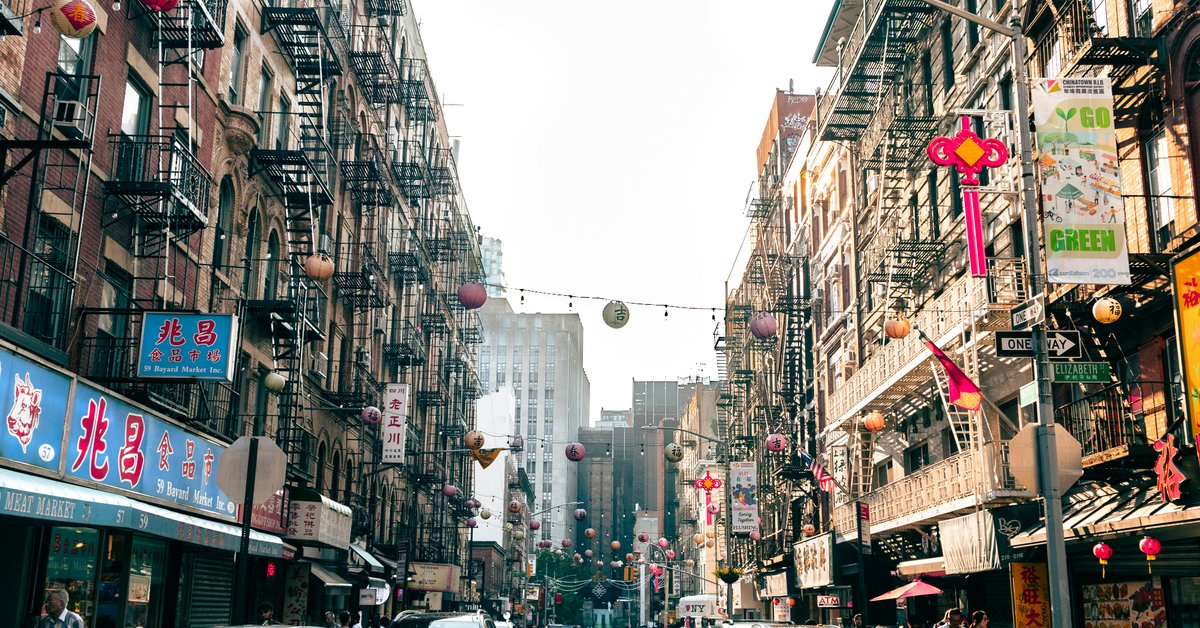
Walk along Mott Street on any morning and you will hear Cantonese and Mandarin, smell roasting pork from the kitchen windows, and watch older women selecting vegetables with the practiced care of people who have done this for decades. New York’s Chinatown is one of the oldest and most densely populated Chinese communities in the Western world. It is also one of the most unlikely. The people who built it did so against laws designed to stop them from coming at all.
If you love New York’s hidden stories, you’ll love our free weekly newsletter. Subscribe to Love New York →
How It Began
The first Chinese immigrants to settle in Lower Manhattan arrived in the 1870s. Most had come first to California — lured by the Gold Rush of 1849, then hired as labourers to build the transcontinental railroad. When the railroad was complete and the gold ran out, the welcome ran out with it. Violence against Chinese workers in California pushed many eastward, and a small cluster of them found work in New York and put down roots in the blocks around Mott Street.
The neighbourhood they settled was already one of the most crowded places in the world. They were living in the shadow of Five Points, the infamous slum that had shaped Irish immigrant life a generation earlier. The streets were dense, the rents were low, and the work available was laundry, cigar-making, and small retail — industries that accepted newcomers others would not hire.
By 1880, a distinct Chinese neighbourhood had formed around Mott, Pell, and Doyers Streets. It was tiny by modern standards — a few hundred people at most. But it had its own associations, its own commerce, and its own social life. It was, in the words of those who lived there, a place where you could be Chinese in America without hiding what you were.
The Law That Tried to Erase Them
In 1882, the United States Congress passed the Chinese Exclusion Act. It was the only federal law ever to bar immigration based on race and nationality. Chinese labourers were barred from entering the country. Those already here could not become citizens. Families were separated. Men who had left wives and children behind in China found they could not bring them over. Women who wanted to join husbands in America were turned back at the border.
The effect on Chinatown was profound. What had begun as a community became, for decades, a community of men. The “bachelor society” — as historians have called it — was not a choice. It was a legal condition. Thousands of Chinese men lived in Chinatown without their families. They sent money home. They waited. Many waited for thirty or forty years. Some never saw their families again.
The same drive to build community in the face of exclusion can be seen across New York’s immigrant history — in the Jewish Lower East Side, in Irish Five Points, in Italian Little Italy. But no other group faced a law specifically written to exclude them by name.
The Paper Sons
Against the law stood ingenuity. After the 1906 San Francisco earthquake destroyed that city’s birth records, a legal loophole opened. American-born Chinese citizens could claim that their children — born in China — had been born in the United States. Children who did not exist on paper could be registered. Those papers could then be sold to men who wanted to come to America. The buyers memorised their new identities. They crossed the ocean knowing that immigration officers would question them at length about the family they were claiming to belong to. The details had to be perfect.
These immigrants were called paper sons and paper daughters. Thousands used this system to enter the United States. They arrived in New York carrying identities that were not their own, moving into Chinatown, working under names that were not their names, building lives in a country that had legally defined them as unwelcome.
Many of their descendants do not know their family’s real surnames. The paper son system is one reason why Chinese-American genealogy research can be so complex — and so emotional when the real story is finally uncovered.
The Tong Wars and Doyers Street
Life in the bachelor society was not merely one of quiet waiting. The Tong associations — powerful fraternal organisations that controlled gambling, labour placement, and trade in Chinatown — competed fiercely for influence. That competition sometimes turned violent.
Doyers Street, a short curved alley running off Pell Street, became the site of some of the worst violence of the Tong wars in the early twentieth century. The street’s tight curve meant that men waiting at one end could not be seen from the other. Ambushes were easy. The street earned the nickname “the Bloody Angle.” Today it is quiet, lined with Vietnamese sandwich shops and beauty salons. But the curve in the road is still there, unchanged.
The Tong wars are a difficult chapter in Chinatown’s history — a reminder that community life in the bachelor society was shaped as much by desperation and competition as by solidarity. By the 1930s, the violence had largely ended. The associations transformed themselves into business and benevolent organisations that still operate in Chinatown today.
Want more stories like this? Our weekly newsletter goes deeper into New York’s heritage every week. It’s free. Subscribe here →
The Laws That Changed Everything
Two pieces of legislation transformed Chinatown. The first was the Magnuson Act of 1943. Wartime alliance with China made the Exclusion Act an embarrassment, and Congress repealed it — though the annual quota for Chinese immigrants was set at just 105 people. Families separated for decades could finally begin to reunite. Naturalisation became possible for the first time.
The second was the Immigration and Nationality Act of 1965, which abolished national-origin quotas. For the first time, Chinese immigrants could arrive in substantial numbers. They did. Chinatown grew rapidly in the late 1960s, 1970s, and 1980s. New arrivals came from Hong Kong, then from mainland China, then from Fujian province in waves that each brought different dialects, different foods, and different expectations of what America might offer.
Chinatown expanded beyond its original few blocks. It spread north and east. It spawned new satellite Chinatowns in Flushing, Queens, and Sunset Park, Brooklyn, as the community grew too large for Lower Manhattan alone.
What You Can Find in Chinatown Today
Modern Chinatown is vast, alive, and complex. Here is what deserves your attention if you are visiting for heritage reasons:
Mott Street — The original heart of Chinatown. Walk it from Worth Street to Canal Street. The buildings are old; the commerce is constant. Several restaurants have been serving the same dishes since the 1950s.
Doyers Street — The Bloody Angle. Short, curved, easy to miss. One of the most historically freighted small streets in New York. Find it off Pell Street.
The Museum of Chinese in America (MOCA) — 215 Centre Street. The definitive institution for understanding the history of Chinese Americans. The permanent collection covers immigration, exclusion, the bachelor society, and the transformation of the community through the twentieth century. Essential for anyone with Chinese-American heritage.
Columbus Park — Built in 1897 on the site of the old Five Points slum. Today it serves as a gathering place for the community — Chinese elders play chess and mah-jong here in the mornings, a tradition that has continued for decades.
The Kim Lau Memorial Arch — At Chatham Square, dedicated to Chinese-American soldiers who died in the Second World War. A quiet and overlooked monument to a community that served a country that had tried to exclude them.
For a planned walking route through Lower Manhattan’s layered immigrant history, the NYC self-guided walking tours guide can help you build an itinerary that takes in Chinatown alongside the nearby Lower East Side and Civic Centre.
Tracing Chinese-American Roots in New York
Chinese-American genealogy is among the most rewarding — and most complex — areas of heritage research. The paper son system means that some family trees have a kink in them, a generational name change that can confuse modern researchers. Here is where to begin:
The Museum of Chinese in America (MOCA) — Its research centre holds oral histories, photographs, and community records that are not available through commercial genealogy platforms. Contact them directly before visiting.
The National Archives in New York — Holds immigration records for Chinese arrivals at the Port of New York, including case files from the period of the Exclusion Act. These files sometimes contain photographs and detailed family information recorded at immigration hearings.
Ancestry.com and FamilySearch — Both platforms hold substantial collections of Chinese immigration and naturalisation records for the New York area.
The Chinese-American Family History Group — A volunteer organisation that supports Chinese-American genealogy research, particularly for families navigating the complexities of paper son histories.
For a broader introduction to tracing any New York City family history, the How to Trace Your New York City Ancestry guide covers resources that apply across all communities.
Frequently Asked Questions
When did Chinese immigrants first settle in New York’s Chinatown?
The first Chinese residents settled in Lower Manhattan in the 1870s, many having moved east after working on the transcontinental railroad in California. By 1880, a recognisable Chinese community had formed around Mott, Pell, and Doyers Streets in Lower Manhattan.
What was the Chinese Exclusion Act and how did it affect Chinatown?
The Chinese Exclusion Act of 1882 was the only US law to ban immigration based on race and nationality. It prevented Chinese labourers from entering the country, barred Chinese residents from becoming citizens, and separated families for decades. The result was the “bachelor society” — a Chinatown populated almost entirely by men unable to bring their families to America. The Act was partially repealed in 1943 and fully abolished by the Immigration Act of 1965.
What is the Museum of Chinese in America and where is it located?
The Museum of Chinese in America (MOCA) is at 215 Centre Street in Lower Manhattan, a short walk from the heart of Chinatown. It is the definitive museum for understanding Chinese-American history and holds a permanent collection covering immigration, exclusion, and community life from the 1870s to the present. It also operates a research centre for genealogical enquiries.
How do I trace Chinese-American ancestors from New York?
Begin with the MOCA research centre and the National Archives in New York, which holds immigration case files from the Exclusion Act era. Ancestry.com and FamilySearch also hold substantial Chinese immigration and naturalisation records for New York. Be aware that the “paper son” system means some family surnames may differ from birth records in China.
Ready to explore the New York your ancestors knew? Subscribe to Love New York — free weekly stories, heritage guides, and hidden history. Join us →
