
Roughly 175 years ago, a stretch of Lower Manhattan contained one of the most densely populated places on earth. Streets barely wide enough for two carts to pass. Buildings stacked four and five storeys high. And a population that, for a few decades in the mid-1800s, was overwhelmingly Irish.
That place was the Five Points.
Today, if you walk to the corner of Worth Street and Baxter Street in Chinatown, you are standing in what was its heart. There are no plaques. Columbus Park, built in 1897 after city authorities cleared the last of the tenements, covers much of where the original streets once ran.
But the people who passed through Five Points went on to shape New York — and the country — in ways that are still visible today.
Love New York history?
Get stories like this straight to your inbox. Join thousands of New York lovers around the world.
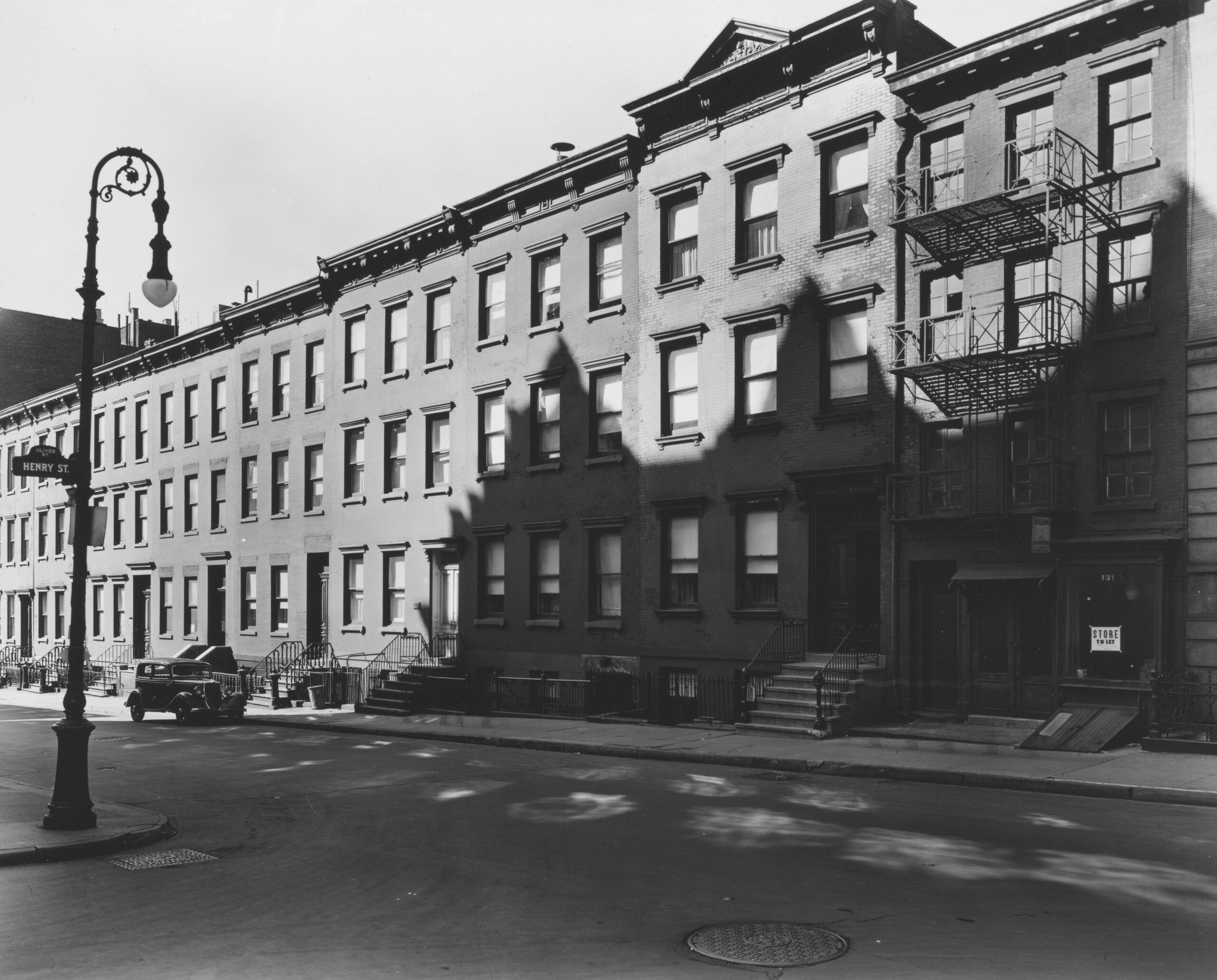
How Five Points Got Its Name
The name came from a five-way intersection at the meeting point of three streets: Orange Street (now Baxter), Cross Street (now Mosco), and Anthony Street (now Worth). That junction, known as “the Points,” gave the surrounding neighbourhood its identity. By the 1830s, it had developed a reputation across the Atlantic as a place of poverty and danger.
The neighbourhood occupied land built over the filled-in Collect Pond, which had been the city’s main freshwater source. Poor drainage, unstable ground, and overcrowded buildings made it unsuitable for wealthier residents, who moved uptown. The people who could not afford to move stayed — or arrived.
How the Famine Changed Five Points
Between 1845 and 1852, the Irish Famine killed approximately one million people in Ireland and forced another million to emigrate. Many who survived made the crossing to New York.
They did not arrive at Ellis Island. Ellis Island did not open as an immigration station until 1892. The vast majority of Famine-era Irish immigrants came through Castle Garden — the circular building that still stands today as Castle Clinton in Battery Park. Between 1855 and 1890, approximately eight million immigrants passed through its doors.
From the docks, many walked directly north to Five Points. Rent was cheap. There were others who spoke Irish. The Catholic church — specifically Old St. Patrick’s Cathedral on Mott Street, which had served the Irish community since 1815 — was within walking distance.
By the 1850s, Irish-born immigrants and their children made up roughly half the population of Five Points. In some tenement blocks, the proportion was higher still.
What Life Was Really Like
The conditions were genuinely brutal. Buildings originally constructed as single-family homes were divided and subdivided. The Old Brewery, a former brewing facility converted into tenement housing, reportedly housed over a thousand people at its peak — families crammed into single rooms, men packed into below-street-level basements. It was demolished in 1852 and replaced by the Five Points Mission, a charity providing food, education, and shelter.
Fresh water was difficult to obtain. Typhus, cholera, and tuberculosis moved quickly through the buildings. Child mortality was extraordinarily high even by the standards of the era.
But Five Points was also a place of active community life. Irish saloon owners were among the most powerful figures in the neighbourhood. The Catholic church ran schools. Irish political networks, eventually channelled through Tammany Hall, began to develop real influence in city politics.
The street gang known as the Dead Rabbits — predominantly Irish — became one of the most notorious in the city’s history. The conflicts between Irish gangs and nativist groups like the Bowery Boys reflected real and often violent tensions that shaped city politics for decades. Martin Scorsese set his 2002 film Gangs of New York in Five Points for good reason.
Love New York history?
Get stories like this straight to your inbox. Join thousands of New York lovers around the world.
Why Five Points Disappeared
City authorities began clearing Five Points in the 1880s under public health legislation and pressure from reformers. Jacob Riis, the Danish-American journalist whose 1890 book How the Other Half Lives documented tenement poverty with photographs and statistics, used Five Points as a central case study.
The buildings came down. The streets were reconfigured. Columbus Park opened in 1897 as a green space for the neighbourhood replacing it — Chinatown. By the early twentieth century, the Irish population had largely dispersed to Hell’s Kitchen, the South Bronx, Brooklyn, and eventually the suburbs. The government buildings that now define the Civic Center area were built on the cleared ground.
What Remains Today
Very little of the physical Five Points survives. Columbus Park covers what was once its busiest intersection. The surrounding streets are now part of Chinatown.
What does remain:
Old St. Patrick’s Cathedral, at 263 Mulberry Street in Nolita, stands essentially as it did when Famine immigrants worshipped there. Its cemetery, running along Mott Street, contains graves from the mid-1800s Irish community. The cathedral is open to visitors and still operates as a parish church.
The Tenement Museum, at 97 Orchard Street on the Lower East Side, is the most accessible way to understand tenement life. Its tours cover Irish immigration specifically and the conditions are directly comparable to Five Points. Book in advance — tours fill up quickly.
Castle Clinton, in Battery Park at Manhattan’s southern tip, is the structure through which most Famine-era Irish immigrants first set foot in America. It is a National Monument, managed by the National Park Service, and free to enter.
How to Trace Your Irish Roots in New York
If you have Irish ancestors who arrived in New York in the mid-to-late 1800s, several records are available.
New York records:
- The New York City Department of Records holds municipal birth, death, and marriage records from 1866 onwards. Earlier records are held by church archives or county clerks.
- The New York Public Library’s Milstein Division holds city directories, census records, and historical newspapers.
- Catholic parish archives — including those of Old St. Patrick’s on Mott Street — hold baptismal and marriage records going back to the early 1800s.
Irish records (for tracing where they came from):
- Griffith’s Valuation, a comprehensive land survey of Ireland conducted between 1847 and 1864, lists the head of household for nearly every family in the country. It is free to search at askaboutireland.ie.
- The Tithe Applotment Books (1823–1837) are available free at churchrecords.ireland.ie.
- The National Library of Ireland holds Catholic parish registers from the 1780s onwards, many now digitised and free at registers.nli.ie.
Online resources:
- Ancestry.com and FamilySearch.org both hold digitised New York census records, ship passenger lists, and naturalisation papers.
- The Immigrant Ships Transcribers Guild has indexed many pre-Ellis Island passenger lists.
- The New York Irish History Roundtable maintains local historical records focused specifically on the Irish community in New York.
The People Who Never Left
The Irish who came through Five Points in the 1840s and 1850s arrived with almost nothing. Many were ill from the Atlantic crossing. The city they entered was hostile to them in organised and visible ways — discrimination in employment, housing, and public life was commonplace.
Within two generations, their descendants were running the city. The political networks built through Five Points and Hell’s Kitchen produced New York’s first Irish mayors. The Catholic church they funded built the cathedral on Fifth Avenue that Archbishop John Hughes — known as “Dagger John,” who had himself arrived in America as an indentured servant — had promised would rival any in Europe.
The neighbourhood is gone. The stories are not.
Love New York history?
Get stories like this straight to your inbox. Join thousands of New York lovers around the world.
