
New York City has hundreds of bridges, but three define the East River skyline between Manhattan and Brooklyn: the Brooklyn Bridge, the Manhattan Bridge, and the Williamsburg Bridge. Ask any visitor which one looks best at night and you will get a different answer every time. Each bridge has a distinct design, a different lighting scheme, and a different character after dark. This guide looks at all three — the facts, the lights, and where to stand to see them at their best.
Love New York? Get our free weekly guide to the city — hidden spots, seasonal events, and local tips delivered straight to your inbox. Subscribe here →
The Brooklyn Bridge at Night
The Brooklyn Bridge opened in 1883, designed by John Augustus Roebling and completed by his son Washington Roebling after the elder Roebling died from a tetanus infection early in the project. For its time, it was a feat of engineering that most people thought was impossible. The main span measures 1,595 feet (486 metres), and it was the longest suspension bridge in the world when it opened.
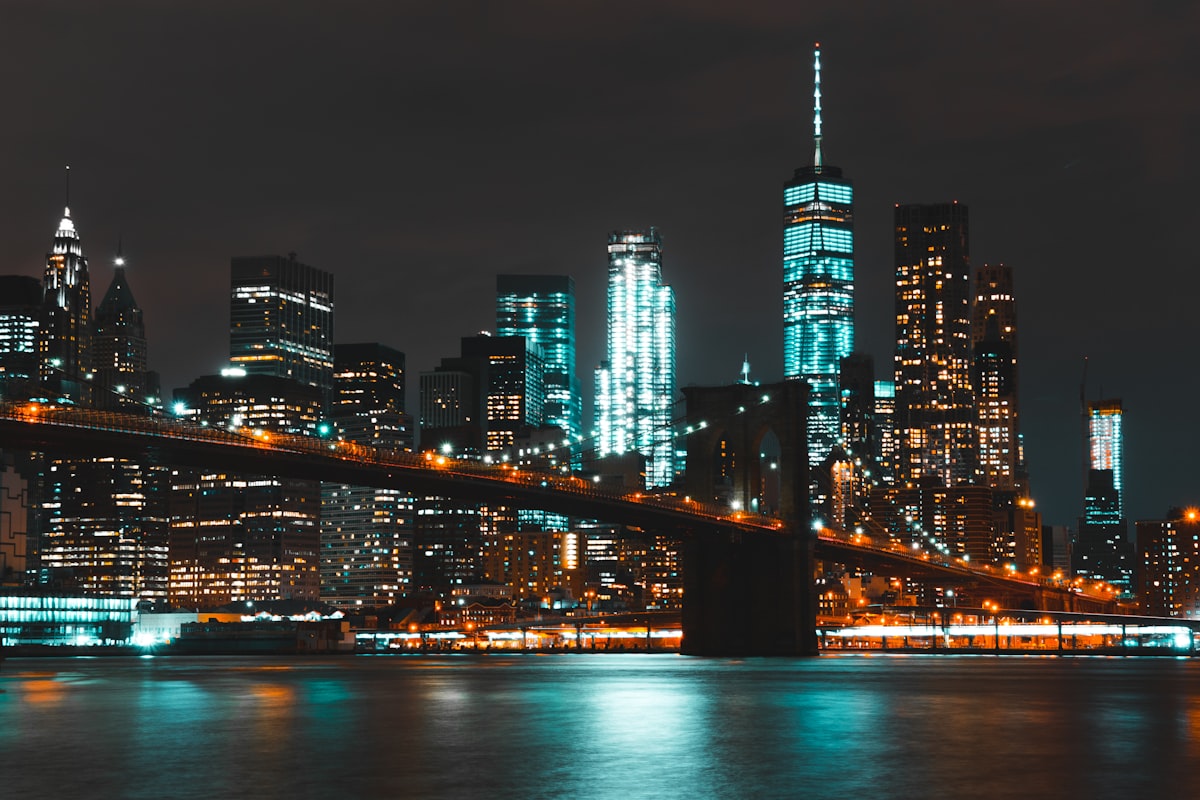
At night, the Brooklyn Bridge is lit with warm amber and golden lights that trace the cables from the two Gothic stone towers down to the roadway. The stone towers themselves are floodlit, giving them a honey-coloured glow that stands out clearly against the dark sky. The effect is traditional rather than showy — the lighting does not try to compete with the bridge’s architecture, it simply makes it visible.
The walkway runs along the centre of the bridge at a height above the traffic, which means you can walk across at night and look back at the Manhattan skyline from mid-span. This is one of the most popular things to do in New York at any hour. The walk takes about 20 to 30 minutes one way at a comfortable pace. From the Brooklyn side, the view back towards Lower Manhattan is excellent, with the towers and cables framing the skyline behind you.
What makes the Brooklyn Bridge stand out at night is the combination of stone and cable. The Gothic arches in the towers create a frame for the sky, and the cables fan outward in a pattern that the lighting picks out clearly. It is the most photogenic of the three bridges for this reason — there is a strong contrast between the warm stone and the dark river below.
The Manhattan Bridge at Night
The Manhattan Bridge opened in 1909, six years after the Williamsburg Bridge. It was designed by the engineer Leon Moisseiff, with the towers and anchorages styled by architects Carrère and Hastings. The main span is 1,470 feet (448 metres). Unlike the Brooklyn Bridge’s stone towers, the Manhattan Bridge uses steel towers, giving it a more industrial look.
At night, the Manhattan Bridge is lit in blue — the suspension cables glow with a cool, steady blue light that sets it apart from the warmer tones of the Brooklyn Bridge. This blue lighting makes it immediately recognisable from a distance and gives it a more modern feel. The steel structure, which is less decorative than the Brooklyn Bridge’s stonework, actually benefits from the lighting: the cables stand out sharply in blue against the sky, and the bridge looks deliberately dramatic rather than accidentally beautiful.
One of the best things about the Manhattan Bridge’s lighting is how well it photographs alongside the Brooklyn Bridge. From the DUMBO waterfront in Brooklyn — specifically the stretch of Washington Street between Front Street and Water Street — you can frame the Manhattan Bridge through the arch created by the elevated buildings on either side of the street. This is one of the most photographed spots in New York, and at night, with the blue lighting on the Manhattan Bridge, it is particularly striking.
The Manhattan Bridge also carries subway lines, which means you can hear and feel the train passing over it if you stand near the towers. At night, the flicker of subway car lights moving across the span adds movement to an otherwise static subject — something that distinguishes it from the other two bridges.
Love New York? Get our free weekly guide to the city — hidden spots, seasonal events, and local tips delivered straight to your inbox. Subscribe here →
The Williamsburg Bridge at Night
The Williamsburg Bridge was actually the first of the three to be completed after the Brooklyn Bridge, opening in 1903. Its main span measures 1,600 feet (488 metres), which made it the longest suspension bridge in the world for a brief period. The designer was Leffert Lefferts Buck. Unlike the other two, the Williamsburg Bridge uses steel towers throughout — there is no stone, no Gothic arch, no decorative flourish on the towers themselves.
At night, the Williamsburg Bridge is lit in white and cooler tones. The lighting is functional and clean rather than atmospheric. The bridge is less visited by tourists than the Brooklyn or Manhattan bridges, which means the views from its walkway are quieter, and the streets around its Brooklyn anchorage in the Williamsburg neighbourhood are more local in character.
The Williamsburg Bridge is the most straightforwardly industrial of the three. Its steel truss design is more visible and less concealed by decorative elements, and at night this means the structure itself — the diagonal bracing, the lattice-work towers — catches the light in a way that rewards a closer look. It is not as immediately photogenic as the Brooklyn Bridge, but it is honest about what it is: a working bridge that has been crossing the East River for over a century.
For viewing, Domino Park on the Williamsburg waterfront gives a clear sightline to the bridge, as does the East River State Park a short walk north. From either spot, you can look west across the river and see the Williamsburg Bridge framed against the Manhattan skyline.
Comparing the Three Bridges
If you are choosing which bridge to visit at night for the first time, here is a straightforward comparison:
Brooklyn Bridge — warm amber lighting, stone towers, walkway open to pedestrians. Most atmospheric, most photographed, most historic. Best for: a first-time night visit to New York.
Manhattan Bridge — blue lighting, steel towers, viewed best from DUMBO rather than walked across at night (the pedestrian path is narrower and less accessible). Best for: photographers who want the classic DUMBO framing shot.
Williamsburg Bridge — white lighting, steel truss design, quieter neighbourhood. Best for: visitors who want to avoid crowds and see a working bridge without the tourist overlay.
In terms of pure visual impact from a distance, the Brooklyn Bridge wins most polls — and the Facebook question that prompted this article reflects that. The warm amber lighting on the stone towers photographs well and looks good to the naked eye. The Manhattan Bridge’s blue lighting is distinctive and arguably more dramatic in a photograph. The Williamsburg Bridge is the least showy, but it has its own character.
Best Spots to View the Bridges at Night
Brooklyn Bridge Park — the waterfront park in Brooklyn runs along the East River and gives views of all three bridges. Pier 1 and Pier 6 are both open in the evening. From Pier 1, you can see the Brooklyn Bridge and the Manhattan Bridge simultaneously.
DUMBO waterfront — the area under the Manhattan Bridge anchorage in Brooklyn. Walk to the corner of Washington Street and Water Street for the view of the Manhattan Bridge through the buildings. Walk towards the river for views of the Brooklyn Bridge.
Brooklyn Bridge walkway — the pedestrian and cycling path runs along the centre of the bridge. Access from the Manhattan side is at City Hall Park; from the Brooklyn side, enter near Cadman Plaza West. The walk is free and open at night.
South Street Seaport (Manhattan) — looking across the East River from the Manhattan side, you can see the Brooklyn Bridge towers clearly from Pier 17 and the surrounding waterfront.
Domino Park (Williamsburg) — a converted sugar refinery site with a waterfront walk. Good for views of the Williamsburg Bridge and the Manhattan skyline.
Tips for Photographing the Bridges
The best time to photograph any of the three bridges is during the blue hour — the 20 to 30 minutes after sunset when the sky is still lit but the bridge lights are fully on. At this point you get a balance between the sky and the artificial light that is more interesting than full dark, when the sky is simply black.
A tripod makes a significant difference at night. Even a small, lightweight travel tripod will allow you to use lower ISO settings and avoid camera shake. If you are using a phone, look for a night mode or a pro mode that allows you to extend the exposure time.
For the Brooklyn Bridge, stand on the Brooklyn side and shoot back towards Manhattan — this gives you the towers against the lit skyline. For the Manhattan Bridge, the DUMBO street view is the standard composition and it works because the buildings on Washington Street create a natural frame. For the Williamsburg Bridge, a slightly longer lens from Domino Park will compress the distance between the bridge and the skyline behind it.
Love New York? Get our free weekly guide to the city — hidden spots, seasonal events, and local tips delivered straight to your inbox. Subscribe here →
Getting There
All three bridges are accessible by subway. For the Brooklyn Bridge and DUMBO area, take the A or C train to High Street station (Brooklyn side) or the 4, 5, or 6 to Brooklyn Bridge–City Hall (Manhattan side). For the Williamsburg Bridge, take the J, M, or Z train to Marcy Avenue or Hewes Street. For Domino Park, the L train to Bedford Avenue is a 10-minute walk.
None of the viewing spots charge admission. The Brooklyn Bridge walkway is free. Brooklyn Bridge Park is free. DUMBO is a public neighbourhood. The bridges have been here for over a century and they are not going anywhere — but the light is at its best for only a short window each evening, so it is worth planning around sunset if you can.
