
Coney Island is one of those places that New Yorkers either love deeply or have somehow never got round to visiting. For those who grew up nearby, it is tied to childhood summers, salt air, and the particular thrill of a rollercoaster rattling over the Atlantic. For visitors, it can look like a lot all at once — fairground rides, hot dog stands, a packed beach, and more than a century of history layered into a single Brooklyn neighbourhood.
The question our readers keep asking is a good one: if you only have one visit, what should you actually do? The honest answer is that some Coney Island traditions have earned their reputation and some have faded. What follows covers the ones genuinely worth your time.
Eat a Hot Dog at Nathan’s Famous
Nathan’s Famous opened on Surf Avenue in 1916. Over a century later, it is still there, and the hot dogs are still the same. This is not a heritage attraction dressed up as a restaurant — it is a working fast-food counter that happens to have been in the same spot longer than most New York institutions.
The original location at the corner of Surf and Stillwell is a different experience from the Nathan’s outlets you find at airports and sports arenas. The hot dogs are inexpensive, the crinkle-cut chips are reliably good, and eating one while standing outside with a view of the boardwalk is exactly as straightforward as it sounds. No reservation, no queue strategy, no advance planning needed.
The annual Fourth of July hot dog eating contest, which has taken place outside this building since 1972, is another tradition entirely — if you are visiting around early July and enjoy competitive eating as a spectator sport, it draws a significant crowd.
Ride the Wonder Wheel
The Wonder Wheel has been operating since 1920. It is a Ferris wheel, but not quite the standard kind — some of its gondolas slide along interior tracks as the wheel turns, which produces a lurching motion that has startled visitors for more than a hundred years. The fixed gondolas on the outer ring offer a calmer ride if you prefer it.
At the top, the views across the Atlantic and back towards Brooklyn are genuinely good. On a clear day you can see the Manhattan skyline. The ride itself takes about ten minutes and the ticket price is low by New York standards.
The Wonder Wheel was designated a New York City landmark in 1989 and has been maintained consistently since. It is one of a small number of things at Coney Island that are genuinely old and not a reproduction of something old, which matters if you are visiting partly for the history.
Walk the Boardwalk End to End
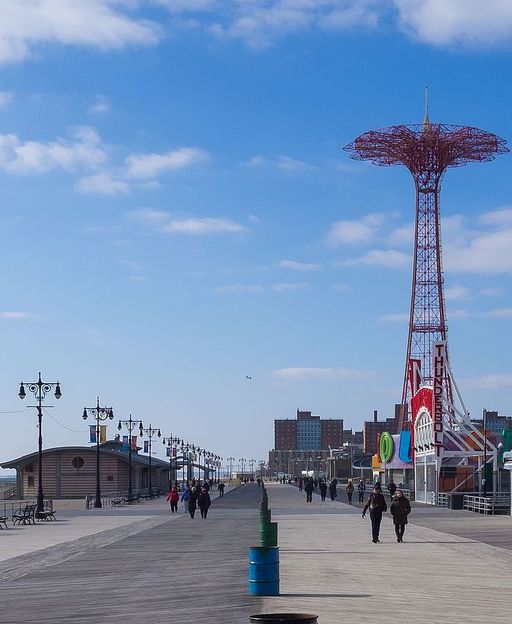
The Coney Island boardwalk — formally the Riegelmann Boardwalk — runs for 2.7 miles along the beachfront. Most visitors cover a section of it rather than the full length, but the whole walk takes about an hour and is worth doing if the weather is reasonable.
The western end towards Sea Gate is quieter and gives a clearer sense of what the area looks like away from the rides. The eastern end, past Brighton Beach, shifts into a Russian and Eastern European neighbourhood with a distinctly different character — different food stalls, different sounds, a different crowd. Brighton Beach is technically a separate neighbourhood but the boardwalk connects them without any clear boundary.
Early mornings are a different experience from afternoons. Residents use the boardwalk for exercise, the beach is mostly empty, and the rides are closed. If you want to see Coney Island without the summer crowd, an early weekday morning in the shoulder season — May or September — works well.
Ride the Cyclone at Least Once
The Cyclone opened in 1927 and is still running. It is a wooden rollercoaster, which means it sounds considerably more alarming than a modern steel coaster — the rattling and creaking are structural features, not warning signs. The ride lasts about 90 seconds and reaches speeds of around 60 miles per hour.
It is not the tallest or fastest ride available at Coney Island, but it is the one with a genuine claim on history. The Cyclone is a New York City landmark and is listed on the National Register of Historic Places. Tickets are available at the gate and the queue moves quickly outside peak summer weekends.
Luna Park, which operates the Cyclone and most of the other rides in the area, also has a range of modern coasters alongside it. The Thunderbolt, which opened in 2014, is faster and smoother. But if you are choosing one ride that is specific to Coney Island, the Cyclone is the one with the history behind it.
Spend Time on the Beach
This sounds obvious but it is actually a separate tradition from visiting the amusement park. Coney Island beach is a public beach managed by New York City Parks. It is free to use, open from late May to mid-September, and has lifeguards on duty during those months.
On a hot summer weekend, the beach is one of the most densely packed in the north-east United States. An estimated one million people visit Coney Island on a busy summer weekend day. The beach is long enough to absorb the crowd, but it is genuinely busy. If you want a quieter stretch, the beach east of the main pier — past the rides concentrated near the boardwalk — tends to be less crowded.
The water quality has improved significantly over the past two decades. The beach regularly meets New York State swimming standards, though the city posts updates when conditions change after heavy rain. Facilities include changing areas, toilets, and outdoor showers.
Visit the New York Aquarium
The New York Aquarium sits right on the Coney Island boardwalk and is the oldest continually operating aquarium in the United States, founded in 1896. It reopened fully in 2019 after significant renovation and now places a strong focus on ocean conservation alongside its exhibits.
The shark exhibit and the sea otter habitat are the main draws for most visitors. The aquarium also runs a breeding programme for Pacific walruses and has an outdoor area overlooking the Atlantic. Tickets should be booked in advance on busy days, particularly during school holidays.
For families with younger children, the aquarium is often a better anchor for the day than the rides — it provides a consistent experience regardless of weather and takes a couple of hours without feeling rushed.
Watch the Mermaid Parade
The Mermaid Parade takes place annually on the first Saturday after the summer solstice, usually in late June. It has been running since 1983 and is one of the largest art parades in the United States. Participants dress in elaborate costumes — the theme is loosely oceanic but in practice covers everything from classic mermaid imagery to full-scale costume installations.
It is free to watch from the street. The parade route runs along Surf Avenue and then along the boardwalk. If you are visiting New York in late June, it is worth checking the exact date and building it into your itinerary. The parade draws large crowds but moves along the full route rather than concentrating in one spot, so finding a clear viewing position is generally straightforward if you arrive early.
The parade was created by Coney Island USA, a not-for-profit arts organisation that also operates the Coney Island Museum and the Coney Island Circus Sideshow. Both are worth a look if you want context for the area’s long history in popular entertainment.
Practical Information for Your Visit
Coney Island is served by the D, F, N, and Q subway lines, all of which terminate at Coney Island–Stillwell Avenue station. The journey from Midtown Manhattan takes around 45 minutes to an hour depending on the line and time of day. The subway is the practical option — parking in the area is limited on busy summer days.
Luna Park is open from April through October. The main season runs June to September, with more limited hours outside those months. Ride tickets can be purchased individually or as an all-day pass. The all-day pass makes sense if you plan to spend the full day on rides; for a mixed visit that includes the beach, boardwalk, and food, individual tickets work out better value.
The shoulder season — May, early June, and September — is often the best time for a first visit. The rides are open, the beach is accessible, and the crowds are substantially smaller than peak July and August. Weekday visits are quieter than weekends at any point in the season.
Coney Island is not a theme park with controlled entry, a single admission price, and a managed experience. It is a real neighbourhood that happens to have a fairground, a beach, an aquarium, and a hundred years of American popular culture embedded in it. The traditions that have lasted — the hot dog, the Wonder Wheel, the Cyclone, the Mermaid Parade — have lasted because they are straightforwardly good. That is the honest case for going.
