
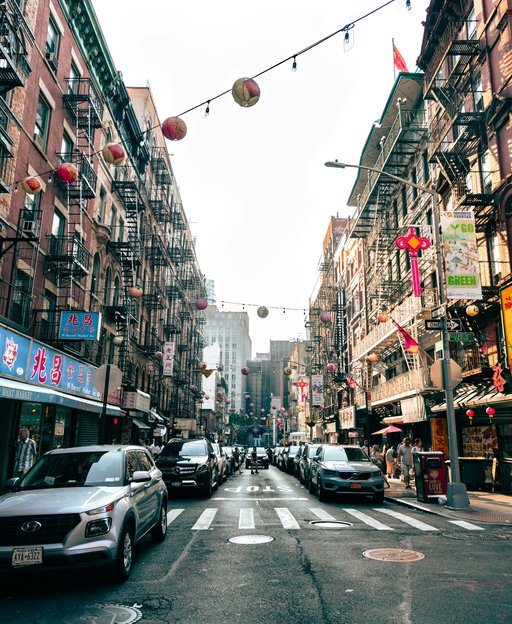
Walk along Mott Street in Lower Manhattan today. Red lanterns sway overhead. Roast ducks hang in restaurant windows. Vendors sell dragon fruit and bok choy on folding tables. The sounds are Cantonese and Mandarin. The smells are star anise, sesame oil, and jasmine tea.
This is one of the oldest Chinese communities in America. For more than 150 years, Chinese immigrants have shaped this small triangle of Lower Manhattan. They came with almost nothing. They built something extraordinary.
This is their story.
If you love New York’s hidden stories, you’ll love our free weekly newsletter. Subscribe to Love New York →
The First Chinese New Yorkers — A Community Born of Hardship
The first Chinese immigrants reached New York in the 1840s and 1850s. Many were sailors who jumped ship in the harbour. Others were merchants from China’s Guangdong province. They settled near the waterfront, close to work.
By the 1870s, they had gathered along Mott Street. This stretch of Lower Manhattan became the spine of the entire community. It still is today.
These early settlers worked in laundries, cigar factories, and restaurants. Discrimination was fierce. White New Yorkers feared Chinese workers as economic competition. City laws made daily life deliberately hard.
Yet the community grew. By 1880, around 700 Chinese residents lived in the area. By 1900, that number had risen to 7,000. And almost all of them were men.
The reason was a federal law passed in 1882.
The Exclusion Era — How One Law Shaped a Generation
The Chinese Exclusion Act of 1882 was one of the harshest immigration laws in American history. It barred almost all Chinese labourers from entering the United States. Wives and families could not join the men already here.
For six decades, Chinatown was a community of men. Bachelors lived in boarding houses. They worked long hours, sent money home, and waited.
To survive without the support of the wider city, the community built its own institutions. The Chinese Consolidated Benevolent Association, known as the CCBA, handled disputes and represented the community to city government. Family associations provided housing, loans, and jobs for new arrivals. Benevolent societies and merchant guilds ran the parallel life of Chinatown.
This was not backwardness. It was brilliance.
A community shut out from mainstream support built its own support from scratch. Chinatown became one of the most self-sufficient neighbourhoods in New York City.
Just a few blocks north, the Jewish community was building its own parallel world on Orchard Street and Delancey Street. Their story of tenement survival and cultural pride echoes the Chinatown story closely. You can read it in full in The Lower East Side That Jewish Immigrants Built.
The Streets That Tell the Story
Three streets form the old heart of Chinatown. Mott Street. Doyers Street. Pell Street. Each carries the weight of the past.
Mott Street is the main artery. Restaurants, bakeries, and produce markets line it from Canal Street to Chatham Square. In the 1880s, the same street held the headquarters of family associations, social clubs, and the offices of Chinatown’s informal government.
Doyers Street is the shortest and strangest. This narrow, L-shaped lane earned a grim nickname in the early twentieth century. Its sharp bend made it useful during the tong conflicts of the 1900s. It was called “the Bloody Angle.” Today it holds a post office and a handful of small restaurants. The bend is still there. The conflict is long gone.
Pell Street connects Mott and Doyers. Its fire escapes and red-painted buildings are classic Lower Manhattan tenement architecture. The Chinatown YMCA on Pell Street opened in 1932 — because no mainstream YMCA would admit Chinese-American members.
Columbus Park, at the bottom of Mott Street, was created in 1897. The city cleared the old Mulberry Bend slum to build it. Mulberry Bend had been part of the Five Points district, the rough Irish and immigrant neighbourhood that had stood here since the 1820s. Today elderly men play chess and mahjong under Columbus Park’s trees. On weekends, music fills the air. It is one of the most quietly joyful corners of Manhattan.
How Two Laws Changed Everything
The exclusion era finally ended during the Second World War. China was an American ally against Japan. In 1943, the exclusion act was repealed. Chinese immigrants could now become citizens. But the annual limit remained tiny — just 105 people per year.
The real turning point came in 1965. The Hart-Celler Immigration Act abolished national-origin quotas. For the first time, immigration from Asia was treated the same as immigration from Europe.
The effect on Chinatown was immediate and profound. New arrivals flooded in from Guangdong, Fujian, Hong Kong, and later from Taiwan and mainland China. Chinatown expanded rapidly. It pushed south into what had been part of Little Italy — the Italian immigrant neighbourhood just a few blocks away. It spread east towards the Lower East Side.
The population grew from roughly 20,000 in 1965 to over 100,000 by 2000.
Want more stories like this? Our weekly newsletter goes deeper into New York’s heritage every week. It’s free. Subscribe here →
Beyond Manhattan — The New Chinatowns
Chinatown has never stopped moving. As Manhattan rents rose, Chinese-American families moved outward. Two new communities grew to rival the original.
Flushing, Queens, became the second great Chinese New York. It now has one of the highest concentrations of Chinese residents of any neighbourhood outside Asia. Main Street in Flushing is a world of Mandarin signs, bubble tea shops, and dim sum restaurants. The food courts beneath its streets draw visitors from across the city and far beyond.
Sunset Park in Brooklyn grew into a third Chinese community in the 1980s and 1990s. Its Eighth Avenue corridor became Brooklyn’s Chinatown, serving families who had moved from Manhattan or arrived directly.
Today, an estimated 400,000 Chinese Americans live in the New York metropolitan area. It is one of the largest Chinese diaspora communities in the Western world.
This pattern of migration and neighbourhood-building is one New York has seen many times over. You can read a parallel story in Harlem and the Great Migration, where African Americans from the South built a neighbourhood that reshaped an entire culture.
Where to Go to Trace Chinese New York Heritage Today
The Museum of Chinese in America (MOCA) is at 215 Centre Street, just north of the main Chinatown streets. It is the finest single resource for understanding the community’s 200-year story. Permanent exhibitions cover the exclusion era, the building of the transcontinental railroad, and the growth of Chinese-American communities across the country. Admission is free on Thursdays.
Mott Street remains essential. Start at the corner of Canal Street and walk south. The Chinatown Ice Cream Factory at 65 Mott Street has been serving green tea and red bean ice cream since 1978. Wo Hop at 17 Mott Street has been feeding New Yorkers since 1938. It is still cash only. It is still worth the queue.
Eastern States Buddhist Temple at 64 Mott Street has been open since 1962. Worshippers buy sticks of incense and leave offerings at the altar. The fortune cookies piled at the entrance are a Western invention. The devotion inside the temple is not.
Columbus Park is free and open every day. On weekend mornings, the sounds of mahjong tiles, erhu strings, and Cantonese conversation carry all the way to Baxter Street.
If you are tracing Chinese ancestry connected to New York, the New York City Department of Records holds vital records from 1866. The New York Public Library’s Milstein Division has ship passenger records, early city directories, and census records. MOCA staff can direct you to specialist genealogical resources for Chinese-American family history.
Frequently Asked Questions
When did Chinese immigrants first arrive in New York City?
Chinese immigrants began settling in Lower Manhattan in the 1840s and 1850s, with many arriving as sailors or merchants from Guangdong province. By the 1870s, Mott Street had become the centre of the community, and the population reached around 7,000 residents by 1900, though it remained almost entirely male due to immigration restrictions in force at the time.
Where is the best place to learn about Chinese immigrant history in New York?
The Museum of Chinese in America (MOCA) at 215 Centre Street in Lower Manhattan is the definitive starting point, with 200 years of documented Chinese-American history. Mott Street itself — with its surviving tenements, temples, and restaurants dating back to the nineteenth century — is an open-air record of what this community built and how it endured.
Is there still an active Chinese community in Manhattan’s Chinatown today?
Yes. Manhattan’s Chinatown remains one of the most densely settled Chinese communities in the Western world, with tens of thousands of residents in the area around Mott Street. Flushing in Queens and Sunset Park in Brooklyn have grown into major Chinese-American communities in their own right, each with distinct regional character and their own restaurants, markets, and cultural institutions.
Ready to explore the New York your ancestors knew? Subscribe to Love New York — free weekly stories, heritage guides, and hidden history. Join us →
