
Every morning, across five boroughs, millions of New Yorkers make a choice that reveals something true about who they are. It is not about politics or neighborhood pride. It is about bagels — specifically, which bakery makes the only real one.
The argument has been running for over a hundred years. Nobody has won. Nobody ever will. And that is exactly why it matters.
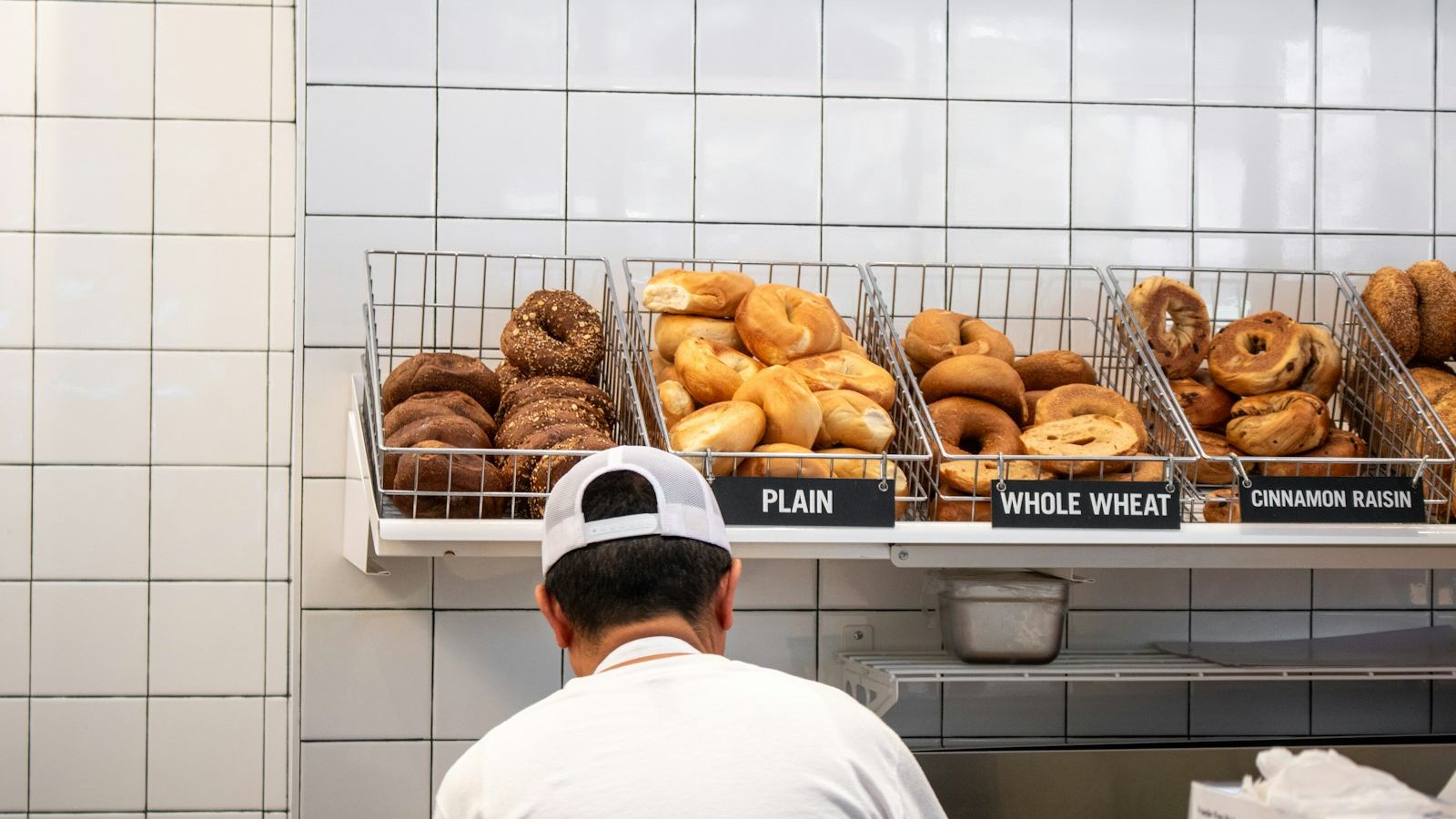
How a Round Bread Conquered a City
Bagels arrived in New York in the late 1800s with Jewish immigrants from Eastern Europe — specifically from Poland and Ukraine, where the chewy, boiled-then-baked bread had been a staple for centuries. The Lower East Side became the first battleground. By 1900, the streets were lined with pushcart vendors and small bakeries, each claiming their version was the authentic article.
The Bagel Bakers Local 338 formalized the craft in 1907. Only union-trained bakers could make bagels sold in New York City, and there was a strict formula: hand-rolled dough, kettle-boiled in water laced with malt barley, then baked at high heat. The result had a crackling crust and a dense, chewy interior that no other bread in the world quite matched.
At its peak, the union had over 300 members working through the night across Manhattan. Bagels were not a breakfast food yet — they were sold on pushcarts by the string, a dozen threaded together, cheap and filling enough to carry a family through a long day of work.
The Machine War That Split New York in Two
In the 1960s, everything changed. An inventor named Daniel Thompson built a machine that could produce hundreds of bagels an hour, perfectly uniform, without a single hand-rolled seam. The union went to war. For years, machine-made bagels were effectively banned in New York City through collective bargaining agreements that held the line on craft production.
By the 1980s, the machines had won. Most bagels sold across America today are machine-made — softer, lighter, and baked without any kettle boiling at all. New Yorkers still argue about whether that product deserves the name. Many will tell you, without apology, that it is bread with a hole. Not a bagel.
The handful of remaining hand-rolled bakeries became something close to sacred. Visiting one on a Saturday morning, watching a baker twist dough into rings with practiced speed, feels like watching something that almost didn’t survive.
The Water Theory Nobody Can Prove — or Disprove
Ask any New Yorker why bagels taste different here, and they will tell you about the water. New York City’s water supply comes from the Catskill Mountains — soft water, naturally low in minerals, long credited with producing exceptional bread dough. Pizza makers say the same thing. Bagel bakers swear by it.
Scientists are more careful. Some studies support the theory. Others don’t find a definitive difference. But here’s what no one disputes: bagel shops outside New York that import NYC water — and a few have tried — get closer to the real thing than those that don’t. Something is happening in that dough.
New Yorkers take quiet satisfaction in the uncertainty. The argument cannot be settled because the answer is partly chemistry and partly history and partly the irreplaceable fact of being here.
Enjoying this? Join New York lovers getting stories like this every week. Subscribe free →
The Great Bakeries and Their Partisans
Ess-a-Bagel. Russ & Daughters. Murray’s. Absolute Bagels. Kossar’s. Each of these names inspires fierce loyalty and muttered insults about every other name on the list. Bring up the ranking at any New York breakfast table and be prepared to lose the next forty-five minutes.
Kossar’s Bagels & Bialys, on Grand Street in the Lower East Side, opened in 1936 and is the oldest bialy bakery in the United States. Bialys are the bagel’s lesser-known cousin — no hole, baked not boiled, with a soft well in the center filled with caramelized onion and poppy seeds. Kossar’s still makes them by hand the old way, which is to say the only real way.
Ess-a-Bagel draws lines around the block every weekend. Murray’s, on Bleecker Street in the West Village, is beloved by downtown New Yorkers who find uptown places overrated. Absolute Bagels on the Upper West Side has a quiet cult following that treats the place like a secret. There is no ranking that satisfies everyone. Offering one in a New York diner will start an argument faster than almost anything else.
The immigrant community that brought the bagel here also brought the pastrami, the brisket, and the pickle. If you want to understand the full story behind New York’s Jewish deli culture, the pastrami sandwich has an equally extraordinary origin story — starting with a Romanian pickle barrel on Delancey Street.
Why It Tastes Different in Every Neighborhood
This is the part that visitors find baffling and New Yorkers consider obvious: the bagel you get in Park Slope is genuinely different from the one you get in Jackson Heights. Even within the same neighborhood, bakeries develop distinct profiles over decades — slightly chewier, darker crust, more salt crust on top, a hint of honey worked into the dough.
That variation is not a flaw. It is the whole point. New York’s bagel culture evolved neighborhood by neighborhood, bakery by bakery, each one carrying a piece of the founder’s regional tradition from Eastern Europe into a new city. The bagels of the Lower East Side reflect one immigrant journey. The bagels of Astoria reflect another. They are all New York bagels. They are all slightly different. Both things are completely true.
The same immigrant energy that brought the bagel here gave New York its Yiddish theater scene on Second Avenue — a cultural world that shaped American comedy, drama, and song for generations. Food and art arrived in the same trunks.
New York’s food culture runs wide and deep. If you want a guide to everything worth eating across the five boroughs, our New York food guide covers the essential eats every visitor needs to know.
Frequently Asked Questions About New York Bagels
Where can I find the best bagels in New York City?
The most celebrated bagel shops include Ess-a-Bagel (Midtown East), Absolute Bagels (Upper West Side), Murray’s Bagels (West Village), and Kossar’s Bagels & Bialys (Lower East Side). Each has devoted fans and detractors — visiting two or three on the same trip and forming your own opinion is the only true New York approach.
What makes New York bagels different from bagels everywhere else?
Traditional New York bagels are hand-rolled, kettle-boiled in malt-laced water before baking, which gives them their characteristic chewy interior and crackly crust. Many credit New York City’s soft mountain water as a contributing factor. Most bagels sold outside New York are machine-made and skipped the boiling step entirely, producing a noticeably softer, less complex result.
What is the best time to visit a New York bagel shop?
Early morning, ideally before 9 a.m. on a weekday. Weekend mornings at popular spots like Ess-a-Bagel and Absolute Bagels draw significant lines, especially between 9 a.m. and noon. Arriving early on a weekday means fresher product and a shorter wait — the bagels have just come out of the oven and the shop smells extraordinary.
What is the difference between a bagel and a bialy?
A bialy has no hole — instead, it has a shallow depression in the center filled with caramelized onion and poppy seeds. Unlike bagels, bialys are baked without being boiled first, giving them a softer crust and a slightly bread-like texture. Kossar’s on the Lower East Side is the best-known bialy bakery in the city and has been making them since 1936.
The hundred-year war over New York’s best bagel has no winner because it was never really a competition. It was an identity — hundreds of immigrant families, each one expressing something essential about home through dough and water and fire. Every New Yorker who walks into their local bagel shop on a Saturday morning is, without thinking about it, continuing something that began long before they were born.
You Might Also Enjoy
- Why New York’s Most Famous Sandwich Started in a Romanian Pickle Barrel
- The Theater Street That Made Millions of New Yorkers Laugh, Cry, and Argue in Yiddish
- New York Food Guide: The Essential Eats Every Visitor Needs to Know
Plan Your New York Trip
Ready to experience New York’s food culture firsthand? Our complete New York food guide has everything you need — from neighborhood breakfasts to legendary delis — to eat your way through the city like a local.
Join 1,100+ New York Lovers
Every weekday morning, get New York’s hidden gems, neighbourhood stories, food origins, and city secrets — straight to your inbox.
Subscribe free — enter your email:
Love more? Join 65,000 Ireland lovers → · Join 43,000 Scotland lovers →
Free forever · Unsubscribe anytime

Subscribe Free