
At its peak, Little Italy stretched across nearly forty blocks of lower Manhattan. The streets smelled of roasting espresso and Sunday gravy. Old men played cards outside social clubs. Dialects from Calabria, Sicily, and Naples mixed in the air. Today, that world has been reduced to about three blocks on Mulberry Street — and most of the people eating at the red-checkered tables don’t speak a word of Italian.
The Great Arrival
Between 1880 and 1924, more than four million Italians passed through Ellis Island. Many of them walked off the ferry and landed right in the same handful of streets south of Houston. They came from villages where everyone knew everyone, and they recreated that world on Mulberry, Mott, and Elizabeth Streets.
They formed mutual aid societies named after patron saints from their home provinces. They built churches, bakeries, and social halls. By 1900, the area between Canal Street and Houston was one of the most densely populated places on earth — an entire Italian world transplanted to lower Manhattan, block by block.
When Mulberry Street Was Its Own Universe
In the early twentieth century, Little Italy hummed with a life that had nothing to do with the city around it. Women hung laundry between buildings. Street vendors sold clams, roasted chestnuts, and lemon ice from wooden carts. The feast days — especially the Feast of San Gennaro in September — transformed the streets into celebrations that lasted days.
The neighborhood had its own rhythms, its own economy, its own rules. Generations of families lived and died within a few blocks of where they’d arrived. Children grew up speaking Neapolitan before they learned English. The outside city felt very far away.
The food culture ran deep. Bread from the same families for generations. Pastry shops that guarded their cannoli recipes like state secrets. And yes — the red-sauce traditions that would eventually conquer American dining. If you’ve ever wondered why New York pizza tastes different from anywhere else on earth, part of the answer starts here.
How Chinatown Changed the Map
The decline wasn’t sudden. It crept block by block over decades. As second and third-generation Italian-Americans prospered, they moved to the suburbs — to Long Island, New Jersey, Westchester. The old neighborhood lost its people even as it kept its name.
Meanwhile, Chinatown — which had been packed into a few streets to the south — began to expand. New York’s Chinatown became one of the most vibrant immigrant communities in the Americas, swallowing block after block of what had been Italian territory. Canal Street used to be a border. Now it’s just a street that Chinatown has long since crossed.
By the 1980s, Little Italy had shrunk dramatically. By the 2000s, it had become more of a memory than a neighborhood. The social clubs closed. The families left. What remained was a strip of restaurants serving the Italian-American dishes that tourists expected, run increasingly by people with no Italian roots at all.
Enjoying this? Join New York lovers getting stories like this every week. Subscribe free →
What Survives on Mulberry Street Today
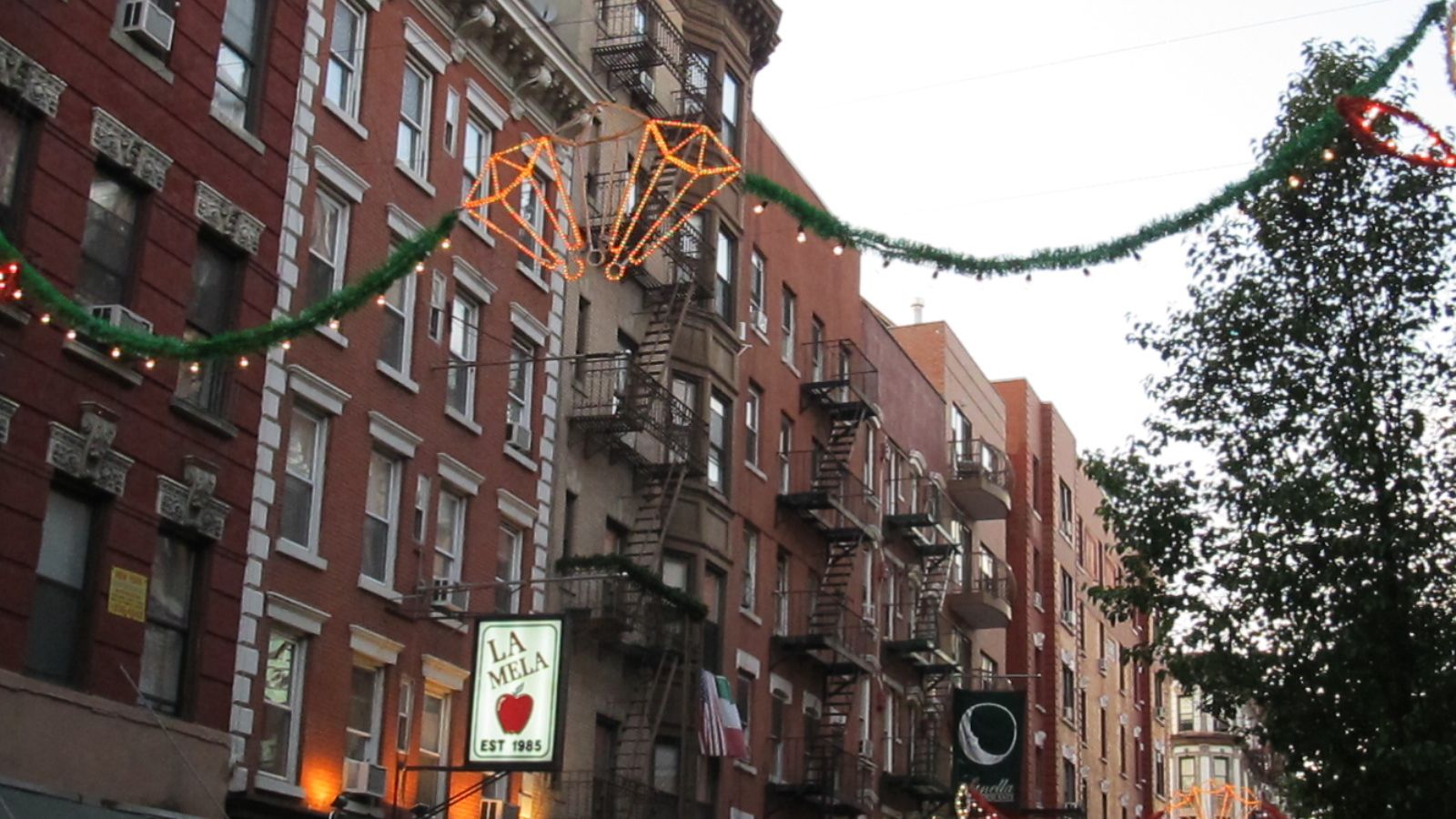
And yet — go to Mulberry Street on a warm evening, and something real still lingers. The old brick facades haven’t changed. The awnings are red, white, and green. Waiters hover at the sidewalk, menus in hand, calling out to anyone who slows down. It feels like a stage set, but even stage sets can hold a kind of truth.
A handful of institutions have survived. Ferrara Bakery on Grand Street has been serving pastry since 1892. Alleva Dairy on Grand — claiming to be the oldest Italian cheese shop in America — still makes its own fresh mozzarella daily. Di Palo’s Fine Foods, run by the same family since 1910, sells imported Italian provisions that would make a Roman weep with recognition.
These aren’t tourist traps. They’re the real thing — survivors from a world that has mostly vanished. The people who run them remember what the neighborhood used to be, and they know they’re holding the last of it.
The Feast That Refuses to Die
Every September, Little Italy briefly becomes itself again. The Feast of San Gennaro closes eleven blocks and draws over a million people across eleven days. Zeppole sizzle in enormous vats of oil. Sausage-and-pepper sandwiches send smoke into the air. The statue of San Gennaro — patron saint of Naples — is carried through the streets in a procession that dates back to 1926.
The feast is both an act of preservation and a performance. Italian-Americans come back from the suburbs to walk the old streets. Visitors come to experience something that feels like the neighborhood at its height. For eleven days, Mulberry Street is full again — and the question of what’s real and what’s recreation quietly stops mattering.
That’s what makes Little Italy so bittersweet. It’s a place that mostly exists in memory and in the stories of people whose grandparents arrived with nothing. But the few blocks that remain carry the weight of all of it — every Sunday dinner, every feast, every argument over espresso, every family that came from nothing and became New Yorkers.
Frequently Asked Questions
What is left of Little Italy in New York City today?
Little Italy has shrunk to just a few blocks along Mulberry Street between Canal and Broome Streets in lower Manhattan. A handful of authentic Italian institutions survive — including Ferrara Bakery (est. 1892), Di Palo’s Fine Foods (est. 1910), and Alleva Dairy — alongside a strip of Italian-American restaurants that cater primarily to visitors.
Where exactly is Little Italy in Manhattan?
Little Italy is located in lower Manhattan, centered on Mulberry Street between Canal Street and Houston Street. The historic core today is mostly the blocks between Canal and Broome. It borders Chinatown to the south and SoHo to the north, and is a short walk from the subway at Canal Street (6, J, N, Q, R, W, Z trains).
Is Little Italy in NYC worth visiting?
Yes — especially for the authentic holdout businesses rather than the tourist-facing restaurants on the main strip. Di Palo’s, Ferrara, and Alleva Dairy are genuine institutions worth seeking out. The neighborhood is also most alive during the Feast of San Gennaro in September, when the streets fill with more than a million visitors over eleven days.
What is the best time to visit Little Italy in New York City?
September is the best time to visit, when the Feast of San Gennaro transforms Mulberry Street into a street festival that runs for eleven days. For a quieter experience, visit on a weekday morning when the long-standing delis and bakeries are at their best and the crowds are thinner.
You Might Also Enjoy
- The New York Chinatown That Preserved a World Nobody Else Remembered to Save — the community that grew up alongside Little Italy
- Why New York Shuts Down 11 Blocks Every September for a Single Saint — the full story of the Feast of San Gennaro
- The Real Reason New York Pizza Tastes Different From Every Slice on Earth — the Italian-American food tradition that changed America
Plan Your New York Trip
Ready to explore lower Manhattan? Our New York City food guide covers the best places to eat across the city — from Di Palo’s mozzarella to the best dumplings in Chinatown, just a block away.
Join 1,100+ New York Lovers
Every weekday morning, get New York’s hidden gems, neighbourhood stories, food origins, and city secrets — straight to your inbox.
Subscribe free — enter your email:
📲 Know someone who’d love this? Share on WhatsApp →
Love more? Join 65,000 Ireland lovers → · Join 43,000 Scotland lovers →
Free forever · Unsubscribe anytime

Subscribe Free