
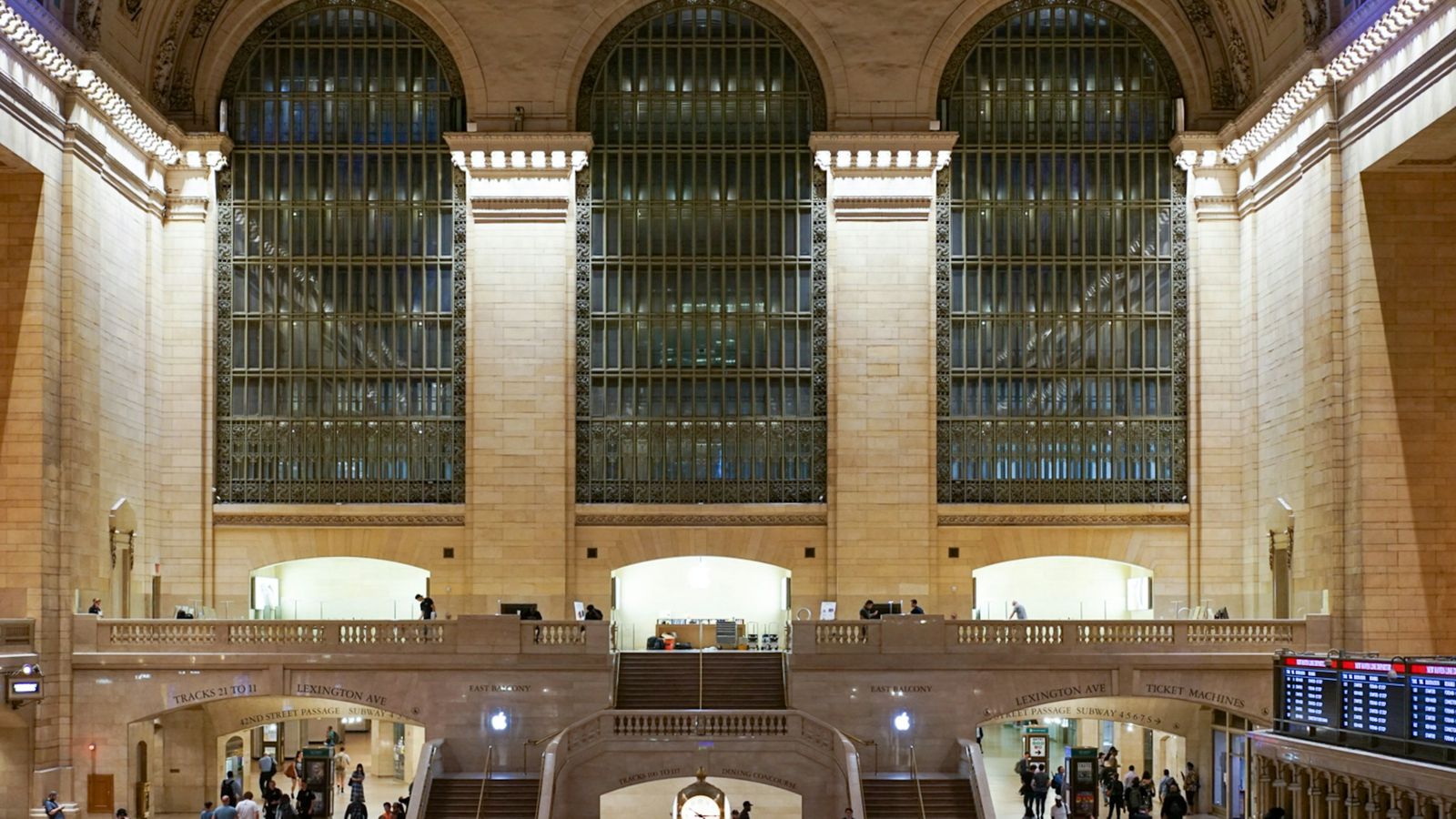
Every weekday, around 750,000 people pass through Grand Central Terminal. They check their phones, grab coffee, catch their trains. Almost none of them look up.
They’re walking through one of the most remarkable buildings on Earth, and most of them don’t know half of what it contains.
The Ceiling That Painted the Night Sky Backwards
The ceiling of Grand Central’s main concourse is famous. Turquoise-blue, dotted with 2,500 gilded stars, it traces the constellations of the Mediterranean winter sky.
But look closely, and something is off. The stars are painted as a mirror image — reversed left to right. Orion raises the wrong arm. The whole sky is flipped.
The most popular explanation: the painters worked from a medieval manuscript that showed the sky from the outside looking in — a “God’s perspective.” Whether that’s an accurate account or an after-the-fact excuse is still debated by historians.
What’s certain is that it went unchanged for decades. When the ceiling was cleaned and restored in the 1990s, the stars stayed exactly as they were. New York kept its backwards sky.
The Secret Platform Used by a U.S. President
Below street level, well beneath the public concourse, lies Track 61. It’s a hidden railroad siding that never appeared on any public map of the terminal.
For decades, it served one primary purpose: to bring President Franklin D. Roosevelt into New York City without being seen.
FDR had polio. He used a wheelchair. He was acutely aware of how the press might perceive visible signs of physical weakness during the Depression and World War II. Track 61 allowed his private rail car — and sometimes an armored military vehicle — to enter the terminal directly and discreetly.
The platform still exists today, used only for storage and occasional film shoots. The elevator that once carried the President up into the Waldorf Astoria hotel, directly above the terminal, still operates.
The Whispering Gallery Nobody Knows By Name
In the lower dining concourse, just outside the entrance to the Oyster Bar restaurant, is one of the most unusual acoustic spaces in New York.
It’s an arched, tiled passageway — four corners, low domed ceiling. If two people stand in diagonal corners, face the wall, and whisper, they can hear each other clearly from 30 feet away. The curved ceiling carries sound as if through a private telephone line.
New Yorkers use it to propose marriage. Tourists stumble onto it by accident. There are no signs. The terminal has never promoted it.
It works because of the geometry of the Guastavino tile vaulting — a system patented by Spanish architect Rafael Guastavino and used throughout New York in the late 19th and early 20th centuries. The same tiles appear in the City Hall subway station, the Cathedral of St. John the Divine, and dozens of other New York landmarks.
Enjoying this? Join New York lovers getting stories like this every week. Subscribe free →
The Campaign That Saved It From Being Demolished
In 1963, New York demolished Penn Station. The loss shocked architects and city planners across the country. If that magnificent building could be torn down, anything could.
By the late 1960s, Grand Central faced the same fate. A developer proposed building a 55-story office tower directly above it. The terminal’s owners needed the revenue. The permits were advancing.
The campaign to save Grand Central became one of the most famous preservation battles in American history. Jackie Kennedy — then Jackie Onassis — became its most visible champion. She wrote letters, gave interviews, and attended hearings.
“Is it not cruel,” she asked at one rally, “to let our city die by degrees, stripped of all her proud moments?”
In 1978, the Supreme Court ruled that New York City’s landmark preservation law was constitutional. Grand Central was saved. That ruling set the legal precedent that has protected historic buildings across America ever since.
The Clock Worth More Than Most People Realise
The four-faced opalescent clock atop the central information booth is the most photographed object in Grand Central — and possibly the most valuable item inside it.
Appraisers have valued the clock at somewhere between $10 million and $20 million. Each of its four faces is made of opal glass — not painted, not plastic — and measures roughly 24 inches across.
For over a century, New Yorkers have been meeting beneath it. “Meet me at Grand Central” has always meant meet me at the clock. Nothing else in New York has served as a meeting point for longer.
The Details Most Commuters Never Notice
Grand Central has 25 ramps and almost no stairs. The original architects — Reed and Stem, and Warren and Wetmore — believed ramps moved crowds faster and more safely than steps. In a terminal designed for 100 million annual passengers, every second of bottleneck mattered.
The building has 44 platforms on two levels. It is the largest train station in the world by number of platforms. Most New Yorkers who pass through it every single day have no idea.
On the south facade facing 42nd Street, a sculpted group of figures faces the city. The central figure is Mercury, the god of travel and commerce, flanked by Hercules and Minerva. Below them, a circular window marks the spot where a proposed tower was once supposed to rise — and never did.
Most commuters who know Grand Central know it by instinct. They know which exit gets them out fastest, which escalator is broken, which track their train uses. But knowing a place by routine is not the same as knowing it at all. Stand under that backwards sky for a few minutes, and the difference becomes clear.
Is Grand Central Terminal free to visit?
Yes, completely free. You don’t need a train ticket to enter and explore. The main concourse, lower concourse, food hall, and Whispering Gallery are all open to the public at no charge, any day of the week.
Where exactly is the Whispering Gallery in Grand Central?
It’s in the lower dining concourse, in the arched passageway just outside the entrance to the Grand Central Oyster Bar. Stand in one corner, have a companion stand diagonally across from you, face the wall, and whisper. There are no signs — knowing where it is is the whole point.
What is the best time to visit Grand Central Terminal?
Weekday mornings between 7 and 9 a.m. give you the full rush-hour spectacle — thousands of commuters crossing the main concourse in every direction. For a quieter visit, come on a weekend afternoon. The famous shafts of light through the upper windows are at their best on a clear winter morning.
Can you visit Track 61 and the FDR secret platform?
Track 61 is not open to the public and has no regular tours. It exists beneath the Waldorf Astoria hotel above Grand Central and is occasionally used for film production. The Roosevelt connection is well-documented by historians and remains one of the terminal’s most compelling stories.
You Might Also Enjoy
- What the Chrysler Building Hides That Most Visitors Never Think to Look For — Midtown’s other great architectural secret, just blocks away from Grand Central.
- What’s Really Hiding Inside New York’s Most Beautiful Building — another landmark with far more beneath the surface than most visitors suspect.
- Why New York’s Fire Escapes Became the Most Lived-In Spaces in the City — the unexpected story of the architectural detail that defines New York’s streetscape.
Plan Your New York Trip
Grand Central Terminal is on 42nd Street at Park Avenue in Midtown Manhattan, open daily and always free to enter. For a complete guide to what to see and do across the city, our 5-day New York City itinerary covers the neighborhoods, landmarks, and hidden details that make any visit unforgettable.
Join 1,100+ New York Lovers
Every weekday morning, get New York’s hidden gems, neighbourhood stories, food origins, and city secrets — straight to your inbox.
Subscribe free — enter your email:
📲 Know someone who’d love this? Share on WhatsApp →
Love more? Join 65,000 Ireland lovers → · Join 43,000 Scotland lovers →
Free forever · Unsubscribe anytime
Frequently Asked Questions
Why is the ceiling in Grand Central's main concourse painted backwards?
The 2,500 gilded stars trace the Mediterranean winter sky as a mirror image — completely reversed left to right. The popular explanation is that painters worked from a medieval manuscript showing the sky from "God's perspective" (looking outward), though historians still debate if this was intentional or an after-the-fact excuse.
What is Track 61 at Grand Central?
It's a secret underground platform built so President Franklin D. Roosevelt could enter the terminal without being seen by the press. FDR used a wheelchair and didn't want to appear physically weak during the Depression and WWII, so his private rail car arrived directly at this hidden siding below street level instead of the public concourse.
Can you visit Track 61 today?
No — it's not open to the public and remains well below street level, used only for storage and occasional film shoots. You can still see the historic elevator that once carried Roosevelt directly up to the Waldorf Astoria hotel above the terminal.
Was the backwards ceiling ever corrected?
No. When the ceiling was fully restored in the 1990s, the reversed stars were kept exactly as painted, preserving over a century of history regardless of whether the backwards design was original intent or accident.

Subscribe Free