
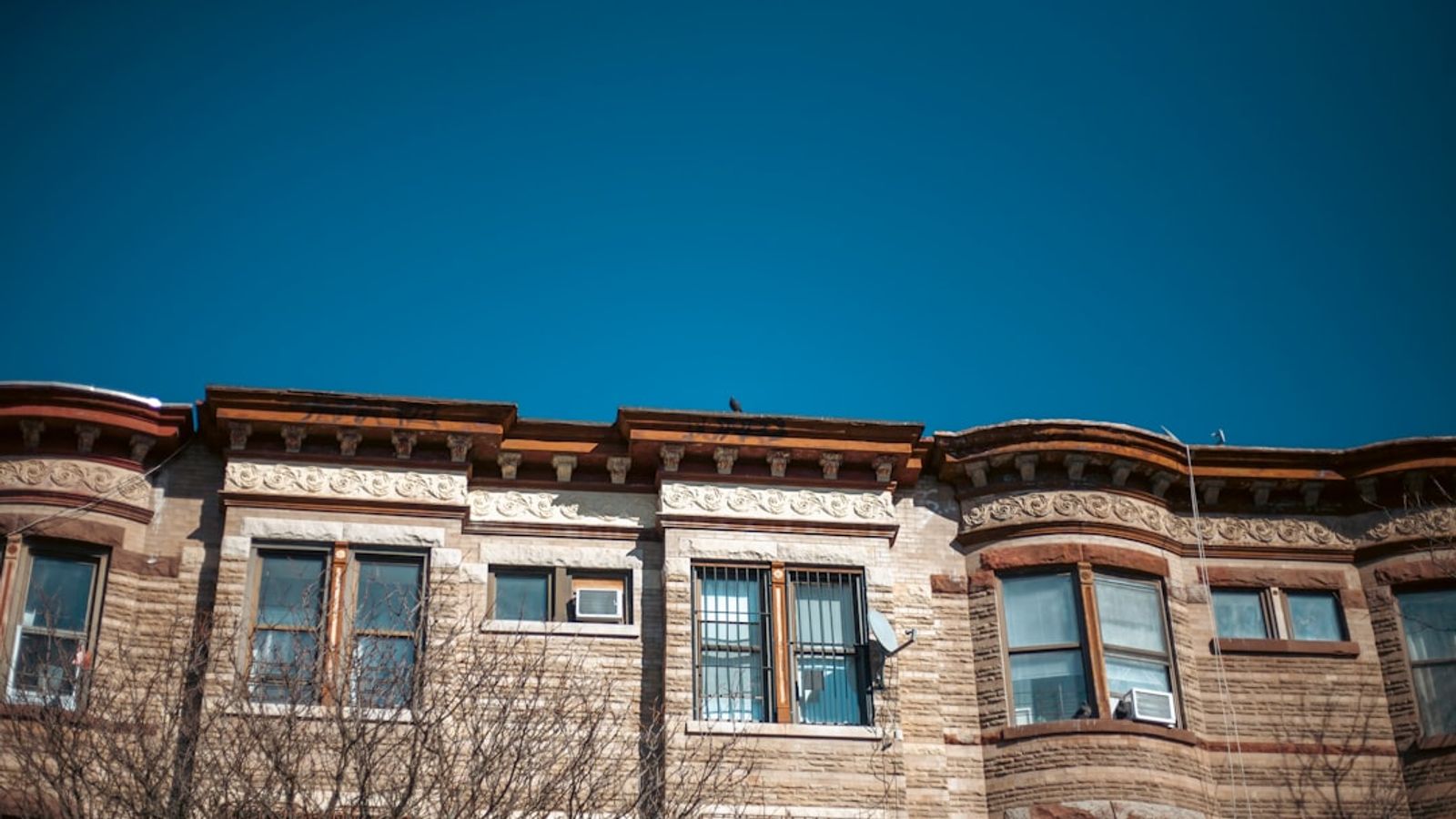
Walk down any street in Park Slope, Cobble Hill, or Fort Greene, and you notice something unusual. The buildings match. Row after row of the same reddish-brown stone, the same ornate stoops, the same carved lintels and cornices. Brooklyn doesn’t look like Manhattan, or Chicago, or any other American city. It looks like Brooklyn — and that’s because of a single type of stone that builders quarried, shipped, and stacked across entire neighborhoods in just a few decades.
What Is Brownstone, Exactly?
Brownstone isn’t brick, though people often confuse the two. It’s a type of reddish-brown sandstone — ancient rock, formed hundreds of millions of years ago. What makes it unusual is how soft it is when freshly quarried. Masons could cut it, shape it, and carve elaborate ornamental details into it with relative ease.
The reddish color comes from iron oxide. As the stone weathers over time, it deepens. That’s why older brownstones often look darker than newer restorations — the original stone has had more time to oxidize.
The main quarries were in Portland, Connecticut, along the Connecticut River, and in Belleville, New Jersey. Both sites were accessible by water, which made shipping large quantities of stone to Brooklyn practical and affordable.
Why Brooklyn? Why the 1860s?
Brooklyn’s brownstone era has a precise timeline: roughly 1860 to 1900. It wasn’t an accident.
This was when Brooklyn’s population was exploding. Waves of immigrants and middle-class New Yorkers were moving across the East River, looking for more space than Manhattan could offer. The Brooklyn Bridge opened in 1883, and migration accelerated. Developers needed to build thousands of homes, fast.
Brownstone fit the moment perfectly. It was cheaper than granite or marble. It could be quarried and shipped within days. And it gave buildings a look of solidity and respectability — which is exactly what aspiring homeowners wanted their addresses to project.
Row houses maximized what developers could build on each lot. A single brownstone rowhouse was often just 18 to 22 feet wide. String fifteen together and you’d filled an entire block with sold-out housing. You can read the story of how Brooklyn’s great bridge changed everything to understand just how quickly the borough transformed.
The Stoop Was Never Just a Step
The iconic brownstone stoop — the raised front entrance with steps descending to the street — isn’t decorative. It’s functional, and it tells you something about how these houses were originally used.
Brownstone row houses were built with a half-sunken “English basement” on the ground floor. That level housed the kitchen and servants’ quarters. The main entrance, at the top of the stoop, opened onto the parlor floor — the formal reception rooms where middle-class families received guests.
Servants used the lower entrance. Residents used the stoop. The stoop was a social dividing line, built right into the stone.
Over time, as single-family ownership gave way to multi-unit living, the stoop became something else: a gathering place. By the mid-twentieth century, Brooklyn stoops were where neighbors met, children played, and the rhythms of street life unfolded. That culture is still alive today on Brooklyn’s best blocks.
Enjoying this? Join New York lovers getting stories like this every week. Subscribe free →
When Brooklyn Almost Lost Its Brownstones
By the 1920s, brownstone was out of fashion. The stone itself was part of the problem. While easy to carve when fresh, it’s also porous — it absorbs water, cracks in freezing temperatures, and spalls (flakes off in layers). Poorly maintained brownstones shed chunks of their facades onto the sidewalk below.
The style also felt dated. Modernism was arriving. Clean brick and glass looked forward; carved brownstone looked like your grandparents’ era. Wealthy families left for newer apartments in Manhattan. Their brownstones became boarding houses, subdivided into small rooms for the working poor.
By the 1950s, urban renewal threatened entire blocks. Some Brooklyn neighborhoods lost significant numbers of these buildings to demolition. What saved the rest was a movement that nobody planned.
How Brooklyn Kept What Nobody Wanted
In the 1960s, something unexpected happened. Artists, writers, and young professionals — priced out of Manhattan — started buying the neglected brownstones of Brooklyn Heights, Cobble Hill, and Park Slope. They didn’t just buy them. They stripped layers of paint, restored original details, and turned them back into single-family homes.
These buyers called themselves “brownstoners.” They formed neighborhood associations, fought demolition permits, and pushed for historic preservation. Entire neighborhoods were eventually designated as historic districts — protecting them from the wrecking ball permanently. Brooklyn Heights was among the first areas in New York City to receive that protection.
The quarries that supplied those original buildings are largely exhausted or closed. The Portland, Connecticut quarry is flooded today — it operates as a quarry park for swimming and scuba diving, not stone extraction. New brownstone is scarce and expensive, used almost exclusively for restoration, not new construction.
The stone that built Brooklyn is essentially gone. But Brooklyn kept the buildings.
Frequently Asked Questions
What makes a brownstone different from a regular brick building?
A brownstone is clad in actual sandstone — a soft, reddish-brown rock quarried in New England and New Jersey — rather than fired clay brick. The stone allowed for far more ornamental carving than brick, which is why brownstones feature elaborate cornices, lintels, and bay windows that brick buildings typically don’t have.
Where are the best streets to see Brooklyn brownstones today?
Park Slope (especially the blocks between Prospect Park and Seventh Avenue), Carroll Gardens, Cobble Hill, and Fort Greene all have outstanding rows. Brooklyn Heights has the highest concentration of pre-Civil War brownstones in the city and is worth an afternoon on its own.
What is the best time of year to walk Brooklyn’s brownstone neighborhoods?
Fall is the most striking — tree-lined streets in Park Slope and Carroll Gardens turn gold and amber against the warm red stone. Spring is equally beautiful when flowering trees bloom along the stoops. Winter evenings, when parlor-floor lights glow through original bay windows, have their own particular magic.
Can visitors see the inside of a Brooklyn brownstone?
The Brooklyn Historical Society and the Brooklyn Heights Association occasionally host house tours with interior access to privately owned brownstones. These are worth checking in advance — they sell out quickly and offer a rare chance to see how these buildings were originally designed to be lived in.
You Might Also Enjoy
- The secrets hidden inside the Brooklyn Bridge’s towers
- How Brooklyn Heights became the address everyone in Manhattan envies
Plan Your New York Trip
Before you go, check out our complete guide to free things to do in NYC — packed with neighborhood walks, historic sites, and everything that makes New York worth coming back to.
The brownstones outlasted the quarries that made them. They outlasted the fashions that dismissed them. They outlasted the urban renewal bulldozers that threatened them. What saved them wasn’t government policy or grand plans — it was regular people who looked at something worn-out and saw something worth keeping.
That’s a very Brooklyn story.
Join 1,100+ New York Lovers
Every weekday morning, get New York’s hidden gems, neighbourhood stories, food origins, and city secrets — straight to your inbox.
Subscribe free — enter your email:
📲 Know someone who’d love this? Share on WhatsApp →
Love more? Join 65,000 Ireland lovers → · Join 43,000 Scotland lovers →
Free forever · Unsubscribe anytime

Subscribe Free