
It took fourteen years, three members of one family, and the labor of workers whose names were never recorded to build the Brooklyn Bridge. By the time the first crowds walked across it in 1883, the man who designed it had been dead for over a decade. The bridge was not just an engineering triumph. It was a monument to human cost.
The Dream That Started on a Ferry Dock
John Augustus Roebling hated the ferry crossing between Manhattan and Brooklyn. In winter, the East River froze and the boats stopped entirely. He was a German immigrant engineer who had already built suspension bridges in Pittsburgh and Niagara Falls, and he believed the East River could be crossed permanently.
He proposed a bridge of unprecedented scale — taller than any structure in the city, spanning 1,600 feet across open water. Many engineers called it impossible. New York said yes anyway.
Then, in 1869, before construction even broke ground, a ferryboat crushed Roebling’s foot against a dock piling during a survey trip at the planned site. He refused amputation. Tetanus set in. He died three weeks later. The dream fell entirely to his son.
The Invisible Enemy Beneath the River
Washington Roebling took over at 32, already a decorated veteran of the Civil War. The biggest engineering challenge wasn’t the steel or the stone — it was getting beneath the river in the first place.
Workers dug the bridge’s foundations inside massive pressurized wooden chambers called caissons, sunk to the riverbed with compressed air to keep water out. The conditions were brutal: gas lamps flickering in permanent darkness, searing heat, 12-hour shifts in an alien, airless world.
When workers rose too quickly from the pressurized depths, nitrogen bubbled in their blood. Joints locked. Paralysis set in. They called it “caisson disease.” We call it decompression sickness, or the bends. Washington Roebling spent too many hours underground himself. By 1872, he was paralyzed, partially blind, and confined to his bedroom in Brooklyn Heights. He would not walk on the bridge he built.
The Woman Who Finished It
This is where history gets extraordinary.
Washington’s wife, Emily Warren Roebling, became the bridge’s de facto engineer-in-chief. She had no formal engineering training. But she spent years learning from her husband — mathematics, cable theory, stress analysis, the physics of suspension design. She carried his instructions to the work crews. She negotiated with skeptical city officials and doubting engineers. She kept the project alive for eleven years from a Brooklyn Heights bedroom.
When the bridge opened on May 24, 1883, Emily was the first person to cross it officially — carrying a rooster as a symbol of victory. Washington watched from his window with a telescope.
Her name appears nowhere on the bridge. His does.
Enjoying this? Join New York lovers getting stories like this every week. Subscribe free →
The Proof That Settled the Doubters
The bridge opened to enormous celebration. President Chester Arthur crossed on opening day. Crowds gathered on both shores. New York threw a party worthy of the occasion.
But in the weeks that followed, nervous New Yorkers whispered about whether a structure this audacious could really hold. Engineers debated. Newspapers speculated. The city’s confidence wobbled.
So showman P.T. Barnum arranged one of the great publicity stunts in city history. He marched 21 elephants across the Brooklyn Bridge in a single procession.
The bridge held. The doubters went quiet. New York moved on — as it always does — toward the next impossible thing on the horizon.
Walking the Bridge Today
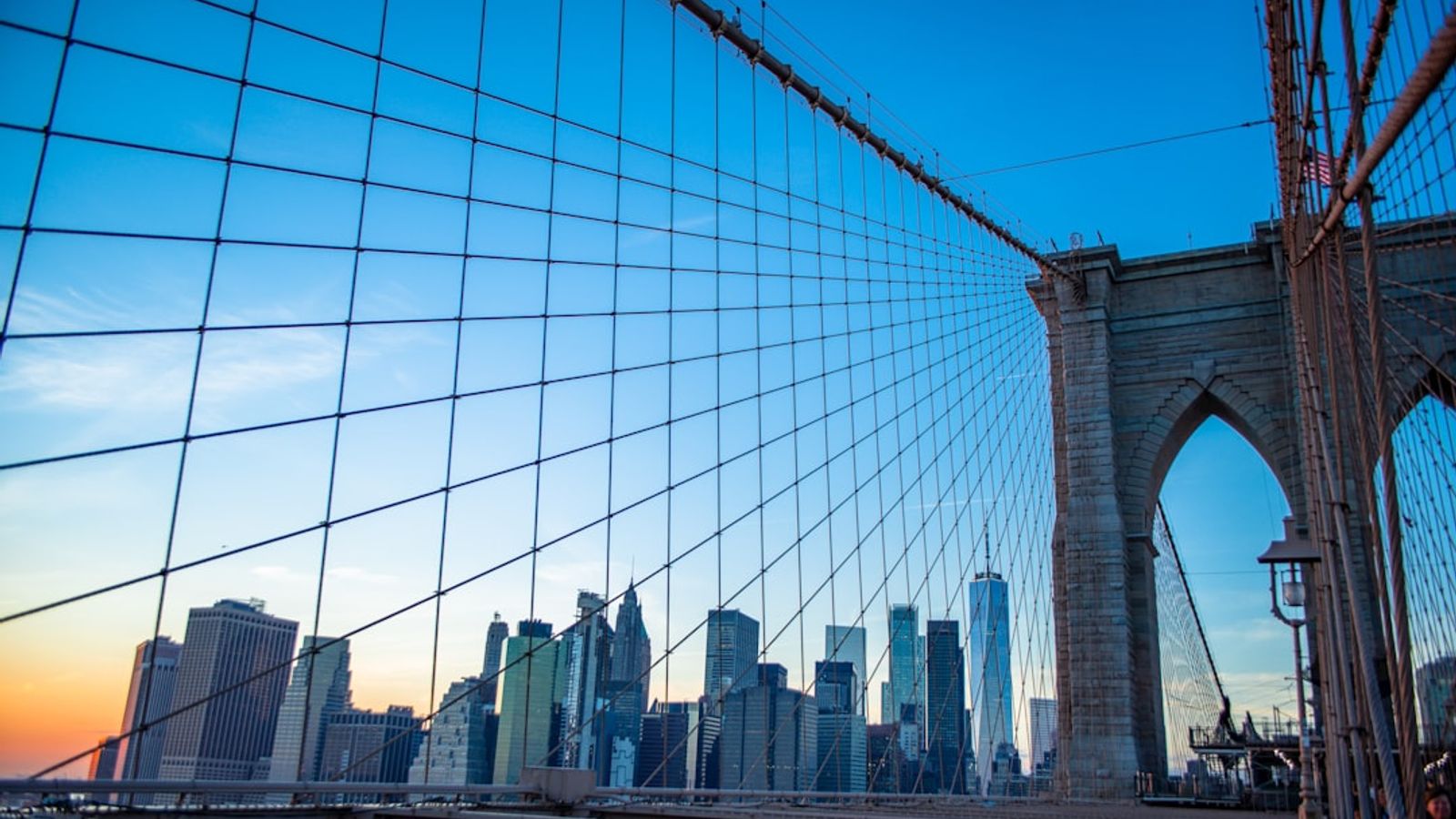
The bridge that cost so much to build is completely free to cross. The wooden pedestrian walkway runs above the traffic lanes, offering a perspective the city’s street grid simply cannot provide — Manhattan’s skyline to the west, Brooklyn spreading out to the east, the East River churning below.
Start in DUMBO on the Brooklyn side for the best approach. The full walk takes about 30 minutes at a comfortable pace — longer if you stop for photographs, which you will.
After crossing, the Brooklyn Heights Promenade offers one of the finest views of the bridge from below — twin Gothic towers glowing at dusk, cables catching the last light. The streets of DUMBO directly beneath the bridge are among the most photographed corners in all of New York — cobblestone, red brick, and those towers always overhead.
The brownstones of Brooklyn Heights were built in the same era as the bridge itself. Walking those blocks, the whole neighbourhood feels like a single act of ambition.
What is the best time to walk the Brooklyn Bridge?
Early morning — before 8 a.m. — gives you the quietest experience and the best light for photographs. Sunrise from the pedestrian walkway, facing the Manhattan skyline, is one of New York’s great free spectacles. Weekday mornings are significantly less crowded than weekends, when the bridge can become very busy by mid-morning.
How long does it take to walk the Brooklyn Bridge?
The full walk from Manhattan to Brooklyn (or in reverse) takes about 20 to 30 minutes at a steady pace. Allow 45 minutes to an hour if you want to pause at the centre span, where both towers and both skylines are visible at the same time — the classic view most people picture when they think of the bridge.
Where is the best place to view the Brooklyn Bridge from ground level?
The most iconic ground-level view is from Washington Street in DUMBO, looking up the cobblestone street between two red-brick warehouse buildings toward the bridge towers — it frames perfectly and is one of the most photographed intersections in New York. For a full span view across the water, the Brooklyn Heights Promenade is unmatched, especially at dusk when the Manhattan skyline lights up behind it.
Is the Brooklyn Bridge pedestrian walkway free?
Yes — walking the Brooklyn Bridge is completely free, any time of day or night. No tickets, no reservations. It’s one of the best free experiences in New York City, open to everyone.
One hundred and forty years after it opened, people still stop at the centre of that walkway and look both ways. At the city that made them feel small. And at the bridge that made them feel something else entirely.
You Might Also Enjoy
- The Brooklyn Heights Promenade: New York’s Most Cinematic Walk
- DUMBO Brooklyn: The Neighbourhood Beneath the Bridge
- The Story Behind Brooklyn’s Beloved Brownstones
Plan Your New York Trip
Walking the Brooklyn Bridge pairs naturally with a morning in DUMBO and an afternoon on the Brooklyn Heights Promenade. For everything you need to plan a New York visit — neighborhoods, timing, transport, and hidden gems — our complete New York City visitor’s guide covers it all.
Join 1,100+ New York Lovers
Every weekday morning, get New York’s hidden gems, neighbourhood stories, food origins, and city secrets — straight to your inbox.
Subscribe free — enter your email:
📲 Know someone who’d love this? Share on WhatsApp →
Love more? Join 65,000 Ireland lovers → · Join 43,000 Scotland lovers →
Free forever · Unsubscribe anytime
Frequently Asked Questions
Why did John Roebling never see the Brooklyn Bridge?
Roebling died in 1869 from tetanus after a ferryboat crushed his foot during a site survey, just before construction began. His son Washington took over the project.
What is caisson disease?
Caisson disease (now called decompression sickness or the bends) occurs when workers rise too quickly from pressurized underground chambers, causing nitrogen to bubble in the blood and leading to paralysis and joint locking. Many Brooklyn Bridge workers suffered this dangerous condition.
How long did it take to build the Brooklyn Bridge?
It took fourteen years to build, starting after John Roebling's death in 1869 and opening to the public in 1883. The project required countless unnamed workers and took a serious physical toll on its chief engineer.
What were caissons and why did workers need them?
Caissons were massive pressurized wooden chambers sunk to the riverbed to allow workers to dig the bridge's foundations without water flooding in. The conditions inside—darkness, heat, 12-hour shifts—were brutal, and workers faced constant danger of decompression sickness.

Subscribe Free