
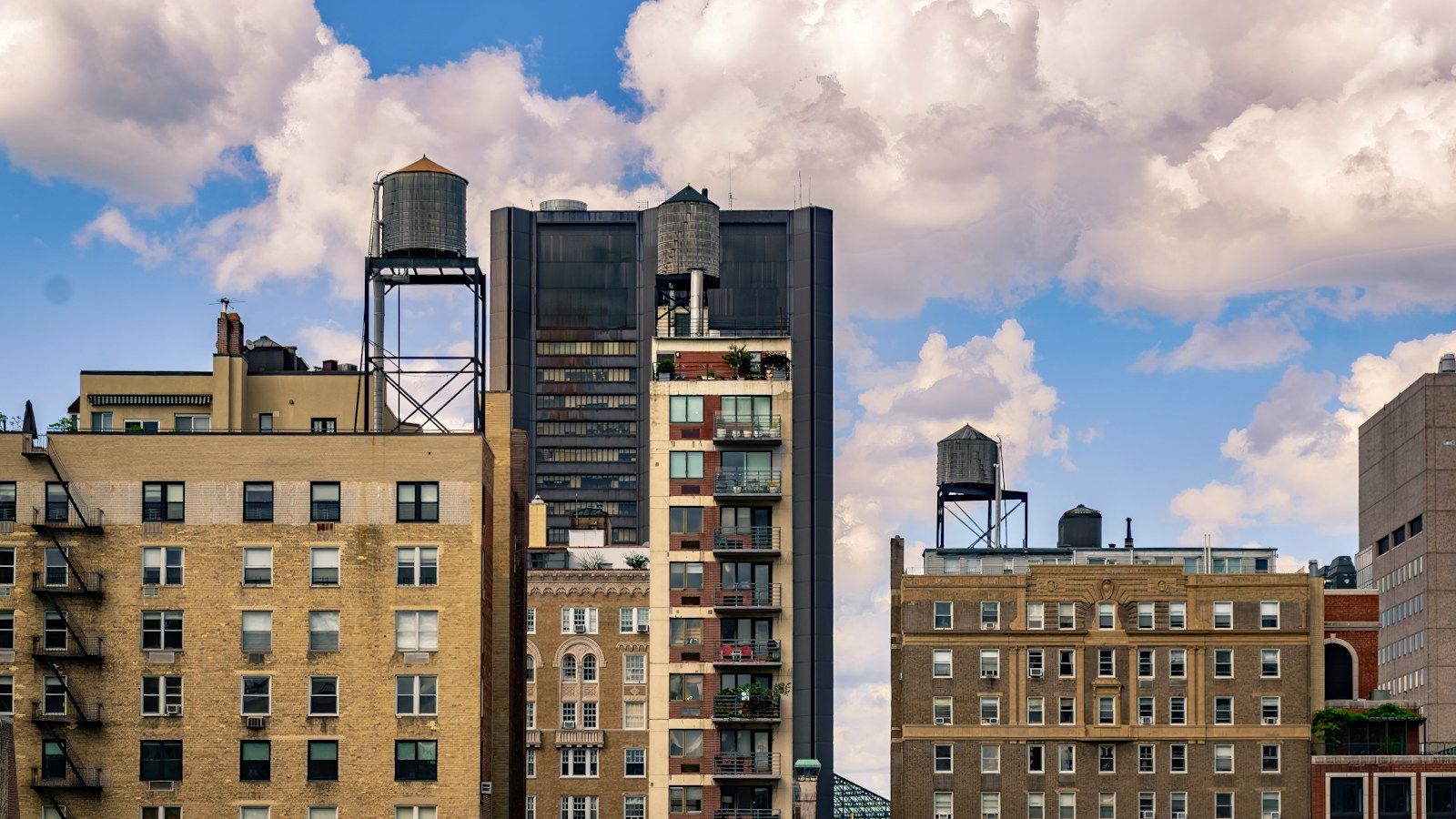
There’s something so familiar about New York’s skyline that most people stop looking at it. But look above the fire escapes, above the cornice lines, above the rooftop water tanks — and you’ll see them everywhere. Round wooden barrels, held together with iron hoops, perched on stilts like stubborn survivors of another century. There are roughly 17,000 of them across the five boroughs. Almost nobody ever thinks about why they’re there.
A Solution to a 19th-Century Problem
The story of New York’s water towers starts underground — with pressure. The city’s water infrastructure was built in the 1800s to push water up to roughly the fifth floor of most buildings. For tenements and row houses, that worked fine.
For the taller commercial buildings rising in the 1870s and 1880s, it was a serious problem. Upper floors couldn’t get reliable water. Running high-pressure pumps around the clock was expensive and prone to failure.
The solution was elegant: fill a rooftop tank overnight when city water pressure was sufficient, then let gravity do the work during the day. Water flowed down through the building naturally, at steady pressure, no pumps needed. It worked then, and it works now. Which is exactly why nobody changed it.
Why Wood Still Beats Steel and Concrete
The wooden water tower looks like it belongs in another era. But there’s a very practical reason it hasn’t been replaced by something more modern.
Wood is an excellent material for holding water. When it gets wet, the grain swells and forms a seal so tight it needs no liner or coating. Cedar and California redwood are the standard choice — both naturally resistant to rot and bacteria, and both excellent insulators that keep water cool in summer and prevent freezing in winter.
Steel and concrete can do the same job. But they cost significantly more to install, require insulation to handle New York’s temperature swings, and are harder to repair when something goes wrong. A properly maintained wooden tower lasts 30 to 40 years. Its replacement is often cheaper than one concrete alternative.
In a city that prides itself on reinvention, the wooden water tower survives because it’s still the most sensible choice. That’s a very New York answer to a very New York problem. If you want to explore more of the city’s unexpected architectural secrets hiding in plain sight, there are plenty waiting overhead.
The Families Who Built the Skyline
Only a handful of companies have ever built New York City water towers. Rosenwach Tank Company has been in the business since 1896 — four generations of the same family, still making wooden tanks the same way their great-grandfather did. Isseks Brothers has been building tanks since 1929.
Both companies still assemble towers largely by hand. Planks are cut, shaped, and fitted using methods that would be recognizable to craftsmen from the 1880s. A crew hoists cedar planks up to the roof and assembles each tank in a single day, fitting piece to piece until the barrel takes shape against the sky.
When you look across the Midtown skyline and count the water towers, you’re looking at the work of these same two families, stacked across a century. It’s one of the quietest family dynasties in New York history.
Enjoying this? Join New York lovers getting stories like this every week. Subscribe free →
How a Water Tower Actually Works
Each rooftop tank holds roughly 5,000 to 10,000 gallons of water. A float valve — operating on the same principle as a toilet tank, just on a vastly larger scale — fills it automatically overnight when city pressure is highest.
During the day, gravity pulls water down through the building’s pipes. Every foot of elevation produces about 0.43 pounds per square inch of pressure. A 20-foot tank sitting on a rooftop 100 feet above the street delivers consistent, comfortable water pressure to every floor below.
The cylindrical shape is structural. A cylinder distributes pressure evenly across every plank, which is why a relatively thin wooden wall can hold thousands of gallons without leaking or bulging. A square tank would need far thicker walls to handle the same load.
Inside? Just water. Open to the air. No pressurization, no pumps, no electronics. The whole system runs on gravity alone. This same elegant simplicity is what makes the city’s older building infrastructure so fascinating to understand — practical solutions that outlasted the problems that created them.
Where to See Them Up Close
The High Line is the best vantage point in the city. Walking the elevated park through Chelsea and the Meatpacking District puts you at rooftop level, with water towers visible in every direction — some weathered dark silver-gray, some still showing the pale honey color of fresh cedar planks.
Midtown Manhattan has the densest concentration. Stand at almost any corner above 30th Street, look up, and count. On a clear day you can spot dozens from a single block. They appear in old photographs of the city from the 1890s, and they appear in photographs taken last Tuesday.
Architecture fans sometimes hunt for the makers’ stamps burned into the wood — a small mark showing whether the tank came from Rosenwach or Isseks. They’re hard to read from street level, but they’re there, quietly recording who built what and when. The same kind of hidden craftsmanship marks run through everything that built this city.
FAQ: New York Water Towers
Why does New York still use wooden water towers instead of modern alternatives?
Wood remains the most cost-effective and practical material for rooftop water storage in New York. Cedar and redwood naturally resist rot and bacteria, insulate against temperature changes, and self-seal when wet. A wooden tower costs significantly less to build and maintain than steel or concrete alternatives and can last 30 to 40 years.
How many water towers are there in New York City?
There are an estimated 17,000 water towers across the five boroughs. They’re required in any building over six stories because city water pressure isn’t strong enough to reliably supply the upper floors without gravity assistance. Most buildings above that height have one.
Who builds and maintains New York City’s water towers today?
Two family companies dominate the trade: Rosenwach Tank Company, founded in 1896, and Isseks Brothers, founded in 1929. Both still assemble towers by hand on rooftops, using methods largely unchanged from the original craftsmen. They inspect, repair, and replace tanks across the city year-round.
Is the water inside rooftop water towers safe to drink?
Yes. New York City’s rooftop water towers are subject to regular city inspections and cleaning requirements. The natural antimicrobial properties of cedar and redwood help keep the water clean. The city requires tanks to be inspected and cleaned at least once a year.
You Might Also Enjoy
- What the Chrysler Building Hides That Most Visitors Never Think to Look For
- Why New York’s Fire Escapes Became the Most Lived-In Spaces in the City
- The Strange Stone That Built Brooklyn and Why Nobody Uses It Anymore
Plan Your New York Trip
Ready to see New York’s hidden architectural layers for yourself? Start with our complete New York travel guide for practical planning advice on neighborhoods, timing, and getting around.
Join 1,100+ New York Lovers
Every weekday morning, get New York’s hidden gems, neighbourhood stories, food origins, and city secrets — straight to your inbox.
Subscribe free — enter your email:
📲 Know someone who’d love this? Share on WhatsApp →
Love more? Join 65,000 Ireland lovers → · Join 43,000 Scotland lovers →
Free forever · Unsubscribe anytime

Subscribe Free