
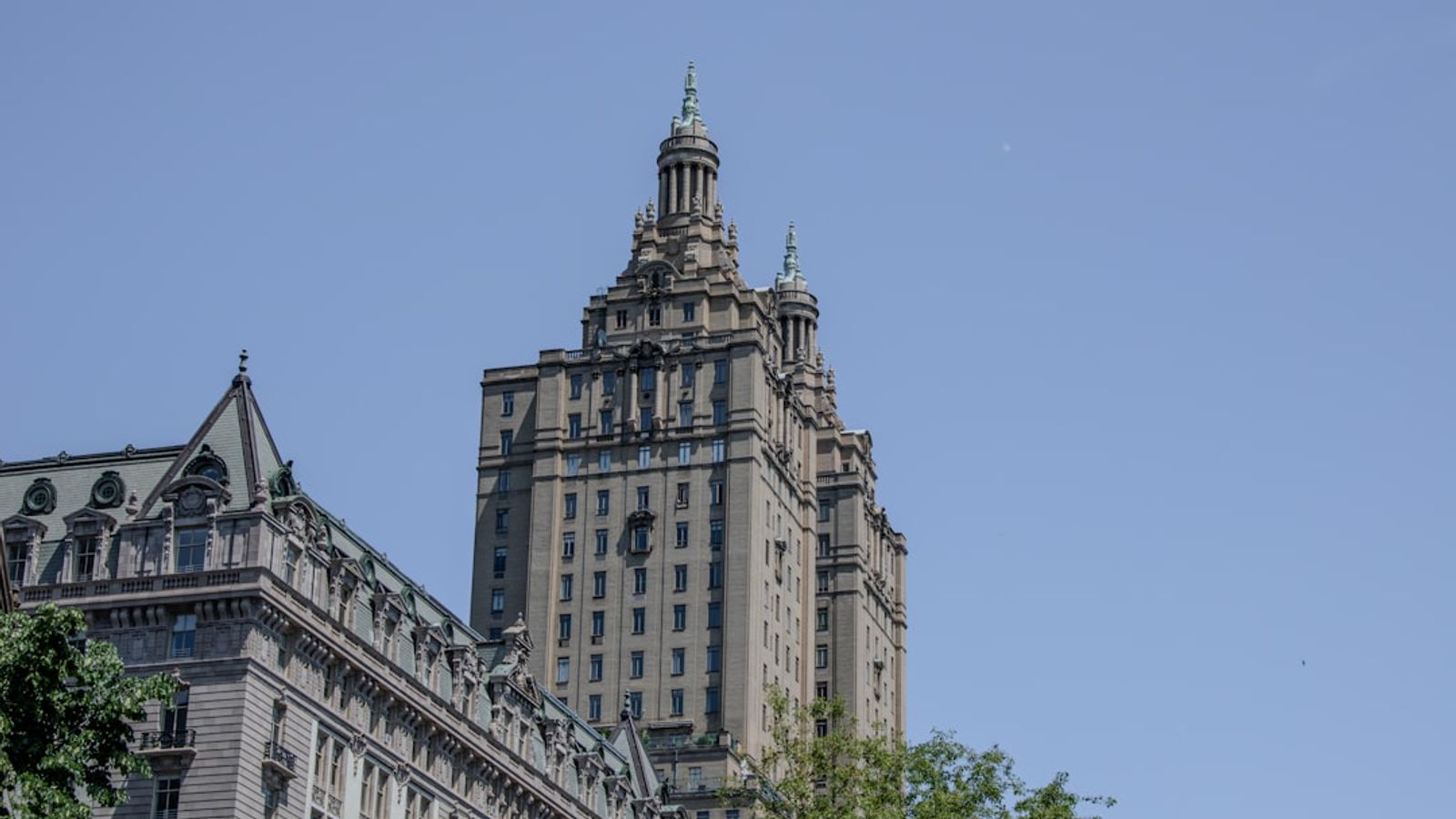
In 1880, when construction began at the corner of 72nd Street and Central Park West, Manhattan’s social map ended well before reaching that far north. The blocks above 59th Street were mostly open farmland and rocky outcrops. The city — its restaurants, its theatres, its comfortable apartments — was still downtown.
Which is exactly why they called it The Dakota.
A Building Named for the Edge of the World
The legend has lasted 140 years: the building was so far from the centre of New York that moving there felt like moving to the Dakota Territory. Whether Edward Cabot Clark, the Singer Sewing Machine heir who commissioned it, invented the name as a joke or a boast, the point landed. The Dakota was an outlier. It said so in its name.
Architect Henry Janeway Hardenbergh — later responsible for the Plaza Hotel — gave it a form to match that ambition. Towers. Gables. Dormers and deep-set windows. A copper-trimmed roofline that bristles against the sky. It was built in the German Renaissance style, a deliberate signal that this wasn’t just a large building. It was a statement.
When it opened in 1884, it was the first large luxury apartment building on the Upper West Side. The neighbourhood barely existed yet. Clark was betting on where New York would grow, and he was right.
What’s Behind the Gatehouse
At street level, the building’s entrance — a wide iron gate with a central carriage arch — has barely changed in a century. Visitors pause there. Residents walk through without looking up.
Inside, the building arranges itself around a central courtyard, a quiet square hidden from the street. The apartments are vast by any measure: eleven-foot ceilings, rooms with dimensions that stopped being built in New York decades ago.
The Dakota was among the first apartment buildings in New York to offer amenities that were then unheard of: a private dining room, a gym, a wine cellar, and a laundry below the ground floor. The idea of apartment living was still new in America — many wealthy New Yorkers saw it as slightly beneath them. Clark set out to change that.
The People Who Chose It
For a building that turns its most famous face to the street, it has always attracted people who valued privacy.
Leonard Bernstein — composer, conductor, the man who wrote West Side Story — lived here for decades. Lauren Bacall called it home for fifty years. Boris Karloff, who gave Frankenstein’s monster his face, lived on the fourth floor. Roberta Flack. Rex Reed. Gilda Radner.
And then there were John Lennon and Yoko Ono, who moved in during 1973 and fell so completely in love with the building and the neighbourhood that they eventually occupied several units. Ono still lives there. Across the park, the quiet garden at Strawberry Fields draws visitors from every country — a tribute to the man who made this address famous around the world.
Enjoying this? Join New York lovers getting stories like this every week. Subscribe free →
A Building That Chooses Its Own Residents
The Dakota is a cooperative apartment building, which means residents don’t just buy units — they apply to a board. And the board is famously, legendarily selective.
Rejections have included people you would expect any building to welcome. The names are part of New York mythology, though the board itself says little. What’s clear is that the Dakota’s residents have long understood that the building’s mystique depends on its exclusivity. Fame alone has never been enough.
This is unusual. Most prestigious Manhattan addresses let wealth speak for itself. The Dakota requires something harder to define — an alignment with whatever the building considers itself to be. If you’re planning a visit to this part of the city, you’ll find the Upper West Side among New York’s most rewarding neighborhoods to explore on foot.
Rosemary’s Baby and the Building’s Shadow Life
In Roman Polanski’s 1968 film Rosemary’s Baby, the building standing in for the fictional Bramford is the Dakota. The choice was deliberate. No other building in New York carries the same weight of atmosphere — the gatehouse, the courtyard, the sense of something ancient enclosed within modern city life.
The film leaned into that quality, and it stuck. The Dakota never pursued the association or rejected it. It simply absorbed it, as it has absorbed everything else over 140 years.
Today, if you stand on the sidewalk outside and look up at the roofline — at the ornamental turrets, the copper dormers, the gabled silhouette catching afternoon light — it’s easy to understand why this building has drawn both the famous and the singular. It doesn’t ask to be noticed. It simply exists, at the edge of the park, as if the city grew up around it.
You can discover more of the hidden corners of Central Park just across the street — it’s one of the best ways to experience this part of the Upper West Side.
Frequently Asked Questions
What is the Dakota building and where is it located?
The Dakota is a cooperative apartment building at 1 West 72nd Street on Central Park West in Manhattan. Built between 1880 and 1884, it is one of New York City’s oldest remaining luxury apartment buildings and a designated National Historic Landmark.
Can tourists visit the inside of the Dakota building?
No — the Dakota is a private residential building and is not open to the public. Visitors can view the exterior and entrance gatehouse from the sidewalk on West 72nd Street, and can cross into Central Park to visit Strawberry Fields nearby.
Why is the Dakota building called “The Dakota”?
The building was reportedly named because it stood so far north on Manhattan Island in the 1880s that it seemed as remote as the Dakota Territory in the American West. Whether meant as a joke or a statement of ambition, the name became part of the building’s identity.
Who are the most famous residents of the Dakota?
Notable residents have included John Lennon and Yoko Ono, Leonard Bernstein, Lauren Bacall, Boris Karloff, Roberta Flack, and Gilda Radner, among others. The building’s co-op board has long been known for its selective and private approval process.
Stand on Central Park West for long enough and the Dakota reveals itself in layers. First it’s a building. Then it’s a story. Then it’s something harder to name — a place that the city built, then outgrew, then grew back to. The neighbourhood it helped found now stretches for miles. The building still looks like it arrived from somewhere else entirely.
That’s what Edward Cabot Clark was betting on in 1880: that a building bold enough to name itself after the wilderness might eventually make the wilderness fashionable.
He was right. New York always finds a way to prove the visionaries correct.
You Might Also Enjoy
- Why This Quiet Corner of Central Park Draws Mourners From 100 Countries Every Day
- The Hidden Corners of Central Park That Most Visitors Walk Right Past
- Best Neighbourhoods in New York City: Your Essential Visitor’s Guide
Plan Your New York Trip
The Dakota sits on Central Park West at 72nd Street and is easy to visit as part of a walk through the Upper West Side. Pair it with a stroll through Central Park’s hidden corners directly across the street, and check the neighbourhood guide for the best routes, cafés, and things to see nearby.
Join 1,100+ New York Lovers
Every weekday morning, get New York’s hidden gems, neighbourhood stories, food origins, and city secrets — straight to your inbox.
Subscribe free — enter your email:
📲 Know someone who’d love this? Share on WhatsApp →
Love more? Join 65,000 Ireland lovers → · Join 43,000 Scotland lovers →
Free forever · · Unsubscribe anytime

Subscribe Free