
In the middle of one of the world’s busiest cities, there is a place where people whisper. They lay flowers on a mosaic floor, play guitar softly, and sit in silence with strangers they will never see again. They have been doing this since December 1980.
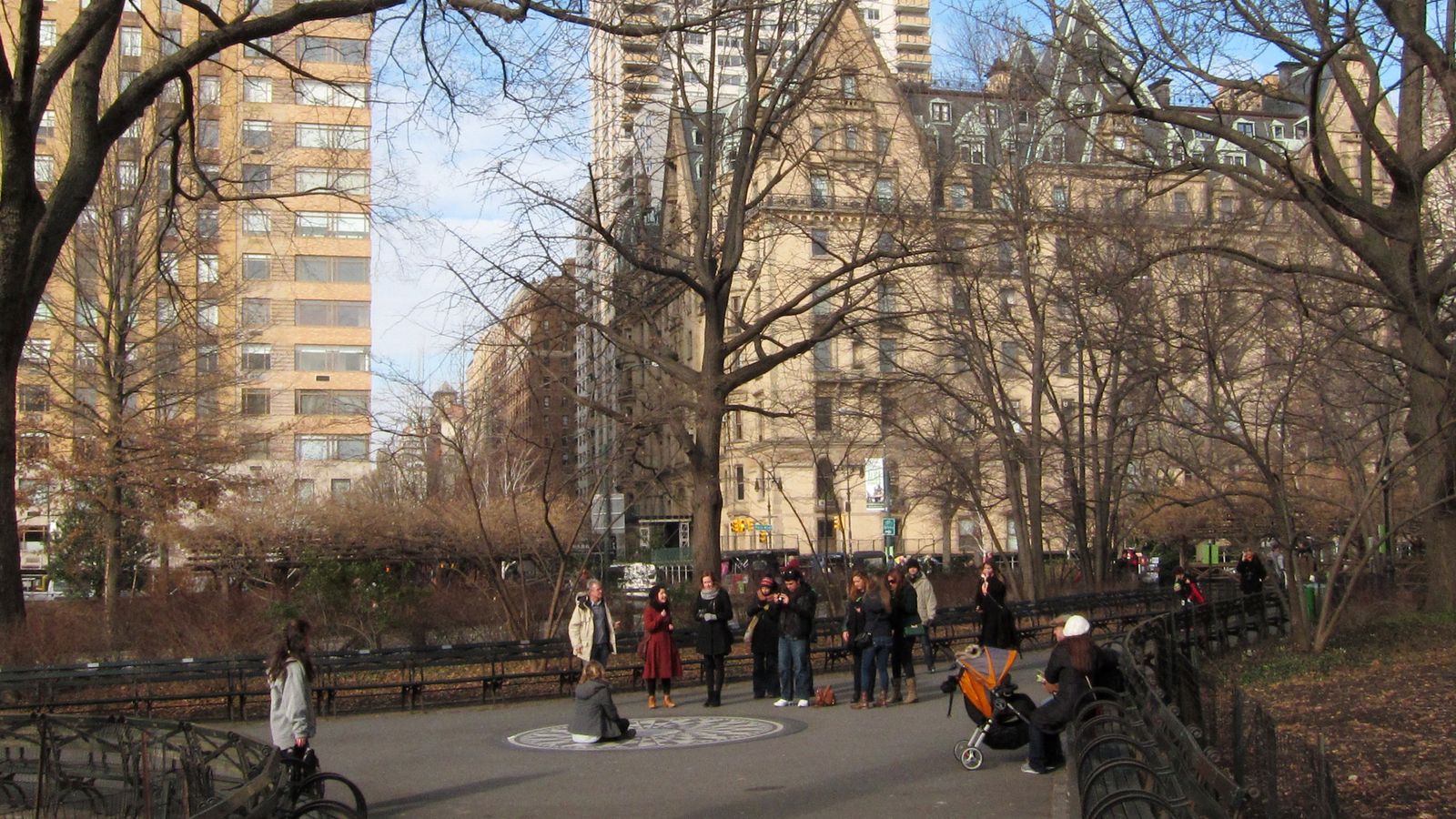
A Patch of Park With a Purpose
The 2.5-acre garden known as Strawberry Fields sits on the west side of Central Park, just inside the 72nd Street entrance. Before 1985, it was an ordinary stretch of trees and open grass. Then Yoko Ono turned it into something else entirely.
John Lennon was killed on December 8, 1980, outside the Dakota — the gothic apartment building on Central Park West where he and Yoko had lived since 1973. The city was at a loss for what to do with its grief. So was Yoko. She decided to answer that grief with something lasting.
She paid for the garden’s landscaping and restoration herself, donating over one million dollars to renovate the neglected section of the park. The city named it Strawberry Fields in 1981. The memorial was formally dedicated on what would have been Lennon’s 45th birthday: October 9, 1985.
The Mosaic That Stopped a City
The centerpiece of Strawberry Fields is a round, black-and-white mosaic bearing a single word: Imagine. It was donated by the city of Naples, Italy, and installed by hand using traditional stone-laying techniques.
There is no fence around it. No raised platform, no barrier of any kind. Anyone can walk up, step beside it, or lay a flower on its surface. Fresh flowers appear every single day, placed there by strangers who feel some pull toward the spot that is difficult to explain.
On quiet weekday mornings, you will often find a guitarist playing “Imagine” on a folding stool nearby. People stop and listen. They stand there for longer than they planned to.
The People Who Keep Coming Back
December brings the largest gatherings. The anniversary of Lennon’s death on December 8th, and his birthday on October 9th, draw hundreds of visitors who arrive with candles, photographs, and handwritten notes. But people come every month, in every season.
Some bring guitars and play songs for hours. Others stand at the edge of the mosaic in complete silence. What strikes many first-time visitors is that silence itself feels chosen here. Central Park is rarely quiet. At Strawberry Fields, quietness feels like respect.
You will hear languages from every corner of the world. German, Japanese, Portuguese, Spanish, Hindi. The memorial draws visitors from more than 100 countries. There are no signs asking people to be solemn. They just are.
Enjoying this? Join New York lovers getting stories like this every week. Subscribe free →
The Dakota, Just Across the Street
From the memorial, you can see the Dakota building through the trees. Lennon and Yoko moved there in 1973, drawn by its particular character — the German Renaissance towers, the ornate archway, the sense of standing slightly apart from the rest of the city.
It was in that archway, on the night of December 8, 1980, that Lennon was shot returning home from a recording session. He was 40 years old. The recording he had been working on that evening was released posthumously the following year.
The Dakota has no public access. But you can stand outside its entrance on 72nd Street and feel the weight of what happened there. Many visitors walk from the Dakota directly to the memorial, crossing the street and entering the park as Lennon would have done on an ordinary evening.
What “Strawberry Fields” Actually Means
Most visitors assume the name comes directly from the Beatles song — which it does. But the song itself was named after Strawberry Field, a Salvation Army children’s home in Liverpool where Lennon played as a boy. The garden behind the home was a place he could wander freely, away from the adults.
Lennon described the original Strawberry Field as somewhere he felt unusually free — a place you could go and not be noticed. “Nothing to get hung about,” he wrote in the lyrics, and he meant it as peace, not resignation.
Central Park’s version carries that same quality. Among the city’s grand monuments and famous views, Strawberry Fields is one of the few places that asks nothing of you. You do not have to be a fan. You do not have to know the songs. You just have to be willing to stop.
Yoko’s Enduring Gift
Yoko Ono has maintained Strawberry Fields at her own expense for over four decades. When the mosaic cracks or the garden needs attention, her foundation arranges the repairs. The relationship between Yoko and this small piece of the park has never wavered.
She still lives in the Dakota, looking out at the park. In 2010, she oversaw a full restoration of the Imagine mosaic — the first since its installation. She has said in interviews that she visits the memorial in the early morning before the crowds arrive.
Central Park has no shortage of remarkable corners. You can visit the Shakespeare Garden, planted with every flower mentioned in the plays, or lose yourself in the Ramble, the woodland where birds gather during migration. But Strawberry Fields is the only spot in the park that regularly makes strangers stop and quietly weep.
There is no charge to visit. No tour guide. No visitor center. Just a mosaic in a garden, and the people who keep finding their way to it.
Whatever you feel when you stand there — loss, gratitude, something harder to name — the city seems to have decided that feeling deserves a place.
You Might Also Enjoy
- The Secret Central Park Garden Planted With Every Flower Shakespeare Ever Mentioned
- The Wild Heart of Central Park Most New Yorkers Have Never Explored
- Free Things to Do in NYC: The Best No-Cost Experiences in New York City
Plan Your New York Trip
Strawberry Fields is open year-round with no admission cost. Find it on the west side of Central Park at 72nd Street — the entrance is directly across from the Dakota building. For everything else you need, our guide to free experiences in New York City covers the best the city offers at no cost.
Join New York Lovers
Every weekday morning, get New York’s hidden gems, neighbourhood stories, food origins, and city secrets — straight to your inbox.
Subscribe free — enter your email:
Love more? Join 65,000 Ireland lovers → · Join 43,000 Scotland lovers →
Free forever · · Unsubscribe anytime
