
Grand Central Terminal is one of the most visited buildings on Earth — and one of the most misunderstood. Most visitors pass through it on their way somewhere else, glancing up at the ceiling before hurrying on. Give it an hour, and Grand Central reveals itself as something far richer than a transport hub. It is a palace built for ordinary people. Architects designed it to stop you in your tracks. More than a century after it opened, it still does.
This guide covers everything you need before you visit Grand Central Terminal in New York City. The best things to see inside. Where to eat. The hidden details that reward slow exploration. Whether you have twenty minutes or an afternoon, there is far more here than most visitors ever find.
What Is Grand Central Terminal?
Grand Central Terminal stands at 42nd Street and Park Avenue in Midtown Manhattan. It has served as the gateway into New York City for more than a hundred years. The New York Central Railroad opened it in 1913, replacing an earlier station on the same site. The firms Reed & Stem and Warren & Wetmore designed the building in the Beaux-Arts style. The result is one of the finest examples of that tradition anywhere in the world.
Note the word: terminal, not station. A station is where a line ends. A terminal is a point of departure — a place where journeys begin. That is exactly what Grand Central has always been. Today it serves as the southern terminus for Metro-North Railroad commuter services. Trains run from here to Westchester County, Connecticut, and the Hudson Valley. It also connects to the New York City Subway and to a network of underground passages beneath Midtown Manhattan.
If you are working through a three-day New York City itinerary, give Grand Central at least an hour — ideally on your first morning, before the full weight of the city crowds in.
The Main Concourse: What to Look For
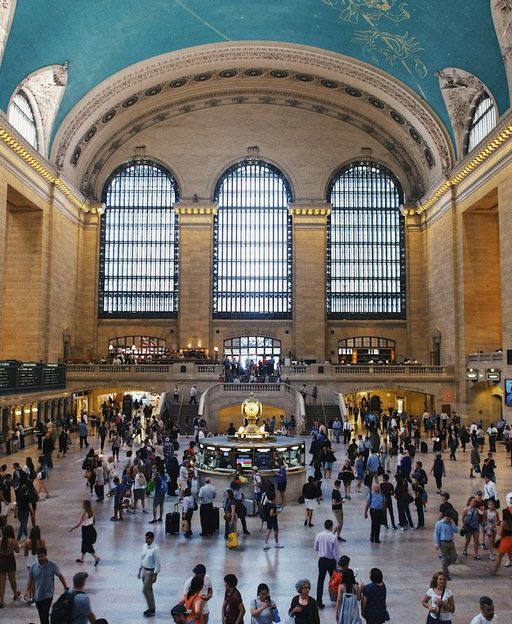
The ceiling stops most visitors immediately. A turquoise sky covers the Main Concourse. Gold leaf traces the constellations of the zodiac across it. Around 2,500 stars appear in the design. On clear mornings, light pours through the great arched windows in long shafts that visitors have photographed for over a century.
Look carefully and you notice something odd: the sky runs backwards. The constellations appear as a mirror image of what you see outdoors. The artist worked from a medieval illuminated manuscript depicting the celestial sphere from outside — as if looking down from above. That is why your night sky and this ceiling do not match.
The Main Concourse is vast. Stand on the balcony above during the morning rush and watch thousands of New Yorkers cross the floor in apparently choreographed near-misses. It is one of the great free spectacles in the city. At the centre of the concourse stands the famous four-faced clock, made of opal glass. It has become one of New York City’s most recognisable symbols and its most reliable meeting point.
The Marble and the Light
Tennessee marble lines the floors, staircases, and passages throughout Grand Central. The architects chose it for its warm golden tones. It absorbs and reflects light in a way that gives the building unusual warmth for a structure of this scale. Notice how the quality of light shifts as you move from the Main Concourse down through the passages to the lower levels. It moves from grand and golden to quieter and more intimate.
The terminal also uses ramps rather than stairs wherever practical. This choice allowed large numbers of people to flow between levels more efficiently than stairwells permit. It struck observers as innovative when builders completed it in 1913. It still works remarkably well today.
🗽 Love New York City? Get our free weekly newsletter.
Hidden gems, local stories, and the New York most visitors never find — delivered to your inbox every week. Free forever.
Subscribe Free →
One email per week · Unsubscribe anytime
The Whispering Gallery
One of Grand Central’s best secrets sits directly below the Main Concourse on the lower level, near the entrance to the Oyster Bar restaurant.
The arched ceiling here has a remarkable acoustic property. Stand in one corner and whisper facing the wall. A person in the diagonally opposite corner hears you clearly. The curved Guastavino-tiled vault channels sound around its surface. Flat or angled ceilings do not do this.
Nobody signposts the whispering gallery. It does not appear on most tourist maps. Most people walk past it every day without realising it exists. Find it. It is worth the short detour — and worth having something interesting to say once you get there.
Where to Eat in Grand Central Terminal
Grand Central offers far better food than most transport buildings. The dining has expanded considerably over the years, and the quality at the top end remains genuinely good.
The Grand Central Oyster Bar
The Oyster Bar is the most famous restaurant in the building and one of the most famous in New York. Chefs have served oysters, clams, and seafood chowder here since the terminal opened in 1913. The vaulted Guastavino-tiled space is stunning. The pan roast — a rich, cream-based stew served straight to order — ranks among the most distinctively New York dishes you can eat anywhere in the city. Prices reflect the reputation and location.
The Grand Central Market
The Grand Central Market runs along the Lexington Avenue passage. Vendors sell fish, cheese, bread, spices, and fresh produce at consistently high quality. New Yorkers shop here regularly. It is not a staged tourist experience. Walk through it even if you are not buying anything — it gives you a good sense of what New Yorkers actually eat.
The Dining Concourse
The lower level Dining Concourse has grown into a proper food hall. You can find sushi, ramen, sandwiches, and coffee down here. The quality varies by vendor. It is convenient and well-suited to a quick meal before a Metro-North train.
Vanderbilt Hall
Vanderbilt Hall sits just off the Main Concourse on the western side. Architects built it as the terminal’s original waiting room. Today it hosts events, markets, and exhibitions throughout the year. Even when it stands empty, the scale and proportions impress. This room comes from an era when waiting formed part of the experience of travel — not an inconvenience to minimise, but a moment in itself.
The Story of Grand Central’s Near-Demolition
Know this story before you visit. It gives Grand Central a different weight.
By the 1960s, the terminal faced serious financial pressure. Developers demolished Penn Station in 1963 to make way for a new Madison Square Garden. Grand Central faced a similar fate. A developer proposed to build a tower above the terminal — a plan that would have gutted the building from the inside.
The campaign to save Grand Central became a landmark moment in American preservation history. Jacqueline Kennedy Onassis led part of the effort. She argued publicly that a civilisation is judged by what it chooses to keep. The case reached the United States Supreme Court, which ruled in 1978 that New York City’s Landmarks Preservation Law was constitutional. Grand Central survived.
Workers undertook a major restoration in the 1990s. They cleaned the ceiling, removing decades of grime to reveal the turquoise underneath. They restored the marble throughout. They returned the terminal to something close to its original appearance. Preservationists widely regard the project as one of the great successes of American architectural restoration.
Getting to Grand Central Terminal
Grand Central ranks among the easiest destinations in New York City to reach by public transport.
By Subway
The 4, 5, 6, and 7 trains stop directly at Grand Central–42nd Street station, one of the busiest on the entire system. The S Shuttle also runs between Grand Central and Times Square. For a full guide to the network, read the NYC subway guide for visitors.
By Metro-North
Trains from Westchester County, the Hudson Valley, and Connecticut terminate at Grand Central. The terminal is an excellent starting point for day trips from New York City. Many of the best escapes — Cold Spring, Beacon, the Hudson Valley wine country — start with a Metro-North train from this building.
On Foot
Grand Central sits within easy walking distance of Bryant Park, the New York Public Library, the Chrysler Building, and much of Midtown Manhattan. No car park attaches to the terminal. Driving here for a visit makes no practical sense.
Practical Tips for Your Visit
When to go: Weekday mornings and evenings draw the largest commuter crowds. Early weekday mornings and weekend afternoons give you more space and better light. The Main Concourse looks its best in the morning, when sunlight enters from the western windows.
How long to allow: Twenty minutes gets you through the Main Concourse. An hour or two lets you find the whispering gallery, explore the market, read the architecture, and eat something. The building does not encourage rushing.
Guided tours: The Municipal Art Society of New York runs walking tours of the terminal on most days of the week. These tours add considerable historical and architectural depth. Check the MAS website for current schedules and bookings.
Photography: You can photograph freely throughout the terminal. Morning light through the western windows produces the shafts across the concourse floor that appear in so many images of Grand Central.
Accessibility: Lifts connect all levels. The ramp system the architects built over a century ago makes much of the terminal naturally accessible.
What Else Is Nearby?
Grand Central sits in the heart of Midtown. Remarkable buildings surround it on every side.
One block north on Lexington Avenue, the Chrysler Building stands as the art deco skyscraper that many architects consider the most beautiful in New York. Its lobby opens to the public and merits a few minutes of your time. Five blocks west on Fifth Avenue, the New York Public Library main branch is another Beaux-Arts landmark worth visiting. The Rose Main Reading Room on the third floor is one of the grandest interior spaces in the city. Bryant Park, behind the library, offers a pleasant place to sit in Midtown.
From Grand Central, you can walk to the full range of Midtown Manhattan attractions without needing the subway. Plan to spend an entire afternoon in this part of the city.
Frequently Asked Questions
Is Grand Central Terminal free to visit?
Yes, Grand Central Terminal is completely free to enter and explore. No admission charge covers the Main Concourse, the whispering gallery, or the architectural spaces. Restaurants, the market, and guided tours with the Municipal Art Society all cost money. But simply visiting costs nothing.
What is the difference between Grand Central Terminal and Penn Station?
Grand Central and Penn Station are New York City’s two main railway termini, but they serve different lines. Grand Central serves Metro-North commuter trains to Westchester County, Connecticut, and the Hudson Valley. Penn Station, at 34th Street and Eighth Avenue, serves Amtrak long-distance trains, NJ Transit commuter services, and the Long Island Rail Road.
How do I find the whispering gallery at Grand Central?
Take the ramp down to the lower concourse level and walk toward the Grand Central Oyster Bar. Look up at the arched Guastavino-tiled ceiling. Stand in one of the four corners and whisper into the wall. Someone in the diagonally opposite corner hears you clearly. No signs point you there — which is half the pleasure of finding it.
When is the best time to visit Grand Central Terminal?
Early weekday mornings and weekend afternoons offer the best combination of good light and manageable crowds. Weekday rush hours bring the largest commuter volumes — spectacular from the balconies but harder for slow exploration. Morning light from the western windows produces the famous shafts across the concourse floor.
Join 1,000+ New York Lovers
Every week, get New York’s hidden gems, local secrets, and travel inspiration — the kind you won’t find in any guidebook.
Subscribe free — enter your email:
Love more? Join 64,000 Ireland lovers → · Join 43,000 Scotland lovers → · Join 30,000 Italy lovers →
Free forever · One email per week · Unsubscribe anytime
