
Around 1880, something remarkable happened in lower Manhattan. Jewish families from the Russian Empire, Poland, Romania, and the Austro-Hungarian Empire began arriving in their hundreds of thousands. They came fleeing pogroms, poverty, and forced military service. They landed at Castle Garden and, later, Ellis Island. Then they walked north into a few square miles of tenements. They called it home.
By 1910, roughly 500,000 people packed into the Lower East Side. It ranked among the most densely populated places on earth. Today, you can still walk those streets and feel the weight of that history.
If you love New York’s hidden stories, you’ll love our free weekly newsletter. Subscribe to Love New York →
Why They Left Eastern Europe
The mass exodus began after the assassination of Tsar Alexander II in 1881. Pogroms swept through the Pale of Settlement — the region in the Russian Empire where Jews had to live by law. Hundreds of communities faced violence, forced displacement, and economic ruin.
Word spread fast. America offered something impossible at home: freedom to live where you chose and work in any trade. Between 1880 and 1924, roughly 2.5 million Jewish immigrants arrived in America. Most passed through New York. Most stayed.
The 1905 Russian Revolution deepened the misery. The Kishinev pogrom of 1903 had already shocked Jewish communities worldwide. Every new outburst of violence sent another wave of families to the ships.
Ellis Island to Orchard Street
The journey to the Lower East Side started at Ellis Island. Immigration inspectors processed new arrivals in the Great Hall. Officials often shortened or changed surnames they struggled to spell or pronounce. Many immigrants emerged with anglicised names that bore little resemblance to the originals.
From the ferry dock at the Battery, the walk to the Lower East Side took about 20 minutes. Most new arrivals had a cousin, a neighbour, or a landsmann — someone from the same town — waiting to meet them. These networks guided families directly to the neighbourhood’s crowded blocks, found them a room, and pointed them toward work.
Life in the Tenements
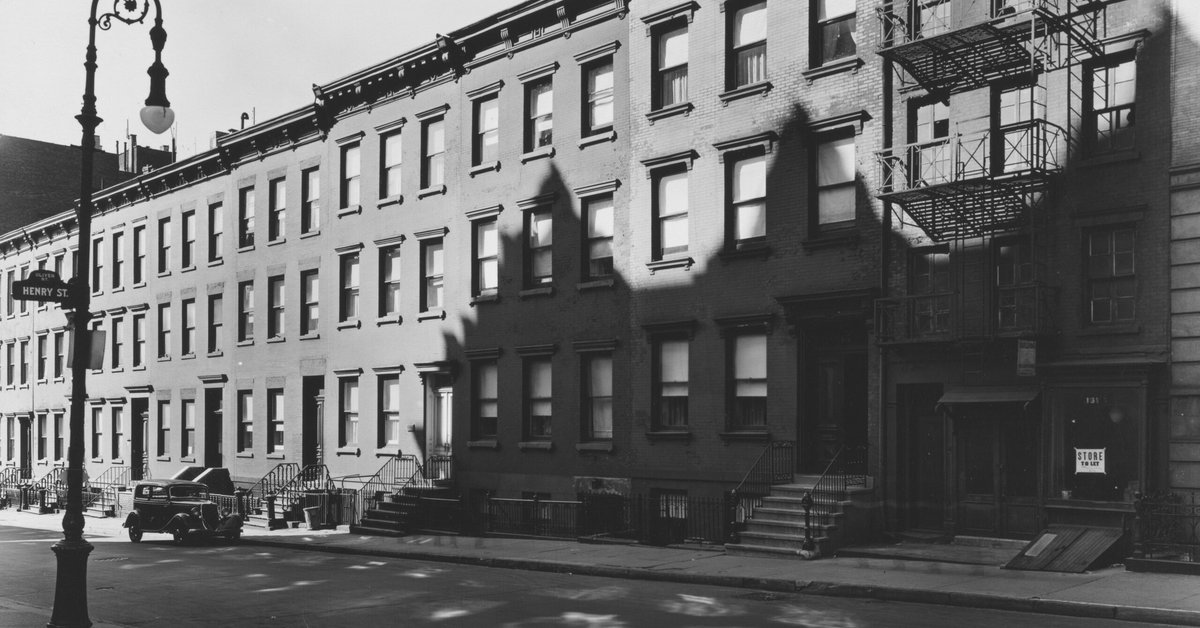
The tenements of the Lower East Side housed families in conditions that shocked reformers. A typical apartment measured around 300 square feet and sheltered six or more people. Many buildings had no indoor plumbing. Toilets sat in the yard. Ventilation was almost non-existent.
Jacob Riis documented the reality in his 1890 book How the Other Half Lives. His photographs showed families sleeping on fire escapes to escape summer heat, children playing in filthy alleys, and entire families gathered around a single kerosene lamp.
Today, the Tenement Museum at 103 Orchard Street preserves several original apartments exactly as immigrants left them. Guides walk visitors through the kitchens, bedrooms, and parlours of real families who lived there between the 1860s and 1930s. It remains the most vivid surviving record of immigrant tenement life in the city.
The Streets That Fed the Neighbourhood
Orchard Street was the artery of immigrant commerce. Pushcart vendors filled the road from kerb to kerb every day except the Jewish Sabbath. You could buy herring from a barrel, bolts of fabric, secondhand shoes, and hot sweet potatoes from the same half-block stretch.
Hester Street market fed a neighbourhood with very little cash. Peddling required only a cart and the stamina to haul goods across the city. Many families used it as their first toehold in the American economy.
The garment industry offered another path. Factories called “sweatshops” occupied the upper floors of tenement buildings. Workers — many of them young women — sewed piece-rate for wages that rarely exceeded a few dollars a week. The Triangle Shirtwaist Factory fire of 1911 brought these conditions to national attention. It killed 146 workers, most of them young Jewish and Italian immigrant women, and it drove New York’s first serious workplace safety laws.
Want more stories like this? Our weekly newsletter goes deeper into New York’s heritage every week. It’s free. Subscribe here →
A Neighbourhood Alive With Culture
Life on the Lower East Side was not only hard. It pulsed with culture, argument, and ambition.
The congregation built the Eldridge Street Synagogue in 1887. It became one of the first grand houses of worship that Eastern European Jews constructed in America. Its Moorish and Romanesque facade still stands on Eldridge Street. Volunteers restored it in 2007 and now run it as the Museum at Eldridge Street.
The Forward newspaper — Forverts in Yiddish — launched in 1897 from an office on East Broadway. At its peak in the 1920s, it sold a quarter of a million copies a day. It ran socialist politics, practical advice for new immigrants, and the famous “Bintel Brief” column. Readers sent in their troubles. The editors published answers. The Forward still publishes today, in English and Yiddish.
Yiddish theatre gave the neighbourhood its evenings. Second Avenue earned the nickname “the Jewish Broadway.” Theatres staged melodramas, comedies, and operas — all in Yiddish. The audience arrived straight from long workdays, still wearing factory clothes, and talked back to the performers without shame.
The Educational Alliance on East Broadway opened in 1889. It offered free English classes, evening school, art exhibitions, and physical training. Immigrants came there wanting to understand America. The Alliance gave them the tools.
Landsmanshaftn: The Original Mutual Aid
Immigrants rarely arrived alone in spirit, even when they came alone in body. They organised themselves by hometown. A group from Minsk formed a Minsker Farband. A group from Vilna formed a Vilner society. These were called landsmanshaftn.
The landsmanshaftn provided burial plots, sick benefits, small loans, and a social life built around shared memory. When a new family arrived from the same town, the society met them at the dock. They found the newcomers housing and a job lead before the first night in America was over.
These networks had no government funding and no formal legal status. They ran entirely on immigrant solidarity and the stubborn belief that neighbours look after neighbours.
Famous Names from the Lower East Side
Irving Berlin was born in Russia in 1888 and grew up on Cherry Street on the Lower East Side. He sold newspapers on the Bowery as a child. He went on to write “God Bless America,” “White Christmas,” and dozens of other songs that shaped 20th-century American culture.
Eddie Cantor, born Edward Israel Itzkowitz in 1892, lost his mother before his first birthday. His grandmother raised him on the Lower East Side. He started performing in amateur shows on street corners and worked his way into vaudeville and Broadway.
Emma Goldman lectured on anarchism and women’s rights to packed crowds near the neighbourhood. Labour leaders who organised garment workers across the city drew their strength from the community the Lower East Side built. The neighbourhood shaped politicians, scientists, artists, and labour organisers in numbers that still astonish historians.
The same immigrant ambition drove a generation of Jewish New Yorkers northward into Washington Heights, where a later wave of Jewish refugees — this time fleeing Nazi Germany — would build their own community in the 1930s. That story of German-Jewish refugees in upper Manhattan shows how different the Jewish immigrant experience could be across just a few decades.
Moving Up and Moving Out
Success on the Lower East Side meant leaving it. Families who saved enough moved to the Bronx, to Brooklyn’s Brownsville and Borough Park, and later to the suburbs of New Jersey and Long Island. The neighbourhood was a launch pad, not a destination.
By the 1950s, the Jewish population had thinned sharply. Puerto Rican and Dominican families moved in as the Jews moved out. Later waves of Chinese immigrants expanded Chinatown steadily northward into the old Jewish blocks. Each group wrote its own chapter on the same streets — just as Irish immigrants had done a generation earlier in Five Points, just south of where the Lower East Side begins. The story of Five Points shows how Manhattan absorbed immigrant after immigrant and transformed them all.
The bagel itself carries this history. Jewish bakers from Eastern Europe brought the bagel to the Lower East Side, where it became a staple of pushcart markets and bakery windows. The New York bagel’s story is inseparable from the neighbourhood that popularised it.
The Lower East Side Today
The neighbourhood has changed sharply since the 1990s. Boutique hotels and cocktail bars now occupy buildings where garment workers once sweated through summer nights. Orchard Street still sells fabric and leather goods alongside restaurants and vintage clothing shops.
What survives is more precious than nostalgia. The Tenement Museum draws hundreds of thousands of visitors every year. The Museum at Eldridge Street has restored one of the neighbourhood’s most magnificent buildings. Essex Street Market — now in a modern building on Delancey Street — carries on the tradition of the old pushcart markets, now indoors and permanent.
Kehila Kedosha Janina on Broome Street is the only active Greek Jewish (Romaniote) synagogue in the Western Hemisphere. The congregation traces its roots to Janina, Greece. It holds services on Saturdays and opens its small museum on Sundays.
Walking the blocks between Delancey and Canal, between Essex and the Bowery, you walk through one of the most consequential neighbourhoods in American history. Every block carries the memory of a community that arrived with almost nothing and built something that shaped an entire country.
Plan Your Lower East Side Heritage Visit
- Tenement Museum — 103 Orchard Street. Guided tours run daily; book in advance. Admission charged.
- Museum at Eldridge Street — 12 Eldridge Street. Open Sunday to Thursday. Admission charged.
- Essex Street Market — 88 Essex Street. Open daily. Free to enter.
- Kehila Kedosha Janina — 280 Broome Street. Museum open Sunday mornings. Free admission.
- The Forward Building — 175 East Broadway. The ornate facade of the original Forverts newspaper building is visible from the street.
- Orchard Street — Still lined with fabric and leather shops; the atmosphere of the market district survives.
Getting there: Take the F, J, M, or Z train to Delancey St/Essex St. The B and D trains stop at Grand Street. The neighbourhood is compact and easy to walk.
Frequently Asked Questions
What was the Lower East Side known for in the early 1900s?
The Lower East Side was the primary landing place for Eastern European Jewish immigrants between the 1880s and 1920s. It held some of the most densely populated blocks in the world, with hundreds of thousands of people living in tenement buildings along Orchard, Hester, and Delancey Streets.
Where can I find Lower East Side Jewish heritage sites today?
Start at the Tenement Museum at 103 Orchard Street. The Museum at Eldridge Street at 12 Eldridge Street preserves the restored 1887 synagogue. Kehila Kedosha Janina at 280 Broome Street is the only active Romaniote Greek Jewish synagogue in the Western Hemisphere.
How many Jewish immigrants lived on the Lower East Side?
By 1910, roughly 500,000 Jewish immigrants and their children lived in the neighbourhood. Peak Eastern European Jewish immigration ran from 1880 to 1924, when new quotas effectively ended mass immigration from Eastern Europe.
Can I visit original tenements where immigrants lived?
Yes. The Tenement Museum at 103 Orchard Street preserves original apartments exactly as families left them. Guided tours take visitors inside the kitchens, bedrooms, and parlours of documented families who lived there between the 1860s and 1930s.
Ready to explore the New York your ancestors knew? Subscribe to Love New York — free weekly stories, heritage guides, and hidden history. Join us →
