
If you ask most visitors where to find peace in Manhattan, they point to Central Park. And yes, parts of it are genuinely calm. But the park is 843 acres with millions of visitors a year, and on a warm Saturday, the main paths feel anything but peaceful. The real quiet spots in Manhattan take a bit of knowing.
Here is a practical guide to places where the city actually stops for a moment — spots that locals rely on but most visitors never find.
The Conservatory Garden
The Conservatory Garden sits at 105th Street on the Upper East Side edge of Central Park, and it is one of the few parts of the park where cycling, ball games, and dogs on leads are all banned. That ban changes the atmosphere completely.
It is a proper enclosed garden — three formal sections separated by hedges and paths. The English-style central garden has a large reflecting pool. The French-style south garden is geometric and planted for seasonal colour. The Italian north section has wisteria-draped pergolas that are worth the trip alone in late spring.
Entry is through the Vanderbilt Gate on Fifth Avenue. There are no food stands inside and no bike hire. People come to sit and to walk. On a weekday morning the garden can feel almost empty, even in summer.
Practical info: Open daily from 8am to dusk. Free entry. Nearest subway: 103rd Street on the 6 line.
The Ramble in Central Park
Most visitors to Central Park stick to the main loop or head for Bethesda Fountain. The Ramble, a 36-acre woodland section in the centre of the park, sees a fraction of that foot traffic.
It was designed by Frederick Law Olmsted to feel like a wild woodland, and it still does. The paths wind around a stream and through dense mature trees. It is one of the best urban birding spots in North America — during spring and autumn migration, hundreds of species pass through, and serious birders come from across the country to watch.
You can enter from the Boathouse side near the 72nd Street transverse, or from the west near the 79th Street entrance. It is easy to spend an hour in here without seeing more than a handful of people, even on busy days in the park above.
Practical info: No bikes allowed inside. Best visited in early morning. Free entry.
Greenacre Park, Midtown
Greenacre Park is a pocket park on East 51st Street in Midtown, and it is one of the least-known green spaces in the city. It covers less than a third of an acre, but a three-storey waterfall at the far end masks all street noise within seconds of entering.
The park has seating, mature trees, and a small raised terrace. The white noise from the waterfall is the key — within a few feet of the cascade, the traffic on 51st Street disappears entirely. It is genuinely peaceful even at lunchtime, when Midtown is at its busiest.
This is a privately owned public space — a POPS in New York planning terms — meaning the landowner is required to keep it open in exchange for additional floor space on their building. There are dozens of these across Manhattan, but Greenacre is one of the best maintained.
Practical info: 217 East 51st Street. Open daily 8am–7:45pm (later in summer). Free. Nearest subway: 51st Street on the 6 line, or Lexington Av/53rd on the E and M lines.
Paley Park, East 53rd Street
Paley Park is two blocks from Greenacre on East 53rd Street and works on the same waterfall principle. It was created in 1967 by the family of CBS founder William S. Paley on the site of the demolished Stork Club.
The cascade here is wider, running across the full back wall of the space. The park has moveable chairs — an unusual feature in New York, where most public seating is fixed — along with honey locust trees overhead that soften the light on sunny days. At midday, office workers come with lunch. In off-peak hours, it is frequently almost empty.
Like Greenacre, Paley Park is a POPS. Unlike many such spaces across the city, it is genuinely welcoming and consistently well maintained.
Practical info: 3 East 53rd Street. Open Monday to Saturday, 8am–8pm (extended hours in warmer months). Free. Nearest subway: 5th Av/53rd Street on the E and M lines.
Fort Tryon Park and The Heather Garden
Fort Tryon Park sits at the very northern tip of Manhattan, above Washington Heights. Most people who make it up here are heading to The Cloisters, the Metropolitan Museum of Art’s medieval art outpost. The park itself, however, is worth the journey on its own terms.
The Heather Garden, within the park, is the largest public garden in New York City’s parks system outside of Central Park. It covers four acres and is planted in layers — shrubs, perennials, and ornamental grasses arranged for year-round interest. From the upper paths, the views across the Hudson River to the Palisades in New Jersey are unobstructed and genuinely dramatic.
Getting here takes around 45 minutes from Midtown on the A train, and it is mostly that journey that keeps the crowds at bay. On a weekday you will likely have stretches of the garden entirely to yourself.
Practical info: Fort Tryon Park is free and open daily. Nearest subway: 190th Street on the A line (use the elevator or the ramp exit — the walk up from the station platform is steep). The Heather Garden is maintained by the Fort Tryon Park Trust.
Riverside Park
Riverside Park runs along the Hudson River from 72nd Street to 158th Street on the Upper West Side. That is four miles of waterfront green space, and it is consistently less busy than Central Park despite being maintained by the same city parks department.
The section between 79th Street and 96th Street is particularly good for an unhurried walk. There is a promenade along the river, a bicycle path separated from the walking areas, and benches facing the water. In the early morning or on weekdays, this stretch has the feel of a neighbourhood park rather than a city attraction — because that is mostly what it is.
The 79th Street Boat Basin is a peculiarity worth knowing about: a functioning marina in the middle of Manhattan, where a small number of people actually live on boats year-round. The rotunda building above it dates to 1937.
Practical info: Free and open daily. Enter at any cross-street between 72nd and 158th. The 1 train runs along Broadway, parallel to the park.
A Note on Timing
All of these spots are measurably more peaceful at certain times. Before 9am on any day of the week, Manhattan feels like a different city — lighter foot traffic, lower noise levels, and none of the midday pressure. If your visit gives you any flexibility, early mornings are worth using.
The least-visited days in most of these parks are Tuesday to Thursday. Weekends are busier than weekdays throughout the year, with the gap widest in summer. If you are visiting at the weekend, the Conservatory Garden and Riverside Park hold up better than most places in terms of crowd levels.
What These Spots Have in Common
Manhattan is loud by design. The density, the grid, the constant movement — that is the point of the city, and most people who visit want some of it. But these places exist because people who live and work in New York need somewhere to decompress during the week.
That is the most practical thing to know: the peaceful spots in Manhattan were not built for tourists. They were built for New Yorkers trying to get through the day. Which means they are almost always free, well maintained, and easy to reach by subway. You just have to know where to look.
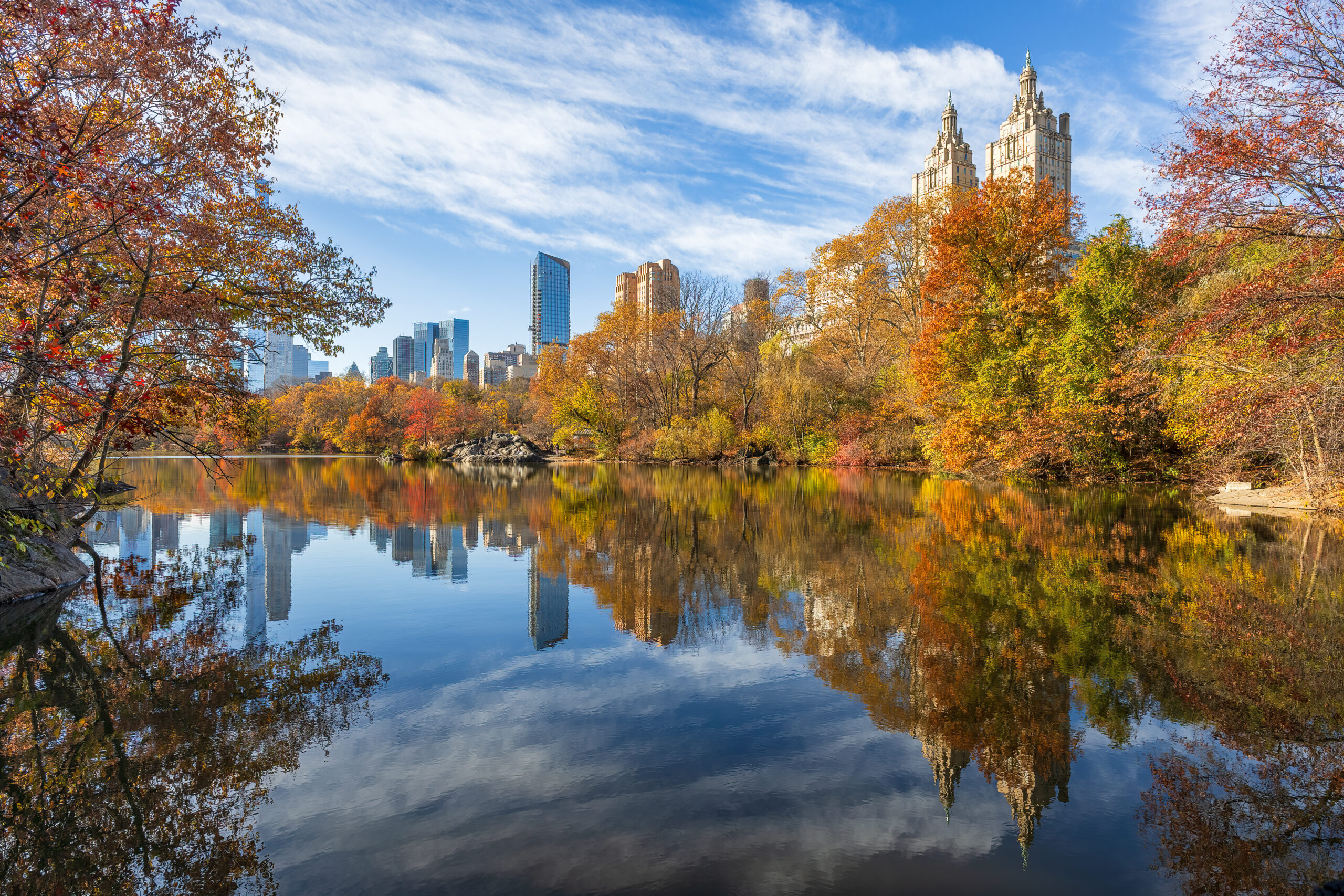
Photo: Central Park, Manhattan. Credit: Superbass, Wikimedia Commons (CC BY-SA 4.0).
