
Most people who walk down West 10th Street in Greenwich Village never notice the iron gate tucked between the brownstones. Push it open and you step into another world — cobblestones underfoot, gas-style lamps overhead, and ten small houses arranged like a scene from Victorian London. Welcome to Patchin Place. You’re still in Manhattan. You just need to know where to look.
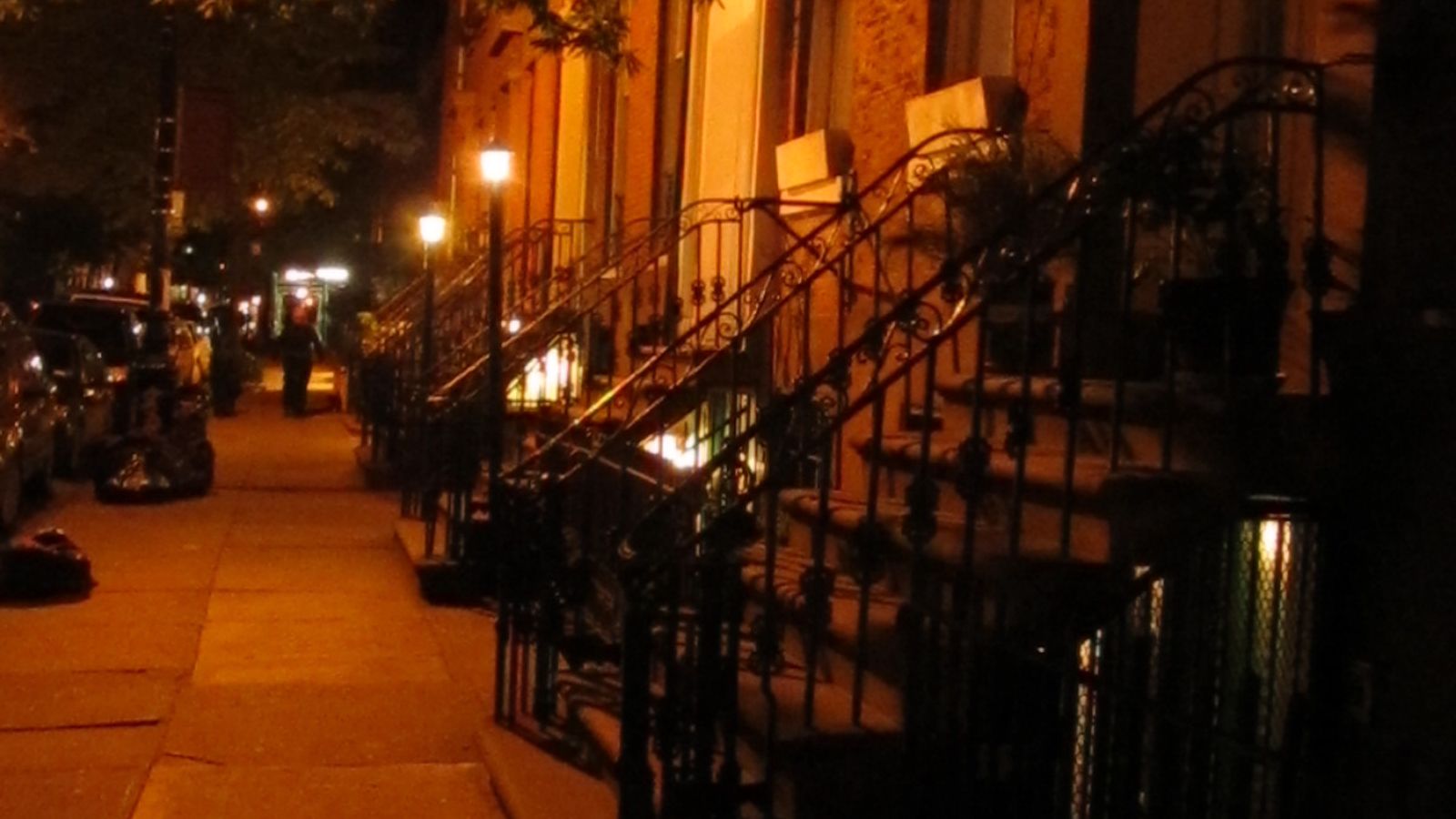
The Private Mews of Greenwich Village
Patchin Place dates to 1848, built to house workers from the nearby Brevoort Hotel on Fifth Avenue. What began as servants’ quarters became, over the following century, one of the most quietly celebrated addresses in American literary history.
E.E. Cummings lived here for over four decades. John Reed wrote here. Djuna Barnes, one of the defining voices of American modernism, spent the last 40 years of her life behind one of these doors. The mews is still privately gated today — but it’s not secret. It’s simply overlooked by anyone who doesn’t slow down enough to spot it.
Just steps away on Sixth Avenue, a smaller twin sits almost as quietly. Milligan Place — built around the same time, originally for Basque hotel workers from the Brevoort — is even less known. Four houses. A courtyard barely wider than two people standing side by side. Almost no signage, almost no foot traffic. The city rushes past it every day.
Sniffen Court: Carriage Houses in the Middle of Midtown
Travel uptown to Murray Hill and you’ll find Sniffen Court tucked off East 36th Street — a short cobblestoned alley lined with Romanesque Revival carriage houses built in the 1850s. They were constructed to stable horses for the wealthy families of Murray Hill. The car arrived, the horses left, and the stables became homes.
Today the court is landmarked and privately held, behind a locked iron gate. But you can see the whole thing through the bars: two rows of arched doorways, worn stone, climbing plants. It looks like it belongs somewhere in Renaissance Italy, not wedged between a pharmacy and a parking garage in Midtown Manhattan.
That contrast is exactly the point. New York was built in layers, and the older layers don’t always yield without a fight. You’ll find hidden pockets like this scattered across all five boroughs — you just need to know they exist.
Enjoying this? Join New York lovers getting stories like this every week. Subscribe free →
The Mock-Tudor Village on the Upper West Side
On the Upper West Side, tucked between West 94th and 95th Streets, sits Pomander Walk — and nothing in New York quite prepares you for it. Two facing rows of small Tudor-style cottages line a private pedestrian lane, each with climbing vines and window boxes, at a scale that belongs nowhere near Manhattan.
The complex was built in 1921, inspired by a London stage play set in a similar English lane. The developer wanted to recreate that world in the middle of New York City. What he built instead was a neighborhood secret that has survived for over a hundred years.
Lauren Bacall grew up in one of these houses. Humphrey Bogart lived here for a time. Lillian Gish called it home. The lane is gated and private — residents only — but it’s fully visible from the street, and the sight of it stops pedestrians cold every single day.
The Parks That Disappear Into Sound
New York also hides its quiet in plain sight. Paley Park, tucked off East 53rd Street in Midtown, is barely 42 feet wide. A so-called “vest pocket park,” it features a waterfall wall along the back that generates enough white noise to make the rest of the city temporarily vanish.
When it opened in 1967, donated by CBS founder William Paley as a public amenity, urban planners called it a breakthrough. The concept was simple and radical: a public space in one of the busiest corridors in the world, designed entirely around the idea of pause.
Greenacre Park on East 51st Street follows the same principle — a narrow slot of greenery with a tumbling waterfall, trees overhead, and moveable chairs. On a summer afternoon, both parks fill with office workers who have quietly figured out what most tourists never will. The loudest city in America has been hiding its silence in plain sight all along.
How to Find New York’s Hidden Spaces
None of these places are on the standard tourist map. They’re not advertised on bus tours or featured in the windows of Times Square hotels. They exist because New York has always been two cities at once — the one that moves at full speed and the one that slips quietly into the gaps between.
The best approach is the simplest one: slow down. Take streets you haven’t taken before. Look for gates, low archways, gaps between buildings that seem to go somewhere. The city rewards anyone willing to wander without a destination, and it has been hiding these pockets for well over a century.
You might also find more of New York’s secret spaces hiding inside its own buildings — the speakeasies and rooftop bars that only regulars know. The principle is the same: the best of New York rarely announces itself.
New York never stops surprising. The city that seems to be all surface — all noise and speed — has been hiding its quietest moments in plain sight for over 150 years. A gate left slightly ajar. A cobblestone lane between brownstones. A waterfall tucked behind a wall on 53rd Street.
You just have to slow down enough to find them.
You Might Also Enjoy
- Hidden Gems in NYC: The New York Most Tourists Never See
- The Secret Bars Hidden Inside New York Buildings That Most People Never Find
- The Ultimate New York Travel Guide
Plan Your New York Trip
Ready to explore New York’s hidden corners for yourself? Our complete New York travel guide covers neighborhoods, timing, and everything you need to make the most of the city.
Join New York Lovers
Every weekday morning, get New York’s hidden gems, neighbourhood stories, food origins, and city secrets — straight to your inbox.
Subscribe free — enter your email:
Love more? Join 65,000 Ireland lovers → · Join 43,000 Scotland lovers →
Free forever · Unsubscribe anytime
