
If you want to understand New York, start at a street corner. Not in a restaurant. Not in a café. At one of the thousands of food carts and stalls that line the pavements of Manhattan, Queens, Brooklyn, and beyond.
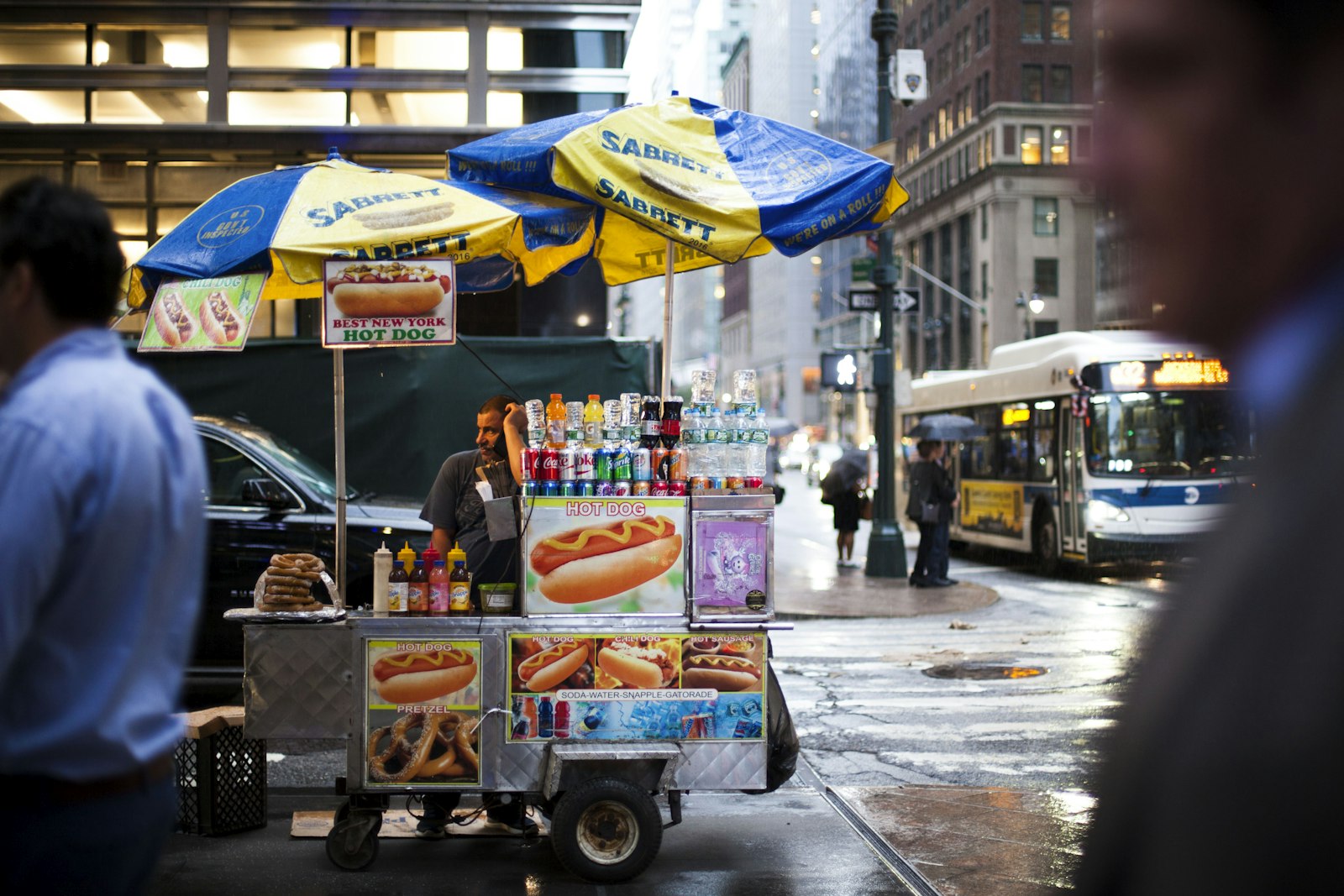
Street food in New York is not a novelty for tourists — it is how millions of people eat every single day. It is fast, cheap, honest, and often very good. The variety is remarkable. In a single block you might walk past a hot dog cart, a halal platter stall, a fresh fruit vendor, and a churro stand. Each one tells a story about the city and the communities that built it.
This guide focuses on the stalls and carts that visitors consistently rate as essential. If you only have time to try a few, start here.
The Hot Dog Cart: A New York Classic
The hot dog cart is the most recognisable symbol of New York street food. There are an estimated 3,000 licensed hot dog vendors in the city, many of them working the same corners for decades. A basic hot dog costs around $3 to $5, though prices near tourist hotspots such as Central Park or Times Square tend to run higher.
Sabrett is the brand most commonly sold from street carts. The natural casing snaps when you bite in — that is the sign of a proper New York hot dog. Ask for mustard and sauerkraut, or go for onion sauce, the classic red cooked onion topping that longtime New Yorkers prefer. The cart outside the Metropolitan Museum of Art on Fifth Avenue is one of the busiest in the city. The vendor at the main entrance to Central Park at 72nd Street is a standard benchmark for the traditional New York experience.
Avoid the novelty toppings added for tourists. A hot dog with mustard and sauerkraut is enough. It has been enough since the 1860s.
Love New York? Get the best travel tips, lesser-known corners, and inspiration straight to your inbox. Subscribe to our free newsletter →
The Halal Cart: The City’s Biggest Street Food Obsession
The Halal Guys started as a single food cart on 53rd Street and Sixth Avenue in Midtown Manhattan in 1990. They served halal food to the city’s Muslim taxi drivers, who had few options for a quick, affordable meal that met dietary requirements. Word spread, and the queue grew. Today, the original cart on 53rd and 6th is one of the most famous street food stalls in the world — at lunchtime, you will often see a queue stretching half a block.
The format is simple. You choose chicken, beef gyro, or a combination. It comes over rice or in a pitta wrap. Add a side salad, white sauce (a tangy, creamy dressing), and hot sauce if you want heat. The white sauce is the reason people keep coming back.
There are now Halal Guys restaurants across the United States, but the original carts are still the best version. Many other halal carts have sprung up across the city inspired by this model. You will find them throughout Midtown, in Jackson Heights in Queens, and across Brooklyn. The price is around $8 to $12 for a platter — excellent value in a city not known for being cheap.
Pretzels, Knishes and the Older Traditions
Before the halal cart, before the food truck boom, there was the pretzel cart. The soft pretzel — large, salted, warm, and chewy — is one of the oldest street foods in New York. German immigrants brought the pretzel to the city in the 19th century, and it became a fixture on street corners across Manhattan. You can still buy a good one for $3 or less. Eaten warm and fresh off the cart, they are more satisfying than you might expect.
The knish deserves more attention. A knish is a baked or fried pastry filled with potato, spinach, or kasha (buckwheat). It is filling, cheap, and deeply tied to the Jewish immigrant food traditions of the Lower East Side. Yonah Schimmel Knish Bakery at 137 East Houston Street has been making them since 1910. It is technically a shop rather than a cart, but no honest list of must-try New York street food leaves it out.
Love New York? Get the best travel tips, lesser-known corners, and inspiration straight to your inbox. Subscribe to our free newsletter →
Elote, Arepas and Latin Street Food
The city’s large Latin American community has produced some of its best street food. Elote — Mexican-style grilled corn — is sold by vendors throughout the outer boroughs, particularly in Jackson Heights and Corona in Queens, and along the Jerome Avenue corridor in the Bronx. The corn is grilled and then covered in mayonnaise, cotija cheese, chilli powder, and lime juice. It is rich, savoury, and genuinely addictive. A full ear costs around $4.
Arepas — cornmeal cakes filled with cheese, pulled pork, or black beans — are a Colombian and Venezuelan staple widely available in Jackson Heights, which has one of the highest concentrations of Latin American food vendors in any US city. Easy to reach on the 7 train, it offers more variety per block than almost anywhere else in New York.
Tamales, fresh coconut water, mango with chilli and lime, and churros with chocolate dipping sauce are all commonly found at weekend markets and on busy corners throughout the outer boroughs.
Where to Find the Best Street Food in New York
Location makes a significant difference. These areas reliably deliver:
Midtown Manhattan — The highest concentration of food carts in the city. Good for hot dogs, halal platters, and pretzels. Prices are slightly higher than elsewhere, but the number of vendors means competition keeps quality up.
Jackson Heights, Queens — The best destination for Latin American and South Asian street food. The 74th Street corridor has Bangladeshi, Indian, Colombian, and Ecuadorian vendors often operating side by side. Take the 7 train to 74th Street–Broadway.
Flushing, Queens — Outstanding for Chinese, Korean, and Taiwanese street food. The indoor food court at the New World Mall on Main Street has dozens of stalls serving dumplings, scallion pancakes, Taiwanese beef noodles, and much more. It operates year-round regardless of weather.
Smorgasburg, Brooklyn — An open-air food market held every Saturday in Williamsburg and Sunday in Prospect Park from spring through autumn. It focuses on independent vendors, many of whom have gone on to open permanent restaurants. Prices are higher than a cart, but the variety and quality are exceptional.
The High Line — A rotating selection of local vendors operates along the elevated park. Options change seasonally, but the quality is generally reliable and the setting is one of the most pleasant in the city for an outdoor lunch.
Practical Tips for Eating Street Food in New York
A few things worth knowing before you queue:
Cash is still king at most carts. Many of the older vendors do not accept cards. Carry small bills — $10 or $20 notes — as change can be limited.
Busy is a good sign. A long queue at a street cart is a reliable quality signal. Vendors with no queue in a busy area are usually worth skipping.
Eat at non-peak hours if you can. Lunchtime between noon and 1:30pm is when queues are longest in Midtown. Eating at 11:30am or after 2pm means you will wait less and the food will often be fresher.
Check for the permit. Licensed food vendors in New York City display a laminated permit on their cart, which confirms they have passed health inspections. If you cannot see one, move on.
Street food is partly a seasonal experience. Some carts reduce hours or close during winter. Outdoor markets such as Smorgasburg operate from roughly April to November. If you are visiting in December or January, focus on Midtown carts and the indoor markets in Flushing and Jackson Heights.
Why It Matters
New York’s street food scene is not just a collection of convenient lunch options. It is a direct record of immigration — of communities feeding themselves and eventually feeding the whole city. The hot dog traces back to German and Eastern European immigrants. The halal cart grew from a practical need within a Muslim community that had few other options. The elote vendors came with the waves of Mexican and Central American migration that reshaped the outer boroughs from the 1980s onwards.
Each cart and stall reflects a moment in the city’s history. Eating from a street cart in New York is one of the most direct ways to experience what the city actually is. You are standing on a pavement, eating from a paper plate or a foil container, surrounded by people doing exactly the same thing.
That is not an inconvenience. That is the point.
Love New York? Get the best travel tips, lesser-known corners, and inspiration straight to your inbox. Subscribe to our free newsletter →
