
New York has no shortage of trendy restaurants, celebrity chefs, and seasonal menus written on chalkboards in cursive. But some of the city’s most reliable and satisfying meals have always come from somewhere far less fashionable: the classic American diner or old-school lunch counter. Coffee that arrives without you asking, menus printed on laminated card, and a counter stool that swivels just enough to watch the cook work the grill. These places have been feeding New Yorkers for decades, and they are well worth your time.
The question of which diner feels most authentically classic is one New Yorkers will debate over their third refill. The answer depends on what you value — the interior, the longevity, the menu, or simply whether the person behind the counter remembers your order. Here is a practical guide to the most genuine examples left in the city.
💌 Want weekly New York tips in your inbox? Subscribe to our free newsletter and we’ll send you the best of the city every week.
What Makes a Diner Genuinely Classic?
Not every place with a neon sign and a picture of eggs qualifies. A genuinely classic New York diner or lunch counter has a few things in common: it has been operating for a long time (usually several decades), it is independently owned, it serves straightforward food at reasonable prices, and it has not been renovated into something unrecognisable. The staff often have years of experience at the same counter. The coffee is not artisanal. The booths may be slightly worn. That is the point.
Many of New York’s oldest diners trace their roots to Greek-American immigrant families who arrived in the mid-twentieth century and built the city’s diner culture almost single-handedly. The stainless steel exterior, the long counter with swivel stools, the wide-ranging menu — these became signatures of a specific New York experience that has largely resisted change.
Lexington Candy Shop, Upper East Side
Lexington Candy Shop on the corner of 83rd Street and Lexington Avenue has been open since 1925. It has barely changed. The lunch counter runs along one wall, the booths along the other, and the menu covers everything from egg creams to club sandwiches. The egg cream — a New York classic made with milk, soda water, and chocolate syrup, and containing neither eggs nor cream — is one of the better versions in the city.
The shop is small, which means it fills up quickly on weekend mornings. Arrive early or be prepared to wait. The pancakes are solid, the coffee is served in the correct style (immediate, refillable, no questions asked), and the prices remain reasonable for the neighbourhood. This is the kind of place that appears in films set in New York because it actually looks like what people imagine when they picture a New York diner.
Waverly Diner, Greenwich Village
The Waverly Diner on the corner of Waverly Place and Sixth Avenue is one of the few places in Manhattan where you can get a proper meal at two in the morning and feel comfortable doing it. It is open 24 hours and has been a Greenwich Village fixture for decades. The interior has the standard diner layout — counter, booths, laminated menus — and the food is what you would expect: eggs, sandwiches, burgers, Greek salads, and a reasonable selection of diner desserts.
The Waverly attracts a cross-section of the neighbourhood at any given hour: students, locals finishing a night shift, people who simply want breakfast at midnight. It is unpretentious in the most genuine sense, which is harder to find in Greenwich Village than it used to be. The portions are generous and the service is efficient without being rushed.
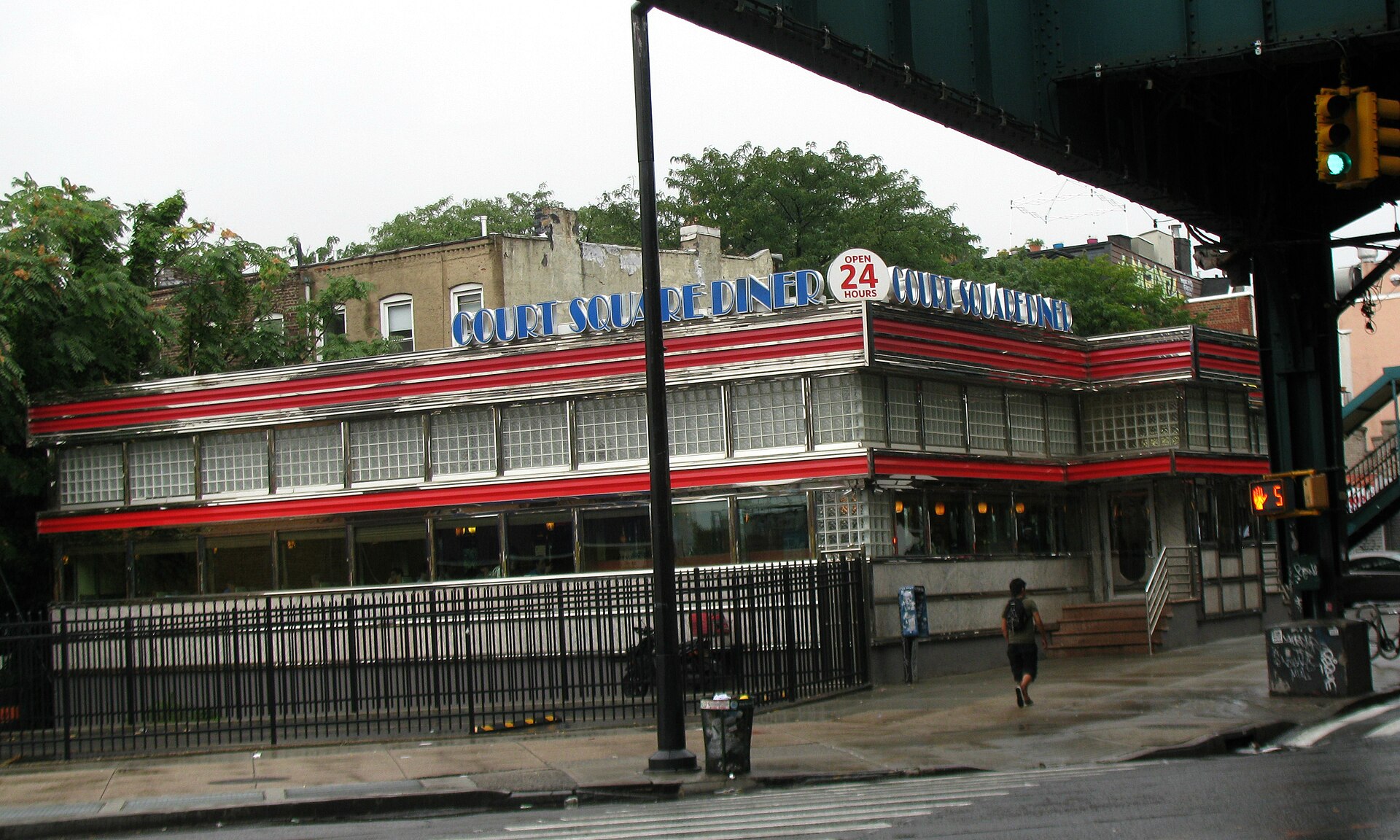
Court Square Diner, Long Island City, Queens
Court Square Diner in Long Island City is a short trip across the East River on the 7 train, and it is worth making. The building itself is a classic stainless steel diner car, the kind that was manufactured in New Jersey and delivered whole to its location. The menu is extensive — several pages of options covering every meal — and the food is reliable diner cooking rather than anything ambitious.
What makes Court Square work is the combination of the authentic exterior, the reasonable prices, and the fact that it serves a real neighbourhood rather than a tourist area. Long Island City has changed considerably in recent years, but Court Square Diner has remained consistent. The omelettes are generous, the toast comes with butter already on it, and the coffee is strong. That covers the essentials.
Eisenberg’s Sandwich Shop, Flatiron
Eisenberg’s Sandwich Shop on Fifth Avenue near 22nd Street opened in 1929 and operated as a lunch counter institution for nearly a century. After closing and reopening under various circumstances, it continues to trade on a menu rooted in the classic New York deli-counter tradition: tuna melts, grilled cheese, matzo ball soup, egg salad, and the egg cream that appears at any self-respecting old-school counter. The space is narrow, the counter is long, and the whole place feels like it belongs to a different era of the city — which is precisely why it remains worth visiting.
Lunch is the best time to go. The counter fills up with people on a genuine midday break, which gives it an energy that matches the food: fast, no-nonsense, satisfying.
Sarge’s Deli and Diner, Murray Hill
Sarge’s on Third Avenue in Murray Hill is technically a deli-diner hybrid, which is a category New York has largely invented for itself. It has been open since 1964 and was a 24-hour operation for most of its existence, though hours have adjusted over time. The pastrami sandwich is the reason most people visit, and it deserves the reputation: thick-cut, properly seasoned, served on rye with mustard. The matzo ball soup is also worth ordering.
The portions at Sarge’s are large enough that sharing is sensible unless you are genuinely hungry. The booths are comfortable, the menu is long, and the atmosphere is exactly what the Murray Hill neighbourhood has come to rely on for decades. It is one of the few places left in Manhattan where the concept of a proper deli-diner still makes practical sense.
📬 Never miss a New York recommendation. Join thousands of readers who get our free weekly newsletter — local tips, neighbourhood guides, and the best of the city delivered to your inbox.
The Flame Diner, Hell’s Kitchen
Hell’s Kitchen has changed dramatically over the past two decades, but the Flame Diner on Ninth Avenue has held its position as a no-frills neighbourhood option since the 1970s. The prices are low by Manhattan standards, the menu covers all the expected diner categories, and the space is functional rather than decorative. It is the kind of diner that does not need to be discovered or reviewed — it simply exists, reliably, for the people who live nearby and want a reasonable meal at a fair price.
The breakfast menu runs all day, which is standard diner practice and one of the more sensible policies in the food industry. If you are staying in Midtown and want a no-nonsense meal that does not require a reservation or a budget adjustment, the Flame is a practical choice.
What to Order at a Classic New York Diner
The diner menu can be intimidating in its length. Most have dozens of options across every meal category, plus specials written on a board that may or may not be audibly communicated to you. A few reliable choices worth knowing:
- Eggs any style with home fries and toast: The foundational diner breakfast. Judge a diner by how it handles this order.
- Egg cream: Specific to New York. If the place makes them, order one — chocolate or vanilla.
- Club sandwich: A useful test of a diner’s approach to fundamentals. Should be three layers, toasted, with a toothpick.
- Greek salad: Reflects the Greek-American heritage of diner culture. Usually generous and reliably dressed.
- Matzo ball soup: In the deli-diner category, this is often the best starter on the menu.
- Pie: If the diner has a rotating pie case, it usually means they take the dessert section seriously. Worth checking.
Practical Tips for Visiting
Most classic diners accept cash and cards, but it is worth carrying cash as a backup — some of the older counters still prefer it. Tipping is expected and 20% is standard for table service; a dollar or two per person is reasonable at the counter for quick service.
Weekday mornings before 9am and the period between the lunch and dinner rush (roughly 2:30pm to 5pm) are the quietest times to visit. Saturday and Sunday brunch hours at Manhattan diners can involve a wait, particularly at the more well-known spots. The outer boroughs — Queens and Brooklyn in particular — tend to have diners that are equally good and considerably less crowded.
A word on coffee: diner coffee is a category of its own. It will not be single-origin or made with a pour-over. It will arrive in a ceramic mug, it will be refilled without ceremony, and it will be exactly what you need at seven in the morning. This is not a compromise — it is the correct form of the drink for the setting.
Why These Places Still Matter
New York loses a diner every few years to rising rents, retiring owners, or simply the changing economics of feeding a city. The ones that remain are not just restaurants — they are part of the fabric of the neighbourhoods they occupy. They are where people go after a shift, before school, on the way home from somewhere, or simply because they want a meal that does not require a decision more complicated than scrambled or fried.
If you are visiting New York and you eat at one classic diner during your trip, you will understand something about the city that no amount of fine dining can teach you. These places are not relics. They are working establishments that happen to have been working for a very long time.
📩 Before your next New York trip, sign up for our free weekly newsletter. We cover neighbourhoods, restaurants, day trips, and the kind of local knowledge that makes the difference between a good visit and a great one.
