
Greenwich Village is where New York City stopped trying to impress you and started trying to mean something. This compact pocket of lower Manhattan has been the spiritual home of American bohemia for over a century — and somehow, despite rising rents and tourists with coffee cups, it still delivers. Writers, musicians, activists, and artists have all called it home, and the streets still carry that charge. If you only have time for one neighbourhood on your New York trip, make it the Village.
Here is everything you need to know about things to do in Greenwich Village, from the iconic landmarks to the genuinely hidden corners.
Washington Square Park: The Heart of the Village
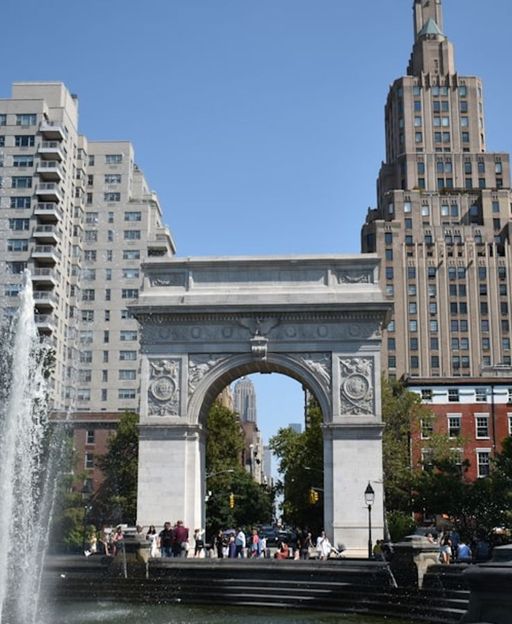
No visit to Greenwich Village begins without Washington Square Park. The marble arch at its northern edge echoes the Arc de Triomphe in Paris, though on a deliberately more human scale. New York City erected it in 1892 to mark the centennial of George Washington’s inauguration. Stand at the fountain and look north through the arch — on clear days, the Empire State Building floats in the distance along Fifth Avenue. It is one of the great free views in the city.
The park itself works as New York City’s greatest outdoor living room. On any afternoon, you will find NYU students working on laptops, chess players running games by the fountain, street musicians drawing small crowds, and dogs conducting their own vigorous social scene on the lawn. The energy is democratic and unhurried.
The ground beneath your feet carries its own dark history. Before the park arrived, this land served as a potter’s field where the city buried its poor. Yellow fever victims still lie beneath the grass — some estimates put the number at over 20,000 bodies. That history gives Greenwich Village its unusual gravity. Nothing here is merely decorative.
The Literary and Musical Legacy of the Village
Greenwich Village reinvented American creative life every few decades throughout the twentieth century. Early in the century, radical political magazines and anarchist salons filled the neighbourhood. In the 1950s, Beat writers — Jack Kerouac, Allen Ginsberg, Gregory Corso — held court in the coffeehouses along MacDougal Street. By the early 1960s, a young Bob Dylan had moved into a flat on West 4th Street and played folk songs in the clubs along Bleecker Street to anyone who would listen.
Walking these streets with any of that history in mind transforms the experience entirely. The White Horse Tavern on Hudson Street, open since 1880, is where Dylan Thomas spent his final nights in 1953 — allegedly consuming eighteen whiskies before collapsing. It still serves pints in the same dark wood interior. Literary pilgrims stop in regularly, and the pub earns its place as one of the most atmospheric rooms in New York City.
Bleecker Street runs through the neighbourhood like a spine. In the 1960s, folk clubs and coffeehouses filled every block. Today you find a mix of boutiques, restaurants, and a few surviving music venues. The Bitter End at 147 Bleecker Street claims the title of New York City’s oldest rock club, with roots stretching back to 1961. Lady Gaga, Billy Joel, and Neil Young have all performed here at various points in their careers.
The Stonewall Inn and Christopher Street
Greenwich Village played a central role in the modern LGBTQ+ rights movement, and the neighbourhood carries that history with pride. Christopher Street, running through the heart of the Village, keeps its rainbow flags up year-round, not merely during Pride month. The energy here stays unapologetically joyful.
The Stonewall Inn at 53 Christopher Street holds status as a National Monument — the only one in the United States dedicated to LGBTQ+ history. In June 1969, patrons fought back against a police raid, sparking three nights of demonstrations that helped ignite the modern gay rights movement. The bar still operates. You can have a drink inside or stand outside and take in the significance of the building and the small park opposite, where the community gathers on warm evenings.
The Christopher Street area also holds several excellent neighbourhood restaurants — the kind of places locals fill rather than tourists. Head south toward Hudson Street for a particularly strong stretch of options.
Jazz in the Village: The Village Vanguard
If you have any interest in jazz — and even if you think you do not — spend an evening at the Village Vanguard on Seventh Avenue South. Since 1935, this basement club has set the standard for live jazz worldwide. Miles Davis, John Coltrane, Bill Evans, Charles Mingus, and Thelonious Monk all recorded live albums here. The triangular room offers superb acoustics, clean sightlines, and an atmosphere of reverence that never tips into stiffness.
The Vanguard runs sets seven nights a week, with musicians rotating through weekly residencies. It operates as a genuine working club — not a tourist trap — that happens to carry an almost incomprehensible weight of jazz history. Book tickets online in advance, especially at weekends. The cover charge is reasonable, and the minimum runs to one drink per set.
Washington Mews and the Hidden Streets
One of the great pleasures of Greenwich Village is discovering streets that feel like they belong to another city altogether. Washington Mews, a cobblestoned lane off Fifth Avenue just north of Washington Square, offers a double row of former stables that owners long ago converted into private residences. The buildings stay uniformly low and pale, the paving stones are original, and on a quiet weekday morning the Mews carries the atmosphere of a village in Normandy — one block from one of the world’s busiest cities.
Minetta Lane and Commerce Street reward exploration too. Commerce Street curves in a way that Manhattan streets almost never do — it follows the original path of an old stream, not the later grid. The curving row of townhouses here is some of the most charming domestic architecture in the neighbourhood. The Cherry Lane Theatre sits at the end of Commerce Street — the city’s oldest continuously operating off-Broadway theatre, founded in 1924.
Eating and Drinking in Greenwich Village
Greenwich Village packs one of New York City’s densest and most varied restaurant scenes into a small area. A few classics worth knowing:
- John’s of Bleecker Street — Coal-fired pizza since 1929. Long queues, no slices, absolutely worth it. The charred crust and simple tomato sauce define the New York pizza ideal.
- Babbo — An Italian flagship on Waverly Place with outstanding pasta and a lively dining room. The lamb’s brain ravioli is not for the faint-hearted, but the regular pasta menu is superb.
- White Horse Tavern — The historic pub on Hudson Street where Dylan Thomas spent his final nights. Perfectly maintained, genuinely atmospheric, and a fine place for a pint.
- Café Wha? on MacDougal Street — The basement club where Dylan, Hendrix, and Richard Pryor all performed early on. It now hosts nightly cover bands and is excellent fun.
- Murray’s Cheese on Bleecker Street — One of the finest cheese shops in America, with an attached bar for wine, charcuterie, and grilled cheese sandwiches.
For coffee, Think Coffee on Mercer Street runs a socially conscious model with reliably excellent espresso. Joe Coffee on Waverly Place has set the standard for New York specialty coffee since 2003.
The Jefferson Market Library and Village Architecture
The Jefferson Market Library on Sixth Avenue stands as one of Manhattan’s most extraordinary buildings. Architects completed this Victorian Gothic structure in 1877 as a courthouse. The red-brick tower, pointed arches, and rose window make it look as though someone lifted it from a Victorian English cathedral and set it down in lower Manhattan. Community campaigners fought to save it from demolition in the 1960s, and the building reopened as a New York Public Library branch in 1967. It remains entirely open to the public as a working library and is worth stepping inside.
The Village as a whole preserves its pre-grid character. City planners imposed Manhattan’s street grid in 1811, but Greenwich Village had already developed — so the streets follow older, organic patterns instead. Row houses, Federal-style townhouses, and irregular street corners create an environment that feels human-scaled and genuinely historic in a city that otherwise tends to demolish and rebuild every few decades.
Practical Tips for Visiting Greenwich Village
Greenwich Village covers a roughly triangular stretch of lower Manhattan, running from 14th Street in the north to Houston Street in the south, between Broadway and the Hudson River. The western portion goes by the name West Village. The nearest subway stations are West 4th Street–Washington Square (A, C, E, B, D, F, M lines) and Christopher Street–Sheridan Square (1 line). Both stations connect well to the rest of Manhattan, and the neighbourhood is very easy to explore on foot.
A weekday morning or early afternoon offers the quietest experience. Washington Square Park fills up on sunny weekend afternoons — arrive before noon for a more relaxed visit. Allow at least half a day for a proper exploration; a full day if you plan to have lunch, visit the Jefferson Market Library, and catch an evening set at the Village Vanguard. Greenwich Village pairs naturally with Chelsea to the north (for the High Line and contemporary art galleries) or with the West Village, which connects seamlessly to the south and west.
More New York City Stories
Greenwich Village is just one piece of what makes New York City endlessly compelling. Explore more with these guides from Love New York:
- Things to Do in the East Village, NYC — a different neighbourhood, a different energy
- Jazz Clubs in New York City — the complete guide
- Hidden Gems in New York City — more secret spots worth discovering
Frequently Asked Questions About Greenwich Village
What is the best time to visit Greenwich Village?
Spring and autumn offer the best conditions for visiting Greenwich Village, with comfortable temperatures and the tree-lined streets at their most photogenic. Weekday mornings see the fewest crowds; weekend afternoons bring more visitors, especially to Washington Square Park.
How do I get to Greenwich Village by subway?
The most convenient station for Greenwich Village is West 4th Street–Washington Square, where the A, C, E, B, D, F, and M lines stop. For Christopher Street and the West Village, take the 1 train to Christopher Street–Sheridan Square. Both stations place you within easy walking distance of the main attractions.
Is Greenwich Village worth visiting for first-time NYC travellers?
Absolutely. Greenwich Village gives first-time visitors Washington Square Park, the Stonewall Inn, historic architecture, excellent restaurants, and live music venues all within easy walking distance. It shows a side of New York City that Times Square simply cannot match.
What is Greenwich Village known for?
Greenwich Village is known for its bohemian heritage, literary and musical history, and its central role in the LGBTQ+ rights movement. Washington Square Park, the Stonewall Inn, and the Village Vanguard jazz club all sit here, as do decades of connections to Bob Dylan, Jack Kerouac, and countless other artists.
Where should I eat in Greenwich Village?
John’s of Bleecker Street is the classic choice for coal-fired pizza. The White Horse Tavern on Hudson Street serves food in one of the most atmospheric rooms in the neighbourhood. For Italian food, Babbo on Waverly Place is outstanding. The MacDougal Street area offers numerous casual options for a quick meal between sightseeing stops.
Join 1,000+ New York Lovers
Every week, get New York’s hidden gems, local secrets, and travel inspiration — the kind you won’t find in any guidebook.
Subscribe free — enter your email:
Love more? Join 64,000 Ireland lovers → · Join 43,000 Scotland lovers → · Join 30,000 Italy lovers →
Free forever · One email per week · Unsubscribe anytime
