
Every Labour Day weekend, Eastern Parkway fills with a million people in sequinned costumes and feathered headdresses. Steel drums ring off the old limestone rowhouses. The smell of curried goat and jerk chicken drifts from Nostrand Avenue all the way to Prospect Park. This is Crown Heights — and it belongs, in every joyful sense, to the Caribbean.
If you love New York’s hidden stories, you’ll love our free weekly newsletter. Subscribe to Love New York →
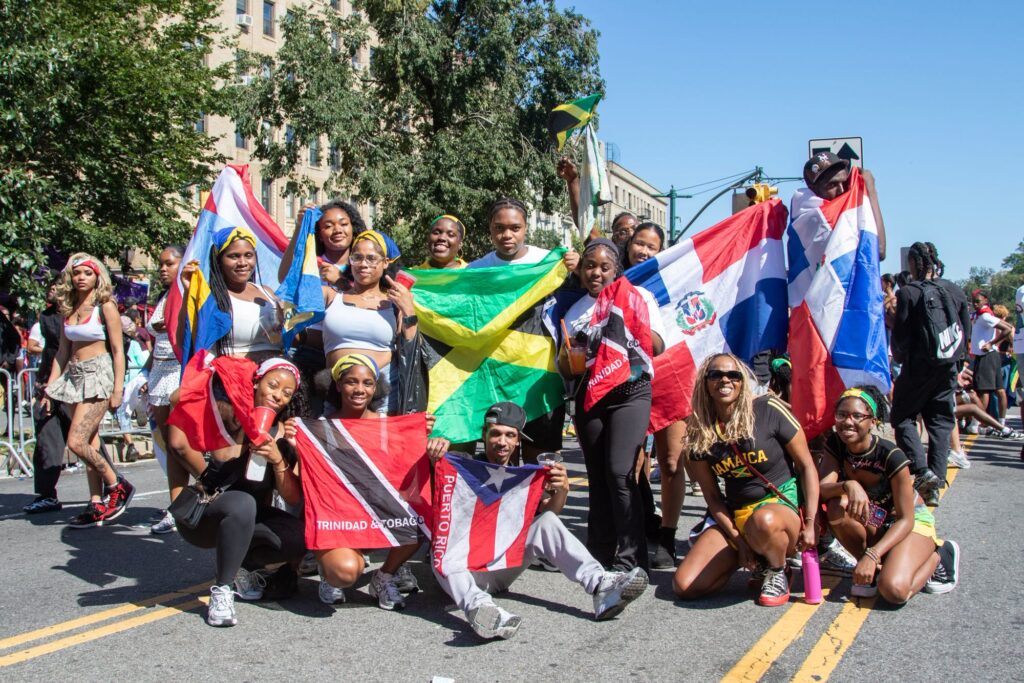
Crown Heights stretches across central Brooklyn between Flatbush Avenue and East New York Avenue. Today it carries one of the most distinct cultural identities of any neighbourhood in America. But that identity took decades to build — through sacrifice, community, and sheer determination. Here is the story of how it happened.
The First Wave: Caribbean New Yorkers Before the Second World War
Caribbean immigration to New York City began long before the 1960s. The first significant wave arrived between 1900 and 1930. Immigrants from Jamaica, Barbados, Trinidad, and British Guiana — then British colonies — settled initially in Harlem alongside the African American families arriving from the South during the Great Migration.
These early Caribbean New Yorkers brought something distinctive with them. They had experience navigating British colonial bureaucracy. Many had higher literacy rates than their neighbours. They organised quickly — into churches, friendly societies, and fraternal lodges that gave the community structure from day one.
The steamship lines connecting New York to Kingston, Bridgetown, and Port of Spain made the crossing possible. A Jamaican labourer earned more in a single week in New York than in a month at home. Word spread fast.
By the 1930s, Caribbean families began moving south from Harlem to Brooklyn. Crown Heights had wide streets, solid rowhouses built in the 1900s and 1910s, and good subway connections. It offered something that Harlem, increasingly crowded, could not — space.
Why Crown Heights? The Geography of Choice
Crown Heights North, built between 1890 and 1930, contains some of the finest rowhouse architecture in Brooklyn. Developers constructed these tree-lined blocks with limestone and brownstone facades. They built them for middle-class Jewish and Italian families moving out of Manhattan. By the 1940s, those families had continued their own migration further out to Queens and Long Island.
Caribbean families moved into the vacated homes. They did not find a neighbourhood in decline. They found solid, well-built housing stock on quiet blocks — exactly what they wanted. Eastern Parkway, designed by Frederick Law Olmsted in 1870 as one of the world’s first parkways, ran straight through the neighbourhood. It felt grand. It felt permanent.
Churches played a central role in the settlement pattern. Caribbean immigrants brought their own religious traditions — Anglican, Methodist, Baptist, Pentecostal, Seventh-day Adventist. They established congregations that became community anchors. Today, Crown Heights has more Seventh-day Adventist churches per square mile than almost anywhere outside of Jamaica itself.
1965: The Year Everything Changed
The Hart-Celler Immigration Act of 1965 transformed Caribbean New York completely. Before this law, strict quotas limited immigration from the Caribbean. After 1965, family reunification became the cornerstone of American immigration policy. Caribbean families could sponsor relatives. Chains of migration formed overnight.
Between 1965 and 1980, over half a million Caribbean immigrants arrived in New York City. Crown Heights absorbed tens of thousands of them. Flatbush Avenue filled with Caribbean-owned businesses. Nostrand Avenue became a corridor of Jamaican patty shops, Trinidadian roti stands, and Barbadian rum bars. The Haitian community, fleeing political instability, added another layer to the neighbourhood’s cultural mix.
By 1970, Crown Heights had become the most Caribbean neighbourhood in North America. It remains so today.
Want more stories like this? Our weekly newsletter goes deeper into New York’s heritage every week. It’s free. Subscribe here →
The Labour Day Carnival: A Community Makes Itself Visible
Nothing expresses the depth of Caribbean identity in Brooklyn quite like the Labour Day Carnival. This celebration draws over two million people to Eastern Parkway every September — making it one of the largest public gatherings in the United States.
The Carnival began indoors. In 1947, Rufus Gorin and Jesse Waddell organised the first West Indian Carnival in New York at the 369th Regiment Armory in Harlem. It recreated the Trinidad Carnival that participants had grown up with — mas costumes, calypso music, soca rhythms. For a community far from home, it provided connection.
By the 1960s, as the Caribbean community shifted south to Brooklyn, the event followed. In 1969, Rufus Gorin moved the Carnival outdoors to Eastern Parkway. The parkway’s wide promenade suited the Carnival perfectly. The West Indian American Day Association (WIADCA) formalised the event in 1971 and has organised it ever since.
The Carnival is not just a party. For Caribbean families scattered across the Americas, it functions as a reunion. Families who left Trinidad for Toronto, London, and New York converge on Crown Heights every September. Grandmothers meet grandchildren born on different continents. Cousins who have never met embrace on Eastern Parkway. The neighbourhood becomes, for one weekend, the centre of the Caribbean diaspora world.
Shirley Chisholm: Crown Heights Gave America Its First
Crown Heights produced one of the most consequential politicians in American history. Shirley Chisholm grew up at 1029 Prospect Place, the daughter of Charles St. Hill from Barbados and Ruby Seale from British Guiana. Her parents had arrived in New York as part of that early Caribbean wave.
Chisholm attended local schools and then Brooklyn College. In 1968, she became the first Black woman elected to the United States Congress. In 1972, she ran for the Democratic presidential nomination — the first Black candidate and first woman to seek nomination from a major American political party. She did not win. But she forced America to look at who could lead it.
Her Crown Heights roots shaped everything. She described her Barbadian mother as the foundation of her ambition. The community she grew up in — church-going, organised, fiercely proud of its Caribbean heritage — gave her the confidence to build a life on her own terms.
The Weeksville Connection: A Deeper Heritage
Caribbean immigration built on a foundation that predates it. Weeksville, a free Black community established in 1838 in what is now Crown Heights, shows that this part of Brooklyn has always been a place of African-descended community-building. Before the Civil War, hundreds of free Black Americans lived in Weeksville, owned property, and built institutions.
The Weeksville Heritage Centre at 1698 Bergen Street preserves four of the original wooden homes from the 1840s and 1850s. These houses survived for 130 years before historians rediscovered them in 1968. Today they stand as the oldest surviving African American community structures in New York City.
Tracing Caribbean Heritage in Crown Heights Today
Crown Heights preserves remarkable physical evidence of its Caribbean heritage. Here are the places that matter most for anyone tracing family connections to this community.
Eastern Parkway remains the symbolic spine of Caribbean Brooklyn. Walk the promenade on any summer weekend and you will see cricket conversations, steel drum practice, and families speaking Patois, Trinidadian Creole, and Haitian Kreyol side by side.
Nostrand Avenue between Atlantic and Flatbush contains the highest concentration of Caribbean businesses. Jamaican patty shops sit beside Trinidadian roti stands, Haitian bakeries, and Barbadian-owned groceries selling salt fish and plantain. This is the street your ancestors would have known.
The Weeksville Heritage Centre at 1698 Bergen Street offers guided tours of the preserved Hunterfly Road houses. The museum also runs genealogy workshops focused on tracing Brooklyn and Caribbean family histories.
Medgar Evers College on Bedford Avenue hosts community events that connect the neighbourhood’s Caribbean heritage to wider diaspora culture. Its library holds materials on Caribbean immigration history valuable for researchers.
Prospect Park connects directly to Crown Heights. Caribbean families have used the park’s Long Meadow as a cricket pitch and community gathering space since the 1950s. Informal cricket matches still run on summer afternoons — a tradition that links Crown Heights directly to the Caribbean.
How to Research Your Caribbean-Brooklyn Family History
If your family came from Jamaica, Trinidad, Barbados, Guyana, Haiti, or another Caribbean territory and settled in Brooklyn, Crown Heights may hold the records of your ancestors’ New York life. Our complete guide to tracing New York City ancestry covers the key resources in detail.
The New York City Department of Records holds birth, marriage, and death certificates from 1866 onwards. Many Caribbean immigrants who settled in Crown Heights in the 1940s-1970s recorded their family events here. Vital records open after 75 years.
The New York Amsterdam News archives at the New York Public Library contain decades of coverage of the Caribbean community in Brooklyn. The paper reported on Caribbean churches, community organisations, and notable arrivals from the 1940s onwards.
Ship manifests record arrivals from Kingston, Bridgetown, and Port of Spain at New York harbour. The US National Archives holds these records from 1895 to 1957. They list names, ages, occupations, and — crucially — the name and address of the person the immigrant planned to contact in New York. That contact person was often a relative already established here.
The Brooklyn neighbourhoods guide covers other parts of Brooklyn worth exploring alongside Crown Heights during any heritage visit.
Frequently Asked Questions
When did Caribbean immigrants first settle in Crown Heights, Brooklyn?
Caribbean families began settling in Crown Heights in significant numbers during the 1940s, moving south from Harlem as housing opened up. The Immigration Act of 1965 triggered a much larger wave, with tens of thousands of families from Jamaica, Trinidad, Barbados, Guyana, and Haiti arriving through the 1970s and 1980s.
What is the West Indian Day Parade in Crown Heights?
The West Indian American Day Carnival Parade runs along Eastern Parkway in Crown Heights every Labour Day. It draws over two million spectators and recreates the Carnival traditions of Trinidad and other Caribbean islands, with mas costumes, steel bands, soca music, and Caribbean food vendors lining the route.
Where can I research my Caribbean family history in New York?
Start with the New York City Department of Records for vital records, the New York Amsterdam News archives at the New York Public Library, and the National Archives ship manifests for arrivals from Caribbean ports. The Caribbean Cultural Center African Diaspora Institute in Manhattan also offers specialist genealogy resources for Caribbean-New York family research.
Is Crown Heights worth visiting for heritage tourism?
Yes. The Weeksville Heritage Centre preserves the oldest surviving African American community structures in New York City, dating to the 1840s and 1850s. Eastern Parkway, Caribbean businesses on Nostrand Avenue, and the annual Labour Day Carnival give visitors direct contact with the living heritage of a remarkable community.
Ready to explore the New York your ancestors knew? Subscribe to Love New York — free weekly stories, heritage guides, and hidden history. Join us →
