
Millions of people carry New York City in their blood. Your great-grandmother may have arrived at Ellis Island with nothing but her name. Your great-grandfather may have worked a pushcart on Orchard Street. Your family may have lived in a tenement on the Lower East Side.
New York holds their records. And those records are more open than ever.
Updated October 2026: we replaced the old Castle Garden website, which no longer works, with the free passenger-list searches at the Statue of Liberty-Ellis Island Foundation and FamilySearch, corrected the New York City vital records dates and where naturalization records are held, checked on statueofliberty.org, nyc.gov/records and archives.gov.
If you love New York’s hidden stories, you will love our free weekly newsletter. Subscribe to Love New York →
This guide covers every major archive for tracing your New York City ancestry. It does not matter whether your family came from Ireland, Italy, Eastern Europe, the Caribbean, or West Africa. The records are there.
Start at Ellis Island
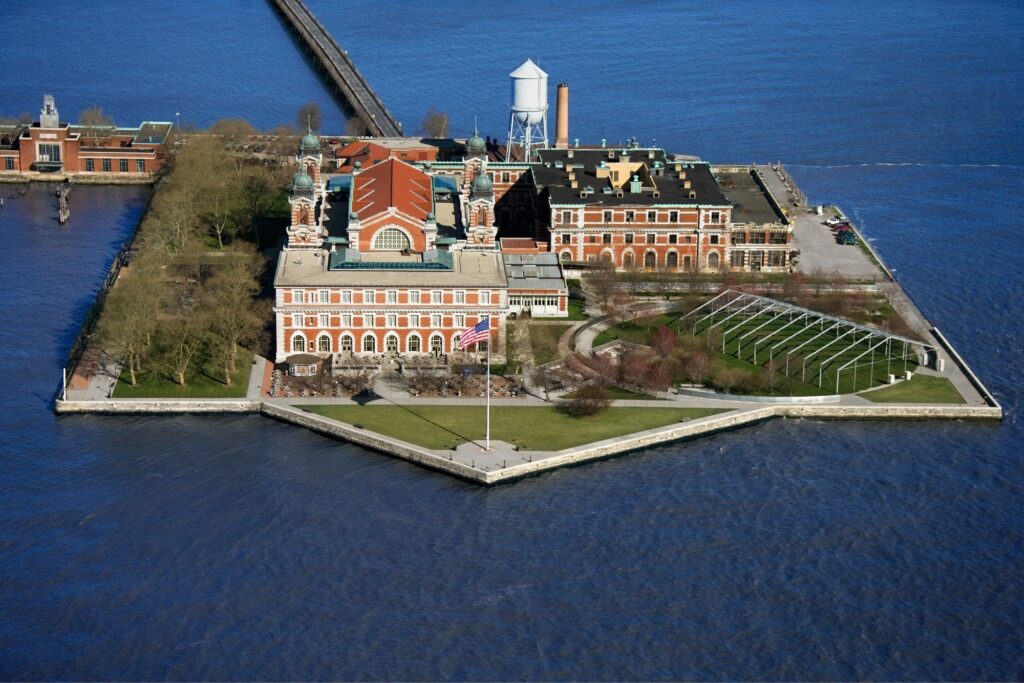
From 1892 to 1924, Ellis Island was America’s largest and most active immigration station, and over 12 million immigrants were processed there, according to the National Park Service. If your family came from Europe in that period, there is a good chance they came through here.
The Statue of Liberty-Ellis Island Foundation’s database, the Arrival Records Collection, is free to search online at statueofliberty.org/arrival-search. Try your surname. Try different spellings too. The Foundation explains that arrival records were filled out at the port of departure and that “immigrants were not given new names upon arrival”, so search for the spelling your ancestor used at home.
According to the National Archives, a passenger list may give nationality and place of birth, ship name and date of entry, age, profession, place of last residence, the name and address of the relative they were joining in the United States, and the amount of money they were carrying.
The relative or contact listed is often the most useful detail. It can show exactly where your family first settled.
If your family arrived before 1892, look for the Castle Garden years. Castle Garden, today’s Castle Clinton in Battery Park, opened as an immigrant landing depot on August 3, 1855 and closed on April 18, 1890, and over 8 million people entered the United States through it (National Park Service). The old Castle Garden website no longer works. Search those years for free instead:
- The Statue of Liberty-Ellis Island Foundation. Its Arrival Records Collection now covers Ellis Island and New York, plus other U.S. ports, across the 18th, 19th and 20th centuries, free online.
- FamilySearch. Its free collection “New York Passenger Lists, 1820-1891” has an index and images. Search it at familysearch.org with a free account.
- The National Archives. It holds passenger arrival records from foreign ports from about 1820 (with gaps). See passenger arrival records.
Checked October 2026.
NYC Vital Records — Births, Marriages, and Deaths
The NYC Department of Records and Information Services runs the Municipal Archives. Its website Historical Vital Records of NYC gives access to “millions of digitized birth, death and marriage records dating from 1855 to 1950.” You can search, browse, download or order certified copies. See the Archives’ genealogy page.
- Birth records after 1909: NYC Department of Health
- Death records after 1950: NYC Department of Health
- Marriage records after 1949: Office of the City Clerk
- The Municipal Archives research rooms are at 31 Chambers Street in Manhattan, by appointment
Who can order which record, and what it costs, is set by each office: check their own pages before you order.
The Municipal Archives’ family history resources also include census records and city directories. Its Tax Photo collection documents every New York City building in the 1940s and the 1980s. If you can visit in person, it is worth the trip.
Naturalization Records
Before September 27, 1906, any “court of record” (municipal, county, state, or federal) could grant U.S. citizenship, so records may sit with state or county courts. Federal court naturalization records for New York are held by the National Archives at Philadelphia, not in Manhattan; the National Archives says “all naturalization records will be moved to Philadelphia.” Its list of New York naturalization holdings links the ones you can already view online at FamilySearch. Source: National Archives, naturalization records. Checked October 2026.
FamilySearch and Ancestry — Start Here Online
Before visiting any archive, start online. Both FamilySearch (free with an account) and Ancestry.com (paid) hold large collections of New York records.
The federal census was first taken in 1790 and every ten years since. Because of a 72-year rule, the most recent census open to us is 1950 (National Archives). The National Archives lists FamilySearch as a free place to search many census years, and the 1950 census has its own free website.
The US federal census lists whole families at a single address. One entry can give you parents, children, grandparents, birthplaces, and jobs — all at once. The National Archives suggests starting with the most recent census and working backwards.
Want more stories like this? Our weekly newsletter goes deeper into New York’s heritage every week. It is free. Subscribe here →
The New York Public Library
The Milstein Division of U.S. History, Local History and Genealogy calls itself one of the nation’s largest publicly accessible genealogical collections. Its reading room is Room 121 in the Stephen A. Schwarzman Building at Fifth Avenue and 42nd Street. It holds family histories, church records, historical newspaper collections and family files, and staff can guide your research. A library card is needed to request most print materials.
The library also offers Ancestry Library Edition for free, but only inside NYPL locations (the Schwarzman Building and the branch libraries), not from home.
YIVO Institute for Jewish Research
If your family came from Eastern Europe and were Jewish, YIVO is essential. The institute is at 15 West 16th Street in Manhattan, inside the Center for Jewish History, which also runs the Ackman & Ziff Family Genealogy Institute.
YIVO’s Miriam Weiner Genealogy Collection holds books, maps, photographs, guides to archives in Poland, Ukraine and Moldova, and travel material on towns in Eastern Europe.
Online, JewishGen is a free resource for Jewish genealogy. It is run by the Museum of Jewish Heritage, not by YIVO.
The Jewish community that built the Lower East Side lives on in these archives.
Finding the Exact Building Your Family Lived In
Finding the building changes everything. It is one thing to read a name in a census. It is another to stand outside the actual door.
Start with the census. Once you have a name and a rough date, search the federal census for that person. The census lists the street address.
Then look up the address with the NYC Department of Buildings to see what stands there now, and find its 1940s tax photo at the Municipal Archives.
Many tenement buildings in the Lower East Side still exist. The Tenement Museum runs guided tours of two historic buildings, 97 and 103 Orchard Street. Families called 97 Orchard Street home between the 1860s and the 1930s, and the tours tell the stories of real families who lived there.
Immigrant Newspapers
Immigrant communities ran their own papers. These papers carried births, deaths, marriages, and letters from home. Searching your surname in the right paper can surface details that no official record holds.
- The Forward — launched as a Yiddish-language daily on April 22, 1897, and still publishing at forward.com
- Brooklyn Newsstand — the Brooklyn Public Library’s free Brooklyn Newsstand includes the full run of the Brooklyn Daily Eagle (1841-1963)
- Chronicling America — the Library of Congress’s free archive of historic newspapers at loc.gov/collections/chronicling-america. Its Directory of U.S. Newspapers in American Libraries helps you find which library holds a paper such as Il Progresso Italo-Americano or the Irish World
DNA Testing and Your NYC Heritage
A DNA test does not replace paper records. But it opens doors that paper cannot.
For New York ancestry, a DNA test can help confirm a paper trail and connect you with living cousins in America and abroad who descend from the same immigrant.
The main consumer tests are AncestryDNA, MyHeritage DNA, 23andMe and FamilyTreeDNA. FamilyTreeDNA’s Y-DNA tests follow the direct paternal line, which helps when you trace a surname.
Contact your matches. Even a third cousin may hold a piece of your puzzle.
Plan Your New York Heritage Visit
There is a difference between reading about your ancestors and standing where they stood. New York makes it possible to do both.
Key sites for family historians in the city:
- Ellis Island National Museum of Immigration — the only ferry authorized by the National Park Service is Statue City Cruises, from The Battery in Lower Manhattan or Liberty State Park in Jersey City
- Tenement Museum — 103 Orchard Street, Lower East Side
- YIVO Institute — 15 West 16th Street, Manhattan
- New York Public Library — Fifth Avenue and 42nd Street, Milstein Division, Room 121
- Municipal Archives — 31 Chambers Street, Manhattan, by appointment
Pair Ellis Island with the Tenement Museum. Both sites sit in Lower Manhattan. Together they tell the full story of arrival and settlement.
Our Irish Lower Manhattan Walk traces the exact streets your Irish ancestors would have known. It is a two-hour walk through Five Points and the old Irish quarter.
For the Italian story, The Little Italy Heritage Walk shows what has survived and what has gone.
To understand what the city looked like when your family first arrived, our piece on life in New York in 1910 gives you a vivid picture of the streets, the rents, and the work.
Frequently Asked Questions
Where can I search Ellis Island records for free?
The Statue of Liberty-Ellis Island Foundation’s Arrival Records Collection is free at statueofliberty.org/arrival-search. FamilySearch.org also holds New York passenger lists at no charge. Search for the spelling your ancestor used at home, and try variants.
Where can I search Castle Garden records now?
The old Castle Garden website no longer works. Search the Foundation’s free Arrival Records Collection, which covers New York in the 19th century too, or FamilySearch’s free “New York Passenger Lists, 1820-1891”. Checked October 2026.
How do I find where my ancestors actually lived in New York City?
Search the US federal census — it lists street addresses. Once you have an address, look it up with the NYC Department of Buildings and find its 1940s tax photo at the Municipal Archives. The Tenement Museum’s tours show how Lower East Side families lived.
What records does the New York City Municipal Archives hold?
The Municipal Archives holds digitized birth, death and marriage records from 1855 to 1950, searchable at Historical Vital Records of NYC, plus census records, city directories and the tax photos. Its research rooms are at 31 Chambers Street, by appointment. Federal naturalization records for New York are at the National Archives at Philadelphia.
Are there free genealogy databases I can use from home?
Yes. FamilySearch is free with an account. The Foundation’s Arrival Records Collection, Historical Vital Records of NYC, the 1950 census website and JewishGen are all free online. The New York Public Library’s free Ancestry Library Edition works only inside its libraries.
Ready to explore the New York your ancestors knew? Subscribe to Love New York — free weekly stories, heritage guides, and hidden history. Join us →
