
Most American family stories start at Ellis Island. For millions of New Yorkers, the real first step came earlier. Castle Garden, at the southern tip of Manhattan, received more than 8 million newcomers between 1855 and 1890. If your ancestors landed in New York before 1892, this is almost certainly where they stood first.
If you love New York’s hidden stories, you’ll love our free weekly newsletter. Subscribe to Love New York →
What Was Castle Garden?
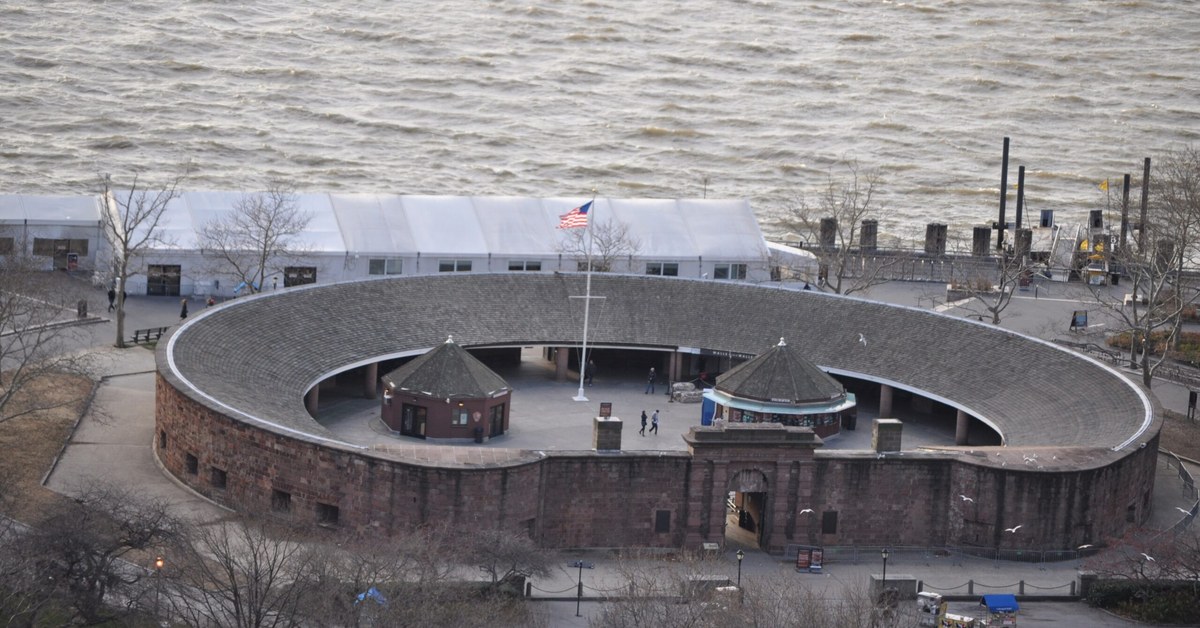
Castle Garden Emigrant Depot was America’s first facility built entirely for the welfare of immigrants. The National Park Service says it opened on August 3, 1855, and closed on April 30, 1890. The building is the round fort now called Castle Clinton, in Battery Park. Before it became a depot, it had served as a fort and an opera house. The depot kept much of the opera house’s ornate columns and balcony.
Before 1855, ships unloaded passengers at the docks with little protection. Runners met the boats and cheated newcomers over lodging, money and train tickets. Castle Garden gave arrivals one fenced, supervised place to land. Staff there registered them, changed their money and sold them rail tickets.
The numbers are huge. Between 1855 and the end of 1889, 8,280,917 of the 10,956,910 immigrants who entered the United States passed through. That is 75 percent. The National Park Service estimates that about 20 percent of Americans can trace their ancestry to someone who came through its doors.
Who Came Through Castle Garden?
Germans formed the largest group. The Irish came next, followed by the English, Swedes, Italians, Scots, Russians, Norwegians, Swiss and French. Many of them walked out of the gate and straight into the neighborhoods you can still trace today.
German families often settled in the Lower East Side district that New Yorkers called Kleindeutschland. Read our story of Little Germany and the German immigrants of Kleindeutschland. Irish families crowded into the streets around Five Points. We tell that history in Five Points and the Irish of Lower Manhattan.
Inside the Rotunda: Noise, Crowds and Confusion
The rotunda was the heart of the depot. It held most of the offices, and it was the most crowded room in the building. One Norwegian immigrant said the noise was so loud that you had to shout into a person’s ear to be heard. Another wrote that a roar met him the moment he arrived. The room was full of every nationality, he said, and there was “much to listen to, but nothing to understand.”
Yiddish speakers gave the place a nickname: Kesselgarden. It means a boiling cauldron of noise and chaos. The word shows how overwhelming the first hour in America felt.
The Registry Desk: Where Your Family Name Was Written
Officials split arrivals into two lines. One line was for English speakers. The other was for people who spoke other languages, usually German or French. At the registry desk, clerks asked each person about themselves and their plans. Interpreters helped, but talking was still hard.
Clerks recorded each person and family, the ship they sailed on, where they were headed, how much money they carried and the names of relatives already in the country. Castle Garden was the first facility of its kind to keep such detailed records. That is why genealogists prize anything that survives.
A visitor in the period described an Irish arrival who wanted to register two gamecocks from Tipperary. “Sure I paid their passage,” he said. Another woman could not give her name aloud. She told the clerks it was painted on her box. These stories show how much patience the desk needed.
Money, Trains and Luggage
After registration, newcomers had practical tasks. The depot offered services under one roof:
- Exchange office: staff changed foreign money into American dollars. Rates changed through the day, and some people suspected they were being cheated.
- Railroad office: three railroads sold tickets here. Agents worked out the fare, including baggage. Clerks sometimes had to guess a destination from a half-remembered name.
- Baggage depot: immigrants could store their bags for up to six days while family sent money for the journey. Bags could go on to Brooklyn, Jersey City, Hoboken and Westchester County.
- Labor exchange: opened in 1867, it matched workers with employers. Men and women stood on separate sides, sorted by skill and references.
- Information bureau and hospital: the bureau offered a list of approved boardinghouses and a waiting room for relatives. A small hospital treated people who fell ill.
Before they left, everyone passed through the bathing rooms. Staff handed out soap, water and towels. Then the outer doors opened onto Battery Park, and the new arrivals walked into the city.
Want more stories like this? Our weekly newsletter goes deeper into New York’s heritage every week. It’s free. Subscribe here →
The Fire of 1876 and a Sailor Named John Lucy
On July 10, 1876, a fire broke out on the second floor of the rotunda. The National Park Service says a careless pipe may have started it. About 300 immigrants were still inside. A sailor on leave from the USS Minnesota, John Lucy, heard the commotion in Battery Park. He ran into the smoke and led hundreds of people outside. Lucy received the Medal of Honor for his courage.
No one was seriously hurt. The fire gutted the old opera house interior, though. Workers rebuilt the depot that November. They never replaced the beloved second-floor promenade, which had offered the best harbor view in the city.
Why Ellis Island Replaced It
Castle Garden closed on April 30, 1890. The federal government then took over immigration processing from the state. Ellis Island became the main station for later arrivals. You can read about that story in our Statue of Liberty and Ellis Island visitor guide. The important point for family historians is the date. If your ancestor came in the 1850s, 1860s, 1870s or 1880s, look at Castle Garden first. Do not assume Ellis Island.
How to Trace an Ancestor Who Landed at Castle Garden
Most original Castle Garden records no longer exist. Newspapers and other sources still preserve many stories. Try these steps:
- Start with what you know: a name, an approximate year and a country or village.
- Check census records for the year your family first appears in New York. Many list a birth country and an arrival year.
- Look for ship passenger lists from the port your family left. Customs lists of arrivals in New York exist for the years before 1892.
- Search the New York newspapers of the day for the ship’s name and arrival date.
- Follow the neighborhood trail. German, Irish and English families often settled close to the Battery within days.
Our full guide, how to trace your New York City ancestry, covers each record type step by step. For life after landing, read what tenement life was like for immigrant families.
Visit Castle Clinton Today
The old depot still stands in Battery Park at the southern tip of Manhattan. Today it is a National Park Service site called Castle Clinton National Monument. The park service lists hours and any closures on its official hours page. Check it before you go, because weather can close the site.
Walk through the round walls and picture the rotunda full of voices. Then stand on the lawn outside. This is where families once sat down on the grass to decide what came next. Bring a printout of your ancestor’s name and the year they arrived. Many descendants find it moving to stand on the exact ground.
Frequently Asked Questions
What was Castle Garden in New York?
Castle Garden was the first immigration station in the United States. It operated from August 3, 1855, to April 30, 1890, at the Battery in Lower Manhattan.
How many immigrants came through Castle Garden?
More than 8 million. The National Park Service counts 8,280,917 arrivals between 1855 and 1889, about 75 percent of all immigrants to the United States in that period.
Was Castle Garden before Ellis Island?
Yes. Castle Garden handled New York’s immigrants for 35 years. Ellis Island took over processing after Castle Garden closed in 1890.
Can I visit Castle Garden today?
Yes, in a way. The building is now Castle Clinton National Monument in Battery Park. Check the National Park Service website for current hours.
Where can I find records of Castle Garden arrivals?
Most original records were destroyed. Use customs passenger lists, census records and newspapers instead. Our New York ancestry guide explains each source.
Ready to explore the New York your ancestors knew? Subscribe to Love New York — free weekly stories, heritage guides, and hidden history. Join us →
