
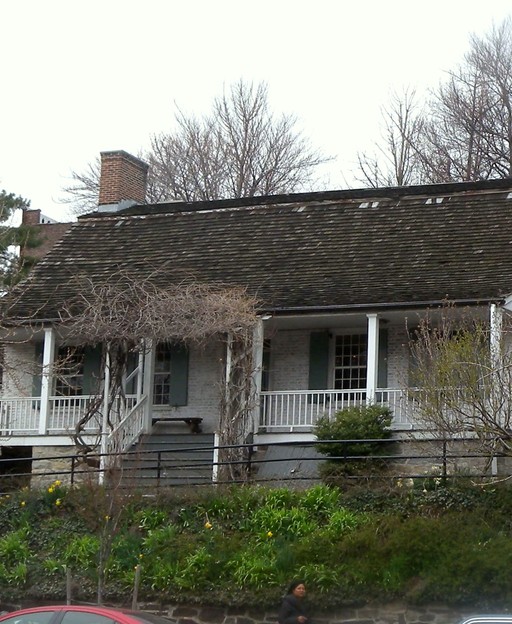
Take the subway to the very top of Manhattan and climb the stairs. You will not find skyscrapers. You will find a hill, a stone wall and a white farmhouse with a sloping roof. This is Inwood. Its story runs from Lenape fishing grounds to Dutch farms, and on to Irish pubs and Dominican bakeries.
Many New York families have roots here and never knew it. This guide follows each wave of people who made Inwood home. It also shows you how to trace your own family in this corner of the city.
Get our free Hidden Gems of New York guide →
Inwood Before the City: Lenape Land and Dutch Farms
Long before any street grid, the north end of Manhattan fed people well. According to this Inwood neighborhood history, it had clam beds, cornfields and yearly fish runs. A large Lenape town stood here. The National Museum of the American Indian has called it the best place to live on the island.
Dutch colonists arrived in the 1600s. The Dyckman Farmhouse Museum says Dutch settlers removed the Munsee Lenape from the land. The Dyckman family stayed for generations. Their founder, Jan Dyckman, came to New Amsterdam from Westphalia.
The family farm covered roughly 250 to 280 acres around 1820, according to the museum’s Dyckman family history. It had a cider mill, corn cribs, a barn and a stable. Rocky ground limited the crops. Corn, cabbage and hay grew in the good spots. Cherry and apple orchards filled the rest.
The farm did not run on family labor alone. The same history notes that enslaved people worked on the Dyckman land. By 1820, the household also included a free Black woman and a free Black boy. Hired laborers lived in other houses on the property. That mix is a reminder that heritage here never belonged to one group.
The Last Farmhouse in Manhattan
The British occupied Manhattan from 1776 to 1783. William Dyckman fled upstate with his family. When the war ended, he returned to find his home and orchards destroyed. The museum says he began a new house on Kingsbridge Road, now Broadway. Its history dates the farmhouse to about 1784.
William died in 1787. His son Jacobus took over the house and farm. He moved in around 1793 and changed the house over the next few decades. Jacobus and his wife Hannah had eleven children.
By the early 1900s the subway was pushing north. The museum’s own account says the IRT extension set off fast development, and the house faced demolition in 1915. Two Dyckman descendants, Mary Alice Dyckman Dean and Fannie Fredericka Dyckman Welch, bought the property that year. They restored it, and it opened to visitors in July 1916.
Today the farmhouse calls itself the last farmhouse in Manhattan. A small garden surrounds it. The garden also holds a reconstructed Hessian hut, built from the remains of soldiers’ shelters that historian Reginald Pelham Bolton found nearby.
Planning a visit? Check the museum’s hours and directions page first. Opening days are limited.
How Inwood Became an Irish Neighborhood
Farms gave way to apartment blocks as the subway arrived. Irish families filled many of them. According to the same neighborhood history, Inwood was largely Irish for much of the 20th century.
The Irish identity showed on the street. The neighborhood had Irish shops and pubs. It even had a Gaelic football field in Inwood Hill Park. Many families came from Irish counties by way of other New York neighborhoods. A grandmother might have started in a Five Points tenement and ended her days on a quiet Inwood block.
Jewish families formed the second-largest group in those years. They spread north from nearby Washington Heights. You can read that story in our guide to Washington Heights, from German Jewish refuge to Dominican heritage capital.
The Irish connection did not stop at the Manhattan line. Across the river, Woodlawn in the Bronx grew into another Irish stronghold.
The Dyckman Oval and a Changing Skyline
Inwood had a sports story too. The neighborhood history says the Dyckman Oval stood near Dyckman Street and 10th Avenue. It held up to 4,500 spectators. It hosted football games, boxing matches and Negro league baseball games. The city tore it down in 1938. Public housing, the Dyckman Houses, replaced it in 1951.
The 1930s brought the Eighth Avenue subway line to Dyckman and 207th Streets. Big estates west of Broadway were sold and built over. Many of the Art Deco apartment buildings you see today date from that building boom. If your family lived in a 1930s Inwood apartment, the building may still stand.
Dominican Inwood Today
From the 1960s through the 1980s, many Irish and Jewish families moved out. They went to the Bronx, the suburbs and beyond. During the same years, Dominican immigrants began to arrive in numbers.
Today, Inwood has a mostly Dominican population, especially east of Broadway. The neighborhood history says it has the highest concentration of Dominican residents in New York City. Walk Dyckman Street and look for Dominican bakeries, restaurants and shops along the way. Confirm hours before you go.
This layering is the real Inwood story. Each group did not erase the one before it. Each added a language, a food and a set of holidays. Today a Dominican family may live in the same Art Deco building where an Irish family once raised children.
How to Trace Your Family in Inwood
Start at home. Ask relatives for names, birth years and any addresses. Even a street name helps. Then follow these steps:
Search immigrant arrival records. The Statue of Liberty-Ellis Island Foundation offers a passenger database. Our guide to Castle Garden before Ellis Island covers earlier arrivals.
Request city records. The NYC Department of Records and Information Services holds vital records and other historical materials. Ask what applies to your family’s years.
Use the library. The New York Public Library genealogy collections include directories and newspapers that can place a family on a block.
Follow our full walkthrough in How to Trace Your New York City Ancestry.
Get our free Hidden Gems of New York guide →
Plan Your Inwood Heritage Visit
Begin at the Dyckman Farmhouse at 4881 Broadway, on the corner of 204th Street. The museum says there is no parking, so ride the subway. Confirm opening days on the museum’s visit page before you go.
Then walk the nearby blocks. Look up at the Art Deco apartment buildings. Stop at a local bakery or café and ask about the neighborhood’s past.
Bring a notebook. Write down every street name and building number that matches a family story. You may return home with the first clue to your own Inwood roots.
Frequently Asked Questions
What is the oldest house in Inwood?
The Dyckman Farmhouse is the best-known old house in Inwood. The museum dates it to about 1784 and calls it the last farmhouse in Manhattan.
Which immigrant groups settled in Inwood?
Irish families made up much of the neighborhood for most of the 20th century. Jewish families formed the second-largest group. Dominican immigrants began arriving in large numbers from the 1960s onward.
Can I visit the Dyckman Farmhouse today?
Yes, the museum is open to visitors on set days. Check its hours and directions page before you travel, because the schedule is limited.
How can I find out if my family lived in Inwood?
Start with family stories and old addresses. Then search Ellis Island passenger records, city records and library directories. Our NYC ancestry guide explains each step.
