
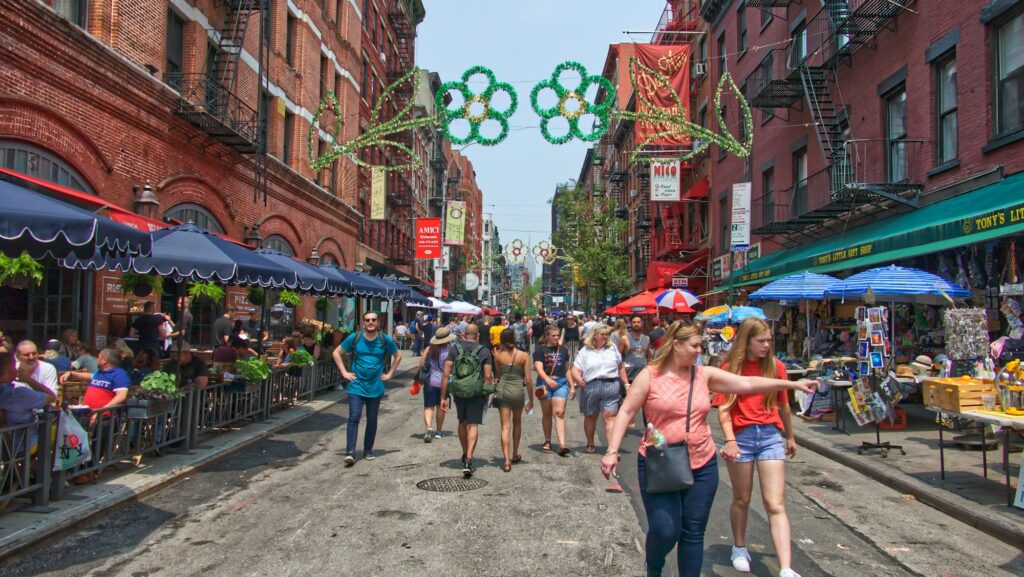
The smell of garlic and fresh bread hits you before you turn the corner. Stand on Mulberry Street in lower Manhattan, and you stand where hundreds of thousands of Italian immigrants built their American lives.
They came from the poorest provinces of Southern Italy. They arrived with almost nothing. And they created a neighbourhood so vital, so loud, so alive, that New York City still bears their mark more than a century later.
This is Little Italy. This is their story.
If you love New York’s hidden stories, you’ll love our free weekly newsletter. Subscribe to Love New York →
Why They Left Italy
The journey to New York began in desperation. Between 1880 and 1924, more than four million Italians left for America. Most came from the Mezzogiorno — the sun-scorched south of Italy.
Peasant farmers in Sicily, Calabria, and Campania faced grinding poverty. Land was scarce. Harvests failed. Taxes crushed families already living on the edge. The northern Italian government offered little help. Volcanic eruptions and earthquakes destroyed entire villages.
The answer, for many, was America. Labour agents called padroni visited villages with promises of work and wages. Entire families scraped together money for a ticket. Young men came first, hoping to earn enough to bring the rest over.
They landed at Castle Garden, and later at Ellis Island. Then they made their way to a few blocks of lower Manhattan where other Southern Italians had already begun to settle.
The Streets They Called Home
By 1900, Little Italy stretched across a patchwork of streets between the Bowery and Centre Street. Mulberry Street was the spine. Mott Street, Hester Street, and Grand Street filled out the grid.
The neighbourhood was extraordinarily dense. Some blocks held more than 1,000 residents per acre. Families of six or eight shared two small rooms in tenement buildings. Summer heat inside those rooms was unbearable. Everyone spilled onto stoops and streets.
Vendors pushed carts through the neighbourhood selling bread, vegetables, and fish. Music drifted from open windows. Neighbours argued in the dialects of dozens of different Italian provinces. A family from Naples might live across the hall from families from Sicily or Basilicata — and they saw each other almost as foreigners at first.
Regional identity mattered enormously. Immigrant families formed mutual aid societies — the società di mutuo soccorso — based on their hometown in Italy. A man from Palermo joined a Palermo society. A woman from Bari found others from Bari. These organisations paid out sickness benefits and burial costs. They offered a lifeline in a strange city.
The Work That Built New York
Italian immigrants built New York, quite literally. They dug the subway tunnels. They laid cobblestones and paved roads. They erected skyscrapers and hauled rubbish. Contractors hired them for the hardest, dirtiest, and most dangerous jobs — and paid the lowest wages.
Many men worked through the padrone system. A padrone recruited workers from their home region, arranged their passage to America, and then placed them in jobs — taking a cut of every wage packet. Some padroni were fair. Many were not. Workers often arrived in debt and spent their first months paying it off.
Women and older children worked in the garment trade. Factories on the Lower East Side employed thousands of Italian women stitching clothing. The work was exhausting. The Triangle Shirtwaist Factory fire in 1911 killed 146 garment workers — most of them young Italian and Jewish immigrant women. That tragedy shocked the city into demanding better conditions.
This neighbourhood shared its industrial story with the Jewish immigrants of the Lower East Side, who worked the same factories in the same decade just a few streets away.
Want more stories like this? Our weekly newsletter goes deeper into New York’s heritage every week. It’s free. Subscribe here →
The Church at the Centre
The Roman Catholic Church anchored every Italian neighbourhood in New York. In Little Italy, the Church of the Most Precious Blood on Baxter Street became the spiritual centre of the Southern Italian community. It still stands today.
St Patrick’s Old Cathedral on Mulberry Street also served Italian families. Built in 1815, it predated the mass Italian immigration by decades but adapted to serve the new communities arriving on its doorstep.
Religion shaped the social calendar. Each province of Italy had its patron saint, and feast days brought explosions of colour and noise to the streets. Brass bands marched. Families pinned dollar bills to images of the saints. Children ate sweets they could rarely afford the rest of the year.
The Feast of San Gennaro
The most famous of these celebrations was — and still is — the Feast of San Gennaro. The first feast took place in 1926 on Mulberry Street. Recent immigrants from Naples organised it to honour the patron saint of their city, just as their grandparents had done back home.
The feast grew every year. By the mid-20th century, it had become a massive street fair running for more than a week. Restaurants set up outdoor tables. Sausage and peppers sizzled on enormous grills. Fried dough and sfogliatelle filled the air with sweetness. The streets became impassable with crowds.
Today, the Feast of San Gennaro still takes place every September on Mulberry Street. It is the oldest and largest Italian heritage festival in America — a direct line back to those first Neapolitan immigrants who wanted to keep their culture alive in a new country.
How Little Italy Changed
By the 1920s and 1930s, more prosperous Italian families began to leave for other boroughs. Brooklyn, the Bronx, and New Jersey offered more space, better schools, and the chance to own a house. Second-generation Italian Americans wanted distance from the crowded tenements of their parents.
The neighbourhood shrank decade by decade. Chinatown expanded northward, taking over streets that Italian families had vacated. By the 1980s, Little Italy had compressed from 40 blocks to just a few. Today, the recognised Little Italy area spans only a handful of blocks on Mulberry Street between Canal and Spring Streets.
Some people mourn the shrinkage. Others point out that the community simply spread across the city. Italians and their descendants are woven into every borough, every industry, and every cultural institution New York has. The neighbourhood changed shape. The heritage never left.
The same story of arrival, struggle, and dispersal played out in neighbouring communities. The Irish community at Five Points, just blocks away, had already moved through this same arc a generation earlier.
What You Can Still Find Today
A handful of institutions trace their roots directly to the original immigrant community.
Ferrara Bakery on Grand Street opened in 1892. For more than 130 years, it has sold pastries, cannoli, and espresso to the families of lower Manhattan. It is one of the oldest Italian cafés in America.
Di Palo’s Fine Foods on Grand Street opened in 1910. The Di Palo family still runs it. They import cheeses, cured meats, and olive oils from the regions of Italy that their predecessors left over a century ago.
The Church of the Most Precious Blood still stands on Baxter Street. You can visit the interior and see the decorations that connect directly to the feast traditions of the Southern Italian immigrant community.
The Tenement Museum on Orchard Street covers the stories of multiple immigrant communities, including Italian families. Their guided tours bring the tenement experience to life with extraordinary specificity.
The Italian American Museum on Mulberry Street tells the broader story of Italian immigration to New York City. It holds photographs, documents, and artefacts from the immigrant era.
Planning Your Heritage Visit
Little Italy sits between Canal Street and Spring Street, centred on Mulberry Street. The nearest subway stations are Canal Street (6, J, N, Q, R, W, Z trains) and Spring Street (6 train).
The best time to visit is September, during the Feast of San Gennaro. The neighbourhood fills with food stalls, music, and the authentic spirit of the original community.
You can combine a visit with a walk through the Lower East Side to see the Jewish heritage that shaped the same era. You can also trace the older Irish immigrant story at Five Points, just a few streets away.
For families researching Italian-American heritage, the immigration records held at the New York Public Library offer an excellent starting point before you visit the neighbourhood itself. The library’s Milstein Division holds passenger lists, naturalisation records, and city directories dating back to the 1880s.
Frequently Asked Questions
When did Italian immigrants first settle in Little Italy, New York?
Italian immigration to Little Italy began in the 1860s, but the mass arrival took place between 1880 and 1920. Southern Italians from Sicily, Calabria, and Campania arrived in the largest numbers, driven by rural poverty and a lack of economic opportunity in the Mezzogiorno.
What streets make up Little Italy in Manhattan today?
The original Little Italy covered roughly 40 city blocks centred on Mulberry, Mott, Hester, and Grand Streets. Today, the recognised Little Italy area covers only a few blocks of Mulberry Street between Canal and Spring Streets in lower Manhattan.
What is the Feast of San Gennaro in Little Italy?
The Feast of San Gennaro is an annual Italian heritage festival held every September on Mulberry Street. Neapolitan immigrants first organised it in 1926 to honour the patron saint of Naples. Today it runs for eleven days and draws millions of visitors, making it the largest Italian-American street festival in the United States.
How can I trace Italian-American ancestry connected to Little Italy?
Start with the Ellis Island passenger records at libertyellisfoundation.org, which hold arrival records for millions of Italian immigrants. The New York City Department of Records holds birth, marriage, and death certificates from the late 19th century onwards. The Italian American Museum on Mulberry Street can also point you to specialist genealogy resources.
Ready to explore the New York your ancestors knew? Subscribe to Love New York — free weekly stories, heritage guides, and hidden history. Join us →
