
Between 1880 and 1924, more than two million Jewish people arrived in New York City. Most of them came to one place. The Lower East Side became their world. It became their refuge. It became their launch pad into American life.
If your family has Eastern European Jewish roots, this is where your story in America most likely begins.
If you love New York’s hidden stories, you’ll love our free weekly newsletter. Subscribe to Love New York →
Why They Came — and Why They Had No Choice
Life in Eastern Europe was dangerous for Jewish families. Violent pogroms swept through Russia, Poland, Romania, and Austria-Hungary. State-sponsored attacks destroyed homes and killed thousands.
The years after 1881 were especially brutal. After Tsar Alexander II was assassinated, the Russian government blamed Jewish communities. Waves of violence followed. Hundreds of thousands of families made a decision. They would leave everything they knew.
America meant something different. America meant safety. America meant a chance.
The journey was hard. Most families sold everything they owned to pay for steerage class on a steamship. The crossing took two to three weeks. Conditions below deck were terrible. But the ships kept coming.
Between 1880 and 1910, more than a million Jewish immigrants arrived in New York. Most came through Ellis Island. Most headed straight to the Lower East Side.
What They Found: One Square Mile, Hundreds of Thousands of People
The Lower East Side was already crowded before they arrived. But the scale of what followed was unlike anything America had seen.
By 1900, roughly 300,000 people lived in less than one square mile. It was one of the most densely populated places on earth at the time.
The streets smelled of herring, pickles, and boiling soup. Pushcart vendors lined Hester Street from dawn until dark. Children played in the gaps between carts. Mothers haggled in Yiddish. Men argued about politics, religion, and the price of bread.
Yiddish was the language of the streets. You did not need to speak English to survive here. You needed Yiddish.
This was the same overcrowded, vibrant, exhausting New York that our guide to life in New York in 1910 explores in detail — a city where every inch of space was shared and every dollar counted.
The Tenements: Home for Six in Three Rooms
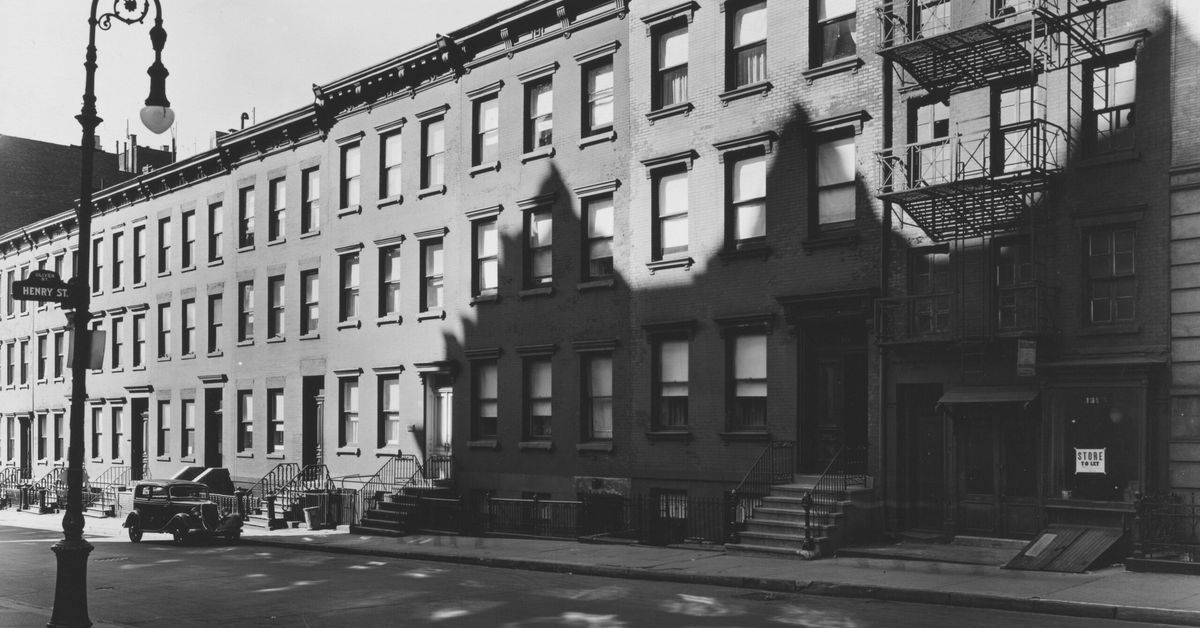
Most families rented a tenement flat. A typical flat had two or three rooms. Six or eight people lived in it.
The buildings were five or six storeys tall. There were no lifts. There was no central heating. Air shafts between buildings gave little ventilation and even less light.
In summer, the heat inside the flats was brutal. Families slept on fire escapes. Some slept on rooftops. Anything to escape the trapped heat below.
You can see what this life looked like today. The Tenement Museum at 97 Orchard Street preserves several flats exactly as immigrant families left them. It is one of the most powerful heritage experiences in New York City. Book your tour in advance.
Orchard Street, Hester Street, Essex Street
These three streets were the arteries of immigrant life.
Orchard Street was the main shopping strip. Merchants displayed their goods on the pavement. You could buy a suit, a pair of boots, or a hat without entering a shop. Bargaining was expected. Prices were never fixed.
Hester Street was the open-air market. Pushcart sellers offered everything from live chickens to secondhand tools. The smell of pickled cucumbers drifted from barrels outside every other door.
Essex Street was where you found the pickle men. Essex Street Pickles is still there today. You can still buy pickles straight from the barrel, exactly as your great-grandparents might have done a century ago.
The Yiddish Press: A Newspaper for Every Opinion
Immigrant life needed a voice. The Yiddish press provided it.
The Jewish Daily Forward — the Forverts — was the most important. Founded in 1897, it reached a circulation of 200,000 by 1917. It was one of the most widely read newspapers in New York, in any language.
The Forverts Building still stands at 175 East Broadway. Its Hebrew letters are still visible on the facade. It is a Grade I landmark. The building has since served as a Chinese church and residential flats. But it survives.
The Forverts ran a famous column called “A Bintel Brief” — A Bundle of Letters. Readers wrote in with their problems. The column helped immigrants navigate a confusing new world. It remains a remarkable record of what immigrant life actually felt like from the inside.
The Synagogues: Faith in a New Country
Faith came with the immigrants. New synagogues appeared on almost every block.
The Eldridge Street Synagogue is the most beautiful of them. Built in 1887, it combines Gothic and Moorish architecture into something extraordinary. It was the first grand synagogue built by Eastern European Jews in the United States.
By the 1930s, as families moved out to Brooklyn and the Bronx, the synagogue fell into disuse. Its main sanctuary was sealed for decades. A restoration project began in the 1980s. Today, the Museum at Eldridge Street tells the full story of the congregation and the community that built it. Address: 12 Eldridge Street. It is a National Historic Landmark.
The Bialystoker Synagogue at 7 Willett Street is even older. Its congregation dates to 1826. It operated as a stop on the Underground Railroad before the Civil War. Today it still serves an active Jewish congregation.
The Garment Industry: A City Built on Stitches
Most immigrant families needed work immediately. The garment industry was waiting.
Thousands of workers — mostly women — bent over sewing machines in small workshops. They worked twelve to fourteen hours a day. Six days a week. For wages that barely covered rent.
The Triangle Shirtwaist Factory fire of 1911 came from this world. One hundred and forty-six workers died, mostly young immigrant women. Many were from the Lower East Side. The fire changed American labour law forever. It helped build the union movement that would transform working-class life across New York.
The Children Who Changed America
The Lower East Side was not just a place where people survived. It produced people who shaped American culture.
Irving Berlin grew up on Cherry Street. He became one of the greatest songwriters in American history. Eddie Cantor and George Burns — both from these streets. Jacob Adler built the Yiddish theatre tradition that influenced American drama for a century.
Jonas Salk, who developed the polio vaccine, came from the immigrant world centred on the Lower East Side. His parents were part of the same wave that filled these tenements.
The neighbourhood also shaped the musical world next door. The Jewish musicians of the Lower East Side influenced the Tin Pan Alley songwriters who gave America much of its popular music. That influence ran from the 1910s through the 1960s.
Want more stories like this? Our weekly newsletter goes deeper into New York’s heritage every week. It’s free. Subscribe here →
Visiting the Lower East Side Today: A Heritage Guide
The neighbourhood has changed. But much survives.
The Tenement Museum (97 Orchard Street) is the essential starting point. Book a tour in advance. Several flat interiors are preserved from the 1860s through the 1930s. They are extraordinary.
The Museum at Eldridge Street (12 Eldridge Street) tells the story of the synagogue and the community. The stained glass and carved woodwork inside are stunning. Allow at least 90 minutes.
Essex Street Market (88 Essex Street) moved from the original outdoor market into a modern covered market in 2019. It is still a working food market with vendors selling pickles, deli meats, and Eastern European specialities.
Russ & Daughters (179 East Houston Street) opened in 1914. It still sells smoked fish, caviar, and herring. It is still run by the same family. It is a piece of living history.
The Educational Alliance (197 East Broadway) opened in 1889 to help immigrants adapt to American life. It ran classes in English, civics, and art. It still operates today as a community centre.
The Chinatown that borders the Lower East Side to the south tells a parallel story of survival and pride. Both neighbourhoods overlap in ways that reward a single afternoon of walking.
For more of lower Manhattan’s immigrant layers, our Irish Lower Manhattan Heritage Walk covers the streets where Irish immigrants settled a generation before the Jewish arrivals.
And you can trace the path Jewish immigrants took out of Manhattan into Williamsburg, Brooklyn — the next destination for thousands of families moving up in the world.
Frequently Asked Questions
When did Jewish immigrants begin arriving in the Lower East Side?
The main wave began in 1881, following violent pogroms in the Russian Empire. Immigration continued until 1924, when restrictive US laws sharply reduced the numbers arriving each year. By that time, more than two million Jewish immigrants had settled in the United States, the majority passing through the Lower East Side.
What is the best way to experience the Lower East Side’s Jewish heritage today?
Start at the Tenement Museum on Orchard Street, then walk to the Museum at Eldridge Street. Allow at least half a day. Book museum tours in advance, especially at weekends. Finish with pickles from Essex Street Market and smoked fish from Russ & Daughters.
Are there any businesses from the original immigrant era still operating today?
Yes. Russ & Daughters (1914) on East Houston Street is still run by the same family. Essex Street Market carries on the tradition of the original pushcart markets. The Bialystoker Synagogue on Willett Street still serves an active congregation and welcomes visitors.
Where can I find records to trace my New York Jewish ancestry?
The YIVO Institute for Jewish Research holds extensive archives from Eastern European Jewish life. The New York Public Library’s Milstein Division has New York city records going back to the 1800s. Ellis Island passenger records are free to search at libertyellisfoundation.org.
Ready to explore the New York your ancestors knew? Subscribe to Love New York — free weekly stories, heritage guides, and hidden history. Join us →
