
In 1900, one square mile of lower Manhattan held more than half a million people. Most were Jewish. They had crossed an ocean to reach this place. They arrived with almost nothing. They built something extraordinary.
This is the story of the Lower East Side. It is a story of survival, hard work, and pride. If your family carries Eastern European Jewish roots, this neighbourhood is almost certainly part of your history.
If New York’s hidden history speaks to you, our free weekly newsletter goes deeper every week.
Subscribe to Love New York →
Who Came and Why
Between 1880 and 1924, approximately two million Jews left Eastern Europe for America. They came from Russia, Poland, Romania, and the Austro-Hungarian Empire. Most were fleeing pogroms — organised attacks on Jewish communities. Others were escaping poverty so severe that starvation was a real threat.
They arrived at Ellis Island with little more than the clothes on their backs. Many carried the name of a relative already in New York. Many did not. The Lower East Side was where they went first. Rents were low. The language on the street was Yiddish. It felt, in some ways, familiar.
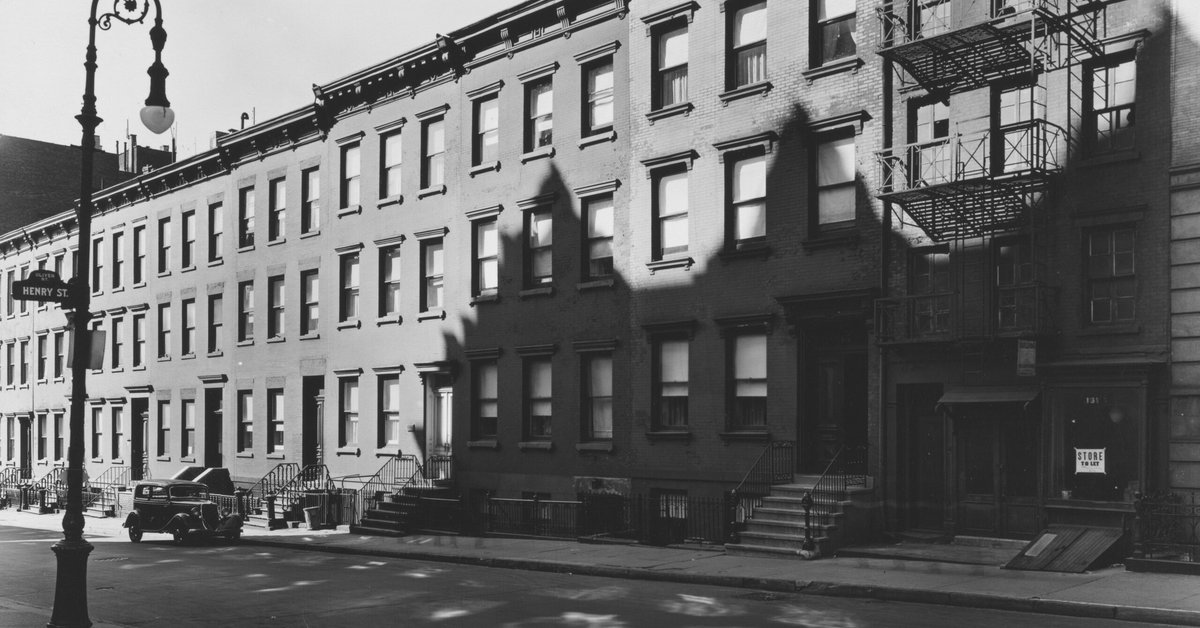
By 1910, the neighbourhood had become one of the most densely settled places on earth. Streets that measured just a few hundred yards long held dozens of tenement buildings, each crammed with families.
If you want to trace exactly where your family settled, our complete guide to tracing New York City ancestry walks you through the key archives and databases, step by step.
Life in the Tenements
The tenements were dark and cramped. Families of eight or ten people lived in three rooms. Ventilation was poor. Winters were brutal. On summer nights, people slept on fire escapes just to breathe.
The streets, though, were alive. Pushcarts lined Orchard Street and Hester Street every day. Vendors sold pickles, herring, cloth, and shoes. They called out in Yiddish. Customers argued. They bargained. They bought.
Children worked. Adults worked. Men sewed in cramped garment workshops called sweatshops. Women finished pieces at home, earning pennies per garment. The working day was long — sometimes more than twelve hours.
The Triangle Shirtwaist Factory fire of 1911 became a turning point. The fire killed 146 workers. Most were young Jewish and Italian immigrant women. The exits had been locked. There was no escape. The tragedy gave rise to the modern labour movement in New York.
This was not an isolated story. The immigrant experience on the Lower East Side was built on sacrifice. It was also built on solidarity. Workers organised. They protested. They formed unions. They pushed for change.
The Institutions They Built
The Lower East Side was not only a place of hardship. It was a place of remarkable creativity.
The Jewish Daily Forward — known in Yiddish as the Forverts — was founded in 1897. At its peak, it sold 250,000 copies a day. It was more than a newspaper. It was a lifeline. Its most famous column, A Bintel Brief — meaning “A Bundle of Letters” — published letters from readers seeking advice. The answers were honest, warm, and practical.
Yiddish theatre thrived along Second Avenue. Tens of thousands packed the theatres each week. The productions ranged from political dramas to sharp comedies. They were performed entirely in Yiddish. To the immigrant community, the theatre was everything — entertainment, education, and emotional release.
The Educational Alliance opened at 197 East Broadway in 1889. It taught English, civics, and trades to new arrivals. It was a place where immigrants could begin to build American lives without erasing who they were.
The Eldridge Street Synagogue opened in 1887. It was the first grand synagogue built in America by Eastern European Jews. The stained glass, the carved woodwork, the soaring interior — all of it spoke of a community that intended to stay. It still stands today, fully restored.
Want more stories like this? Our free weekly newsletter brings New York’s heritage alive every week.
Subscribe here →
Surnames and Roots
Many Jewish surnames were changed at Ellis Island — or altered by immigrants themselves as they tried to fit in. A Shapiro might have become Sharp. A Weissberger might have shortened to Weiss. A Rabinowitz might have become Robbins.
If your family name feels anglicised, there may be an original Yiddish or Eastern European version waiting to be found. Genealogy researchers can often reverse-engineer the original surname from ship manifests, which used the name as it was spelled in the country of origin.
Common Lower East Side surnames — Goldstein, Cohen, Levine, Schwartz, Greenberg, Horowitz, Klein, Feldman — trace back to communities in Poland, Ukraine, Russia, and the Baltic states. Each carries a story of the family that carried it across the Atlantic.
The story of Jewish immigrants in New York shares important echoes with other immigrant communities of the same era. The nearby Italian immigrants who built Little Italy faced similar hardship just a few blocks away. Across the East River, the Polish community of Greenpoint built their own neighbourhood from scratch.
How the Neighbourhood Changed
By the 1940s, the Jewish community of the Lower East Side had begun to disperse. Families moved to the Bronx, Brooklyn, and then to the suburbs. Prosperity made it possible to leave the tenements behind.
A new wave of Chinese immigrants arrived in the 1960s. The neighbourhood borders shifted. What had been the Lower East Side overlapped with an expanding Chinatown. Later waves brought Latin American and Dominican families to parts of the area.
Today, the Lower East Side is a mix of art galleries, bars, and restaurants. Luxury apartments have replaced some of the old tenements. But the traces of Jewish history remain — if you know where to look. The street grid is unchanged. Many of the old buildings survive. And a few of the original institutions are still there.
By the 1920s, the neighbourhood’s immigrant generation was already shaping the culture of modern New York — from the garment industry to politics to the arts. Our piece on New York in the 1920s tells more of that story.
Where to Visit Today
The Tenement Museum at 97 Orchard Street is the essential starting point. This restored tenement building holds the apartments of real families who lived there in the late 19th and early 20th centuries. Guided tours bring those families back to life. It is one of the most powerful heritage experiences in New York City.
The Museum at Eldridge Street is home to the beautifully restored Eldridge Street Synagogue. Tours are available throughout the week. The building is breathtaking. The history is moving. The stained glass alone is worth the visit.
On Orchard Street on Sundays, the market still echoes the old pushcart days. Stalls sell clothing, food, and crafts. Essex Street Market, built in 1940 to bring the old pushcart vendors indoors, is nearby. Some of the traders have been there for two or more generations.
Russ & Daughters at 179 East Houston Street has been selling smoked fish, bagels, and traditional Jewish foods since 1914. It is a living piece of Lower East Side history. Standing at the counter, surrounded by the smell of cured salmon and cream cheese, it is easy to imagine the generations who stood there before you.
The YIVO Institute for Jewish Research holds one of the world’s most important archives of Eastern European Jewish history. Now based at 15 West 16th Street in Manhattan, it is an invaluable resource for anyone tracing Ashkenazi roots. Their genealogy experts can help with records from communities that no longer exist.
Frequently Asked Questions
What is the best way to trace Lower East Side Jewish ancestry?
Start with the YIVO Institute for Jewish Research and JewishGen.org. Both hold vast archives of Eastern European Jewish records, including ships’ passenger lists, community records, and family histories. The Tenement Museum also offers resources for families tracing specific buildings or addresses.
When did Jewish immigrants arrive on the Lower East Side?
The major wave of Eastern European Jewish immigration began in the early 1880s, following violent pogroms in Russia. The flow continued until the Immigration Act of 1924 sharply restricted entry. By 1910, the neighbourhood had become one of the most densely settled urban areas in the world.
What can I visit today to see Jewish immigrant history on the Lower East Side?
The Tenement Museum at 97 Orchard Street is the best starting point. The Museum at Eldridge Street, inside the restored 1887 synagogue, is another essential visit. Russ & Daughters on East Houston Street has operated since 1914 and offers a living connection to the old neighbourhood.
What languages did Jewish immigrants on the Lower East Side speak?
Yiddish was the dominant language of daily life on the Lower East Side. It is a Germanic language written in Hebrew script, and it united Jewish communities from across Eastern Europe. English was learned quickly, especially by children who attended public schools in the neighbourhood.
Ready to explore the New York your ancestors knew? Subscribe to Love New York — free weekly stories, heritage guides, and hidden history.
Join us →
