
When the Fuller Building opened in 1902, New York was not impressed. Critics called it unsafe. Newspapers mocked its bizarre shape. More than a few people predicted it would collapse in a strong gust of wind. They were wrong about almost everything.
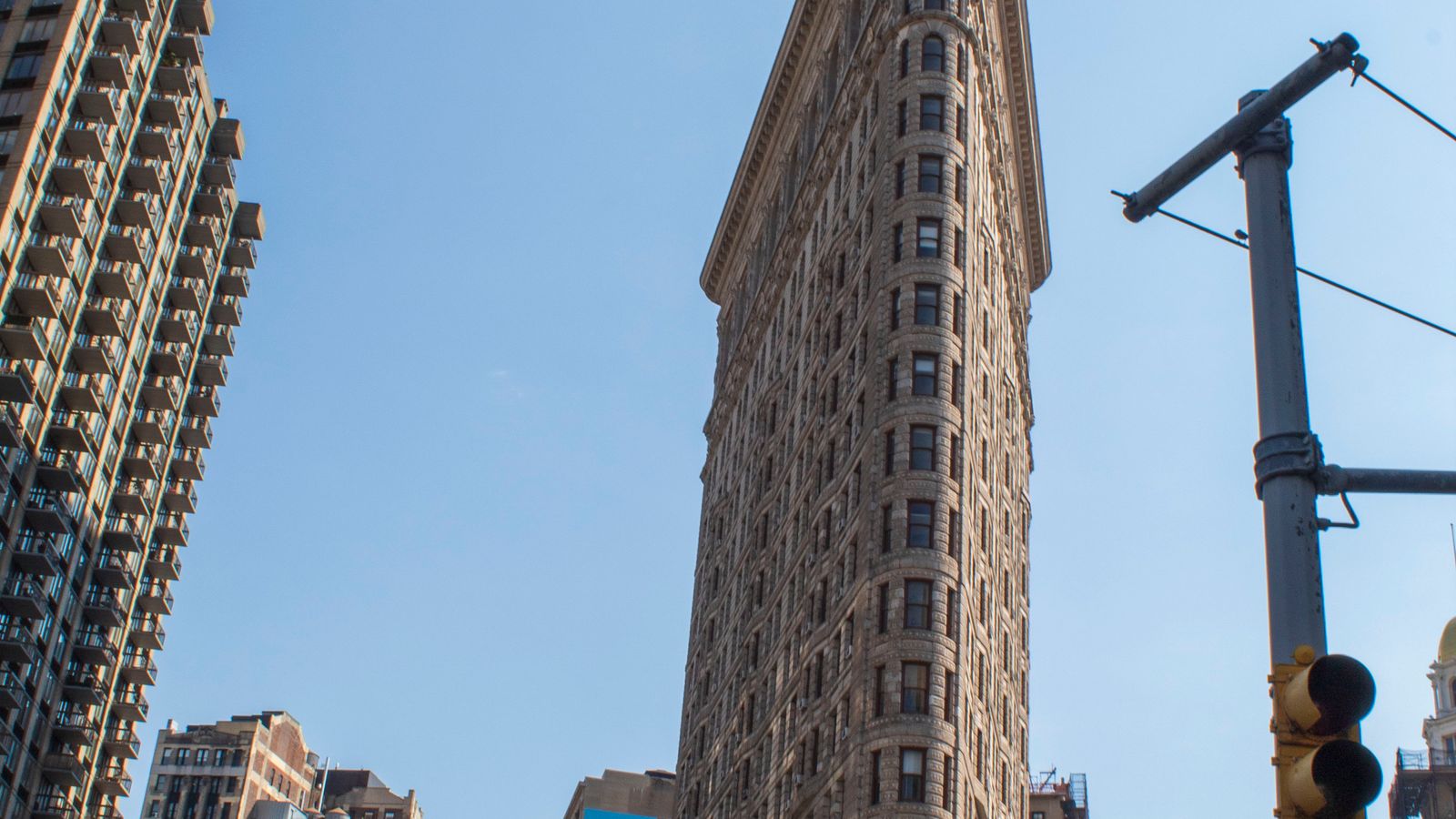
The Building Nobody Thought Would Stand
The building rises from one of Manhattan’s most awkward intersections — where Fifth Avenue and Broadway cross at 23rd Street, leaving a narrow triangular sliver of land.
Architect Daniel Burnham used that sliver brilliantly. He designed a 22-story tower that tapered to a wedge just six feet wide at its north tip.
The shape looked impossible. Structurally, it was anything but. Burnham built the entire frame from steel — one of the first buildings in New York to do so — letting the walls carry no structural load at all. The critics had no idea what they were looking at.
The Steel Revolution Hidden in Plain Sight
For centuries, buildings were limited by the thickness of their walls. The taller you built, the thicker the base had to be. Stone and brick had a ceiling.
Steel changed everything. A steel skeleton could carry the weight instead, allowing walls to be thin, floors to be wide, and shapes to be almost anything the architect imagined.
The Fuller Building was living proof. Its steel frame made the whole thing possible — a building that looked like it should buckle became one of Manhattan’s most structurally solid landmarks. Other iconic towers that came after, including the Woolworth Building, owed a quiet debt to what Burnham had already shown was possible.
New Yorkers didn’t celebrate the engineering. They gave the building a nickname instead. The silhouette looked like a clothes iron. The name “Flatiron” stuck before the building was even finished.
The Corner That Became Famous for the Wrong Reasons
The building solved one engineering problem and created a social one.
The triangular shape acts like a wedge that splits the wind sweeping down Fifth Avenue. At street level, the gusts at that corner became notorious. Strong enough to send hats flying. Strong enough to scatter the day’s newspaper across the sidewalk.
Strong enough, it turned out, to lift the hems of passing women’s dresses.
Crowds of young men figured this out quickly. They gathered at the corner on windy days, hoping for a glimpse of ankle or calf — considered shocking in Edwardian New York. Police were regularly stationed there to move the crowds along.
The phrase they reportedly used — “Twenty-three, skidoo!” — referenced the building’s address at 23rd Street. Whether or not the expression originated at that exact corner, it entered American slang as shorthand for “get out of here.” The Flatiron Building had become notorious for reasons its architect never intended.
Enjoying this? Join New York lovers getting stories like this every week. Subscribe free →
How an Embarrassment Became an Icon
Something shifted in the years after the Fuller Building opened.
Photographers discovered it first. Edward Steichen captured the building in a hazy, atmospheric photograph in 1905 that made it look almost dreamlike. Alfred Stieglitz photographed it in winter, steam rising from the street below, the wedge shape cutting through fog. Suddenly the building looked less like a civic embarrassment and more like something worth remembering.
Artists, writers, and newcomers to the city began to see it differently. The building had refused to follow the rules — and New York, a city that quietly admires rule-breaking, started to warm to it.
By the mid-20th century, no postcard collection was complete without it. The same shape that critics once called a monstrosity was being reproduced on souvenirs, prints, and magazine covers. The Chrysler Building would later pull off a similar trick — arriving controversial, becoming beloved — but the Flatiron got there first.
A Symbol That Never Asked to Be One
The Flatiron Building was designated a New York City Landmark in 1966 — one of the first buildings in the city to receive the honor.
Today the wedge-shaped corner at Fifth and Broadway is one of the most photographed spots in the city. The building appears in countless films and television shows. Tourists who couldn’t name its architect pose in front of it as if they’ve always loved it.
It’s worth remembering that Manhattan’s entire grid — the numbered streets that make these intersections possible — was itself the result of a deliberate decision made nearly a century before the Flatiron was built. The city was always planning for something. It just didn’t always know what.
What made the building great was always there. New York just needed time to see it.
Standing at the corner of Fifth Avenue and 23rd Street on a windy afternoon, with traffic flowing in three directions and the old stone tower rising above you, it’s hard to believe anyone ever wanted this building gone. It’s harder still to imagine New York without it.
You Might Also Enjoy
- The Chrysler Building’s Crown Was a Secret — Until It Pierced the Sky in 90 Minutes
- Inside the Woolworth Building: The Cathedral of Commerce That Changed New York Forever
- The Iron Staircases Covering New York’s Buildings Were Never Supposed to Be Permanent
Plan Your New York Trip
The Flatiron Building sits at the heart of Midtown Manhattan — easy to visit on foot and best seen from across the street or from Madison Square Park, which faces its southern facade. For more ways to explore the city like this, understanding Manhattan’s grid is a surprisingly good place to start.
Join New York Lovers
Every weekday morning, get New York’s hidden gems, neighbourhood stories, food origins, and city secrets — straight to your inbox.
Subscribe free — enter your email:
Love more? Join 65,000 Ireland lovers → · Join 43,000 Scotland lovers →
Free forever · Unsubscribe anytime
