
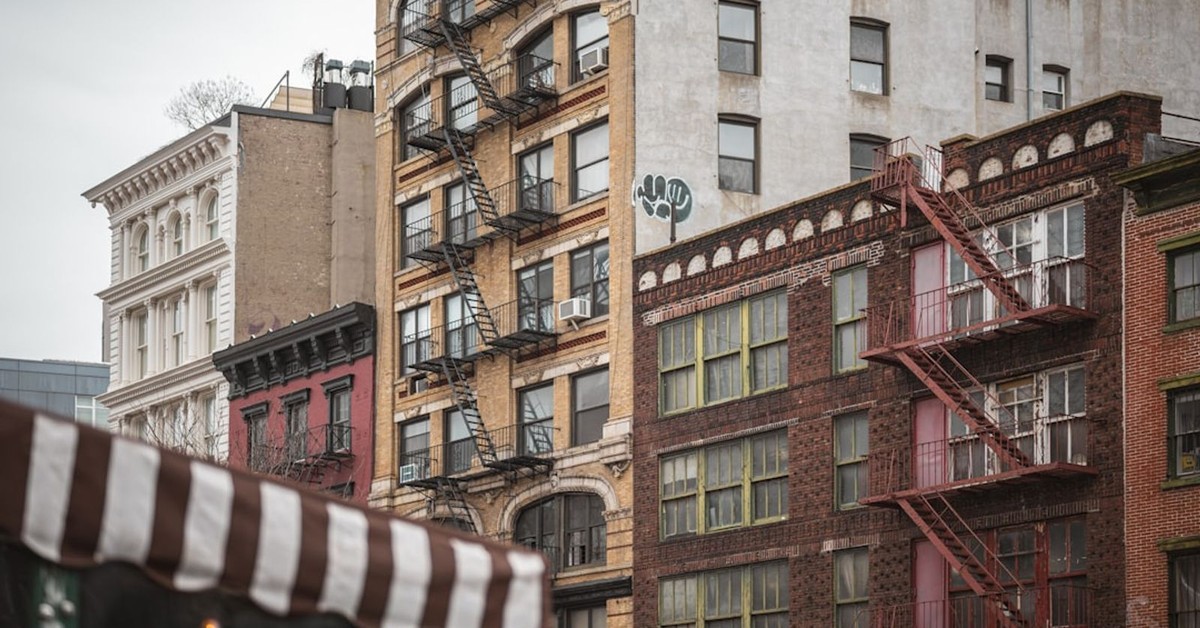
You are standing at the intersection of Worth Street and Baxter Street in Lower Manhattan. Nothing here looks like history. There are courthouses, a small park, and the edges of Chinatown. But beneath this ordinary corner lies one of the most extraordinary stories in American history.
This was Five Points. The most notorious neighbourhood in 19th-century New York. The place where Irish families — starving, desperate, and refused entry almost everywhere else — built a new world from nothing.
If your family came from Ireland, there is a good chance your ancestors passed through here.
If you love New York’s hidden stories, you’ll love our free weekly newsletter. Subscribe to Love New York →
Why Ireland Came to Five Points
By 1845, Ireland was dying.
The potato blight destroyed the crop that fed nearly half the country. Within six years, one million people had starved. Another million had emigrated. Entire villages emptied. Families sold what little they owned for a ticket on a “coffin ship” — overcrowded vessels where disease killed passengers before they even reached America.
Many of those ships docked at the Port of New York. The immigrants who stumbled onto the docks were often penniless. They had nothing but the clothes on their backs and the addresses of relatives who had come before them.
Five Points offered the cheapest rents in the city. That was its only recommendation. And so the Irish came, in tens of thousands, and Five Points became the first great Irish neighbourhood in America.
What Five Points Was Really Like
Five Points sat at the meeting point of five streets: Anthony (now Worth), Cross (now Park), Orange (now Baxter), Mulberry, and Little Water — a street that no longer exists.
It was one of the most densely packed places on earth. Families of eight lived in single rooms. Cellars housed more families below them. The building called the Old Brewery — a former malt house converted to housing in 1837 — held more than a thousand residents at its peak. Some never left its tunnels for weeks.
Water came from shared pumps. Sewage ran in open channels. Pigs roamed the streets and were considered useful — they ate the rubbish. Disease spread constantly. Cholera hit in 1832, 1849, and 1866.
In 1842, Charles Dickens visited Five Points on a tour of New York. He wrote that he had “never been in a more miserable place.” His guide was a police officer — because no visitor went without one.
But Dickens missed something. He saw the poverty and the squalor. He did not see what was being built inside it.
The Community That Grew From the Ruins
The Irish of Five Points were not passive victims of their poverty. They organised.
Catholic churches became the centres of community life. St. Patrick’s Old Cathedral on Mott Street (built 1815) served tens of thousands of Irish parishioners. The church ran schools, orphanages, and mutual aid societies. It was the one institution that never turned the Irish away.
Irish labourers dug the canals and laid the rail lines that built the Northeast. Irish women worked as domestics in the wealthy homes of uptown Manhattan — often walking several miles each way. Irish men joined the police force and the fire brigades in such numbers that by the 1880s, both institutions were dominated by Irish names.
And then there was Tammany Hall. The Democratic political machine that would control New York City for nearly a century drew much of its power from the Irish vote in Five Points. Politicians like “Boss” Tweed and later figures like “Honest John” Kelly built their power base here. The Irish may have arrived as outsiders, but they learned American politics with extraordinary speed.
If you are tracing your own roots, our guide to how to trace your New York City ancestry covers every major archive and database you will need.
The Music, the Dance, and the Streets
Five Points was not only poverty. It was also alive.
The neighbourhood produced one of America’s first musical fusions. Irish jigs met African American rhythms in the basement dance halls of Five Points. The result was a new form of percussive dance that eventually became tap dancing. The Irish brought the footwork; the African Americans brought the syncopation. In those cramped basement halls, they created something entirely new.
Saloons lined the streets. They were not only places to drink. They were community centres. Job notices were posted on their walls. Political meetings were held in their back rooms. A new arrival from County Cork or County Kerry could walk into a Five Points saloon and hear Irish spoken within minutes.
The neighbourhood had a particular energy. Visitors who survived it — and not all did — rarely forgot it. Abraham Lincoln visited in 1860, before his presidency, and was shown a Five Points Sunday school. He reportedly wept at what the children had overcome.
Irish and African American Neighbours
The history of Five Points is not only an Irish story. Free African Americans lived in the neighbourhood long before the Irish arrived. The two communities shared the same streets and competed for the same jobs.
That competition was real and sometimes violent. The Irish, having escaped one form of oppression, did not always extend sympathy to those facing another. The draft riots of 1863 — in which Irish workers attacked African Americans across the city — remain one of the darkest chapters in New York’s past.
But there was also something else. In the basement dance halls, the two communities mixed in ways that were almost unthinkable elsewhere in 19th-century America. The music they created together outlasted the hatred that also existed between them.
For more on the immigrant journey through Lower Manhattan, the walk from Ellis Island to Orchard Street follows the path that thousands of families took after arriving at the docks.
The End of Five Points
By the 1880s, the city had decided that Five Points must go. The neighbourhood was cleared — block by block — for civic improvement projects. The Old Brewery was demolished. Tenements were torn down. Columbus Park was built on part of the site in 1897, one of the first public parks built specifically for immigrant communities.
The Irish had mostly moved on by then. They moved north — to Greenwich Village, then Hell’s Kitchen, then the Bronx. Each generation climbed a little higher. By the early 20th century, the Irish had entered the middle class in large numbers. The police chief was often Irish. So were the priests, the politicians, and the judges.
Five Points itself became Chinatown. The wave that replaced the Irish was Chinese, and they built their own community in the same streets where the Irish had once struggled. The pattern repeated itself — another group, another poverty, another generation of survival.
The Lower East Side tells a similar story — the Jewish immigrants who arrived after the Irish followed the same path from tenement poverty to middle-class life.
What You Can See Today
Want more stories like this? Our weekly newsletter goes deeper into New York’s heritage every week. It’s free. Subscribe here →
Five Points no longer exists as a neighbourhood. But the traces are there if you know where to look.
- Columbus Park (Mulberry Street, between Worth and Baxter) — Built on the site of the most crowded part of Five Points. A plaque near the entrance marks the area’s history. Today the park is a gathering place for the Chinese community that came after the Irish.
- St. Patrick’s Old Cathedral (263 Mulberry Street, Nolita) — The original St. Patrick’s, completed 1815, served the Irish of Five Points and Lower Manhattan for generations. It is still an active Catholic church. The churchyard contains the graves of Irish immigrants from the Five Points era.
- The Museum of Chinese in America (215 Centre Street) — Covers the history of the neighbourhood from the Irish era through the Chinese immigration that followed. Exhibits include artefacts from the tenement period.
- The Tenement Museum (103 Orchard Street) — Although in the Lower East Side rather than Five Points itself, the Tenement Museum offers the most vivid physical experience of what tenement life was like. Tours reconstruct specific family stories from the 1860s through the 1930s.
- Five Points Archaeological Site (26 Federal Plaza) — In the 1990s, construction beneath the federal courthouse uncovered thousands of artefacts from the Five Points era. The collection is now held at the National Museum of American History in Washington. A historical marker at 26 Federal Plaza notes the excavation.
The best time to visit is a weekday morning, when the courts are open and the streets are quieter. From Columbus Park, walk north on Baxter Street to Worth Street, then east to the site of the Old Brewery (now courthouse buildings). The neighbourhood fits into a morning’s walk of about two hours.
Frequently Asked Questions
Where exactly was Five Points located in New York City?
Five Points was located in Lower Manhattan, roughly where Columbus Park and the surrounding courthouse district stand today. The streets that gave it its name — Anthony, Cross, Orange, Mulberry, and Little Water — converged near what is now the intersection of Worth Street and Baxter Street. The area sits between present-day Chinatown to the east and City Hall to the south.
When did Irish immigrants come to Five Points?
Irish immigrants began arriving in significant numbers in the 1820s and 1830s, but the largest wave came during and after the Great Famine of 1845 to 1852. By the 1850s, Irish-born residents made up a significant majority of Five Points. Irish immigration to the neighbourhood continued through the 1870s, by which point many families were beginning to move to other parts of the city.
What can visitors see at Five Points today?
Columbus Park now occupies much of the original Five Points area and includes historical markers. St. Patrick’s Old Cathedral on Mulberry Street, which served Irish parishioners from the Five Points era, remains open for visits. The Tenement Museum on Orchard Street, though in the adjacent Lower East Side, offers the most immersive experience of 19th-century immigrant life in Lower Manhattan.
How did Five Points influence modern New York?
Five Points shaped New York in three lasting ways. The Irish political machine that grew from the neighbourhood’s community structures influenced city government for over a century. The cultural fusion between Irish and African American communities in Five Points dance halls contributed to the development of American popular music, particularly tap dancing. And the neighbourhood established the model of immigrant self-organisation — churches, mutual aid societies, political clubs — that successive waves of newcomers would follow.
Ready to explore the New York your ancestors knew? Subscribe to Love New York — free weekly stories, heritage guides, and hidden history. Join us →
